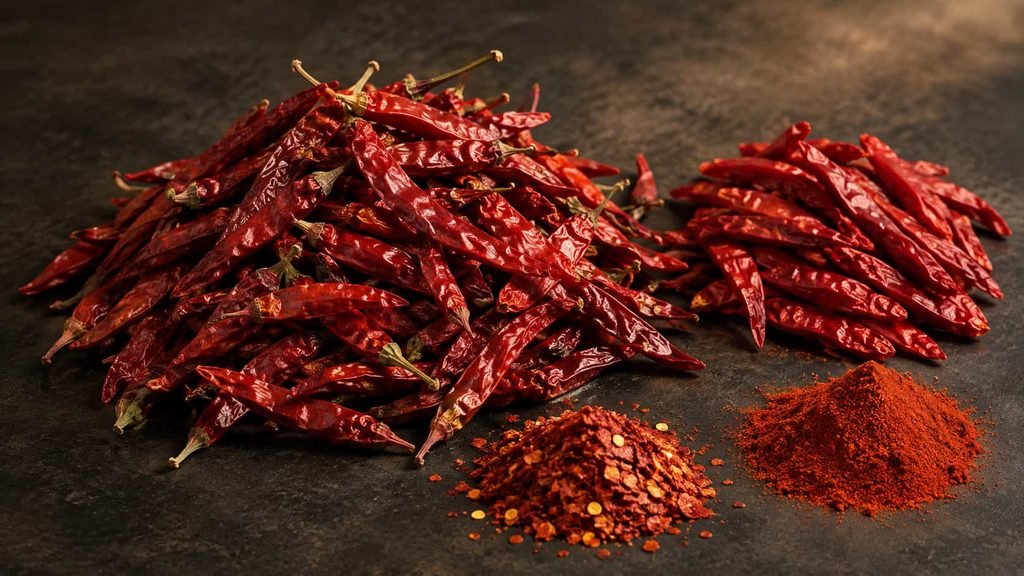
Why did the exact same chilli crop show up as four completely different products? 🌶️ It sounds like a riddle, but it is honestly one of the most common confusions in the spice trade. Picture a buyer at a desk with three tabs open, comparing quotes. One supplier offers whole pods, another offers dandi cut, a third offers crushed flakes, and a fourth offers fine powder, and every single one is described as “premium red chilli.” Same plant, same harvest, same Capsicum annuum. Yet one of those products will sit calmly in a warehouse for ages, one will make a quality inspector smile, one will make a pizza look magnificent, and one will vanish invisibly into a curry base. The variable most buyers overlook until it bites them is processing form, and picking the wrong one costs real money and real quality further down the line. 💸
Let’s begin where the chilli begins, on the whole pod. Imagine a dried red pod as a tiny sealed treasure chest. The skin, the seeds, the pigment, and the capsaicin are all locked inside a protective shell, and as long as that shell stays intact, aroma and colour stay put. That is exactly why whole pods have the longest shelf life of any chilli form, and why serious buyers who want whole red chilli pods bulk tend to be the ones with their own grinding lines. Whole pods hand you total control. You decide the grind size, you decide the blend, you decide when the pod finally meets the mill. If you run a spice processing plant, that flexibility is gold. One raw material can become five different finished products depending on what your customers ask for this quarter. 🏭
Now here is the catch nobody mentions in the brochure. A whole pod still wears its stem, and stems are a nuisance. They are woody, they carry dust and field debris, and they add nothing to flavour, colour, or heat. For a buyer with relaxed foreign matter limits, that may not matter. For a buyer whose customer audits are strict, it matters enormously. This is the moment dandi cut walks into the story. If you are searching for a dandi cut red chilli supplier, what you are really asking for is a whole pod with the stem removed at origin, so that what arrives at your factory is essentially all chilli and very little else. Same pod, same shelf life advantage, same buyer control, but with the stem contamination question already answered before the container is even sealed. 🎯
Think about how that plays out on an actual production floor. A grinding operator feeds a hopper. If the hopper is full of stemmed pods, the stems go through the mill too, and they end up in the powder as pale, fibrous flecks that dull the colour and nudge up the foreign matter reading on the lab report. Many food manufacturers have learned this the hard way, usually right after a customer complaint. Stemless pods do not eliminate every quality risk, nothing does, but they remove one of the most predictable ones. If your buyers are strict, your audits are frequent, or your finished product is judged on visual purity, dandi cut is often the quietly smart choice. And since the pod is still whole, you keep every advantage of buying whole. 😌
There is a bigger habit hiding in here, and it is worth naming. Smart buyers, the same ones who wisely purchase fennel and other spices whole and grind them near the point of use, increasingly order whole or dandi cut chilli and grind it downstream themselves. Why? Because ground spice is a fragile thing. The moment a pod is milled, its surface area explodes, and aroma and colour begin to fade faster than they ever would inside the intact pod. Pre ground stock that has travelled across oceans and waited in warehouses simply has more time to lose its edge. Buying whole and grinding on your own schedule is like buying coffee beans instead of a can of pre ground coffee. You are choosing to meet the freshness at the last possible second. ☕
Not everyone wants to grind, of course, and not everyone needs to. So let’s meet the crushed flakes, which are the show offs of the chilli family. Flakes exist for one reason above all others, and that reason is visible texture. When a pizza arrives at a table with a shaker of red flakes beside it, the flakes are part of the experience. You can see them, you can taste them, and you can control how many you scatter. The same logic applies to seasoning blends where those crimson specks are meant to be seen, to food service toppings, and to table condiments. If you are hunting for a crushed red chilli flakes exporter, your real question is about particle size, because in flakes the look of the piece is the point. A blend maker who wants that rustic, speckled appearance in a rub or a topping cannot get it from powder, no matter how good the powder is. 🍕
The trick with flakes is consistency of cut. Too coarse and the shaker clogs or the pieces feel like gravel. Too fine and the visual charm disappears into a dusty haze. Buyers who order flakes are best served by defining the particle size they want before placing an order, rather than hoping the supplier’s idea of “crushed” matches theirs. It is worth talking through a chilli grind specification with the exporter early, so that everyone imagines the same flake. Documentation should follow the product too, which we will get to in a moment, because form does not excuse a product from testing. 📏
And now, fine powder, the workhorse. If flakes are the show offs, powder is the quiet professional who keeps the whole food industry running. Curry blends, sauces, marinades, ready meals, snack seasonings, and countless food manufacturing recipes rely on fine chilli powder, and they rely on it for two reasons that have nothing to do with looks. The first is colour consistency. When a sauce producer makes a million jars, every jar needs to be the same shade of red as the last one. The second is heat distribution. Powder disperses evenly through a batch, so every spoonful carries the same warmth instead of some bites being fiery and others tame. For anyone searching for red chilli powder bulk Pakistan, consistency is the currency. Texture matters far less here, because in a simmered sauce nobody sees the particles anyway. 🍛
Powder does come with one special responsibility, though, and it is quality assurance. Because ground chilli hides its origin, colour testing matters more, not less. Powder is the form where economic adulteration tends to show up, which is why a buyer should never treat a beautiful red shade as proof of a beautiful product. If you want to understand exactly how that works and how to protect yourself, check this out, a full walkthrough of Sudan dye, why it is dangerous, and how to verify a supplier. Powder buyers who read it tend to start asking sharper questions about testing, and that is a very good habit. 🔬
So how does a buyer actually choose? Start with your production line, not your price list. If you run your own mills and value maximum freshness and flexibility, look to whole pods. If your customers audit foreign matter closely, or you simply do not want stems anywhere near your grinder, dandi cut is the sensible upgrade. If your product needs visible texture on the plate, flakes are the answer. If your product needs uniform colour and even heat across enormous batches, powder wins. Spice processors, seasoning blend manufacturers, sauce producers, wholesalers, and private label brands all land in different places on that map, and none of them is wrong. The only wrong choice is choosing a form because it was the first quote in your inbox. For a broader view of how private label brands weigh these decisions alongside packaging, learn more here, where the Dried Chilli Peppers range is laid out. 🧭
It is also worth looking at a real product example to see how varied the chilli world is. For a specific listing of a Pakistani hybrid chilli, visit this page and notice how a single variety can be considered in several forms depending on what the buyer intends to do with it. The point is not the variety. The point is that form and variety are two separate decisions, and treating them as one is how orders go sideways. 🌿
Let’s talk about the promise that quietly ties this all together, which is documentation. Whichever form you choose, the product should arrive with a Certificate of Analysis, and that certificate should not change depending on whether you ordered pods or powder. A good buyer asks for the same standard of testing across every form, because a chilli that fails a safety parameter fails it whether it is whole or ground. Harmain Global supplies all four forms across its Pakistani chilli range, with a Certificate of Analysis regardless of which form a buyer picks, and its facility works under Halal certification, ISO 22000, and HACCP, with GACC registration for Chinese market access. That consistency is part of why buyers who start with one form often come back to source another. Buyers who need a bulk red chilli for food manufacturers programme can define the form, the grind, and the documentation together instead of stitching three suppliers into one supply chain. 📄
Practical details matter, so here they are plainly. The minimum order quantity for bulk red chilli is 1 MT, and shipping is FOB Karachi. Harmain Global has been exporting since 1985 to more than 28 countries, and Pakistan’s EU GSP+ status means zero import duty eligibility for European buyers, which is a real margin advantage compared with origins that do not qualify. If you need a specific cut, a particular flake size, or a custom grind, the honest way forward is to send your specification and confirm it directly with the sales team, since custom processing requests are best agreed in writing before anything is produced. That single conversation saves more headaches than any brochure ever could. 🤝
This is where the story circles back to the desk with three tabs open. Our imaginary buyer no longer sees four confusing quotes. They see four tools, each built for a different job. Whole pods for control and shelf life. Dandi cut for cleanliness and audit comfort. Flakes for texture you can see. Powder for colour and heat you can count on. The transformation is small but powerful: from asking “which chilli is cheapest” to asking “which chilli form fits my production line.” Buyers who make that shift almost always end up with better products and fewer surprises. 🎉
So here is the closing thought. One exporter, every form, one Certificate of Analysis. That is what Harmain Global offers to spice processors, food manufacturers, wholesalers, and private label brands who would rather choose the right chilli form once than fix the wrong one repeatedly. If you are weighing a trusted Pakistani chilli exporter for your next order, or looking for export grade red chilli all forms under one roof, reach out through HarmainGlobal.com and tell the team what your line actually needs. You can also start at https://harmainglobal.com and take it from there. Your chilli, in exactly the form you meant it to be. 🌶️✨