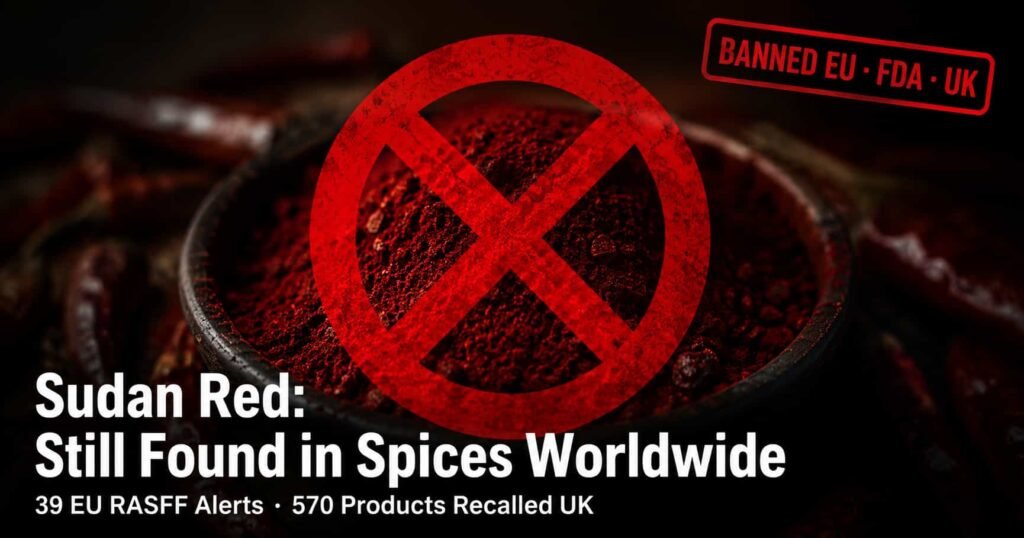
In February 2005, the UK Food Standards Agency issued a product recall notice. Then another. Then another. By the time the withdrawals stopped, 570 food products had been pulled from shelves across Britain — chicken tikka masala, Worcester sauce, soups, ready meals, pesto, sauces, curry pastes — all contaminated by a single batch of chilli powder that contained Sudan I dye. It remains the largest food recall in UK history, triggered not by a pathogen, not by an allergen, but by an industrial dye used to colour floor polish.
Twenty years later, the same problem is still appearing in EU RASFF alerts, FDA Import Alerts, and border rejections across multiple continents. This is what food buyers sourcing chilli, paprika, and red spice products need to understand about it — and what to check before placing their next order.
What Sudan Red Actually Is
Sudan I, II, III, and IV are synthetic azo dyes developed for industrial applications: colouring textiles, plastics, wax, shoe polish, and floor coatings. They produce vivid, stable red and orange-red tones, which is precisely what makes them useful in industry — and precisely what makes them attractive to bad actors in the spice trade.
They are not food colourants. They have never been approved as food colourants in any regulated market. The International Agency for Research on Cancer classifies Sudan I through IV as Group 3 carcinogens — possible human carcinogens — based on evidence of carcinogenicity in animal studies. Their use in food is banned under EU Commission Decision 2005/402/EC and prohibited by the US FDA. In practical terms, if Sudan dye is found in a food product anywhere in the EU or the US, that product is illegal. It is not a residue exceedance. It is a food fraud event.
The reason they appear in chilli powder, specifically, is economic. Chilli powder is priced partly on colour. High-quality dried chilli — like Longi from Pakistan — produces deep, vivid red powder with ASTA colour values of 80 to 100 or above. Over-dried, sun-damaged, old-crop, or simply inferior chilli produces dull, orange-brown powder. That discoloured powder sells at a lower price. A small addition of Sudan dye — invisible at the concentrations typically used — turns dull powder bright red. The seller commands a higher price. The buyer has no idea.
Food fraud researchers call this economic adulteration: deliberate contamination for financial gain, as distinct from accidental contamination. There is no version of Sudan dye appearing in chilli powder that is an accident. Someone added it.
Twenty Years of Detections
The first EU detection was in Indian chilli powder, in France, in 2003. The European Commission responded immediately with Decision 2003/460/EC, requiring all Capsicum imports into the EU to be accompanied by an analytical report confirming the absence of Sudan I. In 2004, the requirement was extended to cover Sudan II, III, and IV. It appeared, briefly, that the regulatory response had contained the problem.
It had not. In early 2005, Sudan-I was detected in Worcester sauce supplied by Premier Foods to hundreds of UK food manufacturers. By the time the tracing was complete, 570 finished products from across the food industry — brands and own-label alike — had been implicated. The contamination had entered the supply chain through a single batch of chilli powder used in the sauce, and from there had spread as an ingredient into everything it touched.
2003
First EU detection: Sudan-I in Indian chilli powder, France. EU Decision 2003/460/EC enacted — mandatory analytical testing for all Capsicum imports.
2004
EU expands the requirement to cover Sudan-II, III, and IV.
2005
UK’s largest-ever food recall: 570 products withdrawn. Sudan-I traced to contaminated chilli powder in Worcester sauce. EU Decision 2005/402/EC codifies the ban across food categories.
2016
New York State food inspectors test 57 commercially available spice products. Sudan dyes found in 16 of them — 28% of the sample.
2014–2024
39 RASFF notifications for Sudan dyes recorded in the EU. 12 US FDA Import Alerts issued. The problem persists across origins.
March 2024
Taiwan detects Sudan Red in chilli powder from China. Import operations from 21 Chinese exporters halted.
What the timeline shows is that this is not a historical problem that was solved. It is a recurring problem that is controlled unevenly across origins and time. The incentive to adulterate has not disappeared. The price differential between vivid red chilli powder and dull-coloured chilli powder has not narrowed. And not every supplier in every origin is subject to the same testing regime.
570 UK food products recalled in 2005 — largest UK recall at the time
39 EU RASFF notifications for Sudan dyes, 2014–2024
16/57 Commercial spices testing positive in New York, 2016
21 Chinese chilli exporters halted by Taiwan in March 2024
Detection, Testing, and What Your CoA Should Show
Sudan dyes are detectable by LC-DAD (liquid chromatography with diode array detection) and by LC-MS/MS — more sensitive methods used for confirmation and for low-level detection. These are established, routine analytical methods. The testing is not technically difficult, and it is not expensive relative to the cost of a contamination event. EU member states carry out mandatory testing on all chilli and Capsicum-based imports as part of coordinated controls. The question is not whether the regulators are testing — they are. The question is whether your supplier is testing before shipment, and whether you can see the result.
A CoA for any chilli, paprika, or red spice product should list Sudan I, II, III, and IV as separate parameters with numerical results. The correct result is “not detected” — meaning no signal above the limit of quantification, typically 0.5 to 1 mg/kg depending on the method. A CoA that omits Sudan dye testing entirely is incomplete for a product in this category. A CoA that lists Sudan dyes as “pass” without a numerical result gives you no information about how close to the limit the batch actually sits.
If your supplier cannot provide Sudan dye test results on a batch-specific CoA from an ISO/IEC 17025-accredited laboratory, you are carrying a risk that your customers — and EU border controls — will not share with you. The liability for what is in your finished product sits with you, not with your raw material supplier.
Why Clean Chilli Doesn’t Need Dye
The adulteration incentive exists specifically because low-quality chilli can be made to look like high-quality chilli with a few grams of industrial dye per tonne. The countermeasure, from a buyer’s perspective, is to source chilli whose natural colour performance means there is no commercial reason to adulterate it.
Longi dry red chilli, sourced from Pakistan’s Sindh and Punjab chilli-growing regions, achieves ASTA colour values at or above 100 as a natural characteristic of the variety, the growing conditions, and correct post-harvest drying. At Harmain Global, our Longi chilli achieves ASTA ≥100 naturally — no dye required or used. The colour is a production output, not something added after the fact.
Every commercial shipment is tested for Sudan I, II, III, and IV as standard in our pre-shipment Certificate of Analysis from an ISO/IEC 17025-accredited laboratory. The result is numerical and it is not-detected. That result, alongside the ASTA colour value, gives buyers two independent data points that together make the natural quality case: the colour is high because the chilli is good, and the absence of dye confirms the colour has not been engineered.
The same standard applies to our masala products. Any compound product containing chilli is tested for Sudan dyes at the finished-product stage. Our processing standards are built around the premise that documentation should confirm what is already true about the product — not paper over what isn’t.
Before sourcing any chilli, paprika, or red spice, ask your supplier for:
1. A batch-specific CoA from an ISO/IEC 17025-accredited laboratory listing Sudan I, II, III, and IV as separate parameters with numerical results — not a pass/fail notation.
2. The ASTA colour value for the same batch. Natural colour and dye-free status are most convincing together: high ASTA from a supplier with no Sudan detection history is a coherent story. High ASTA from a supplier who cannot provide Sudan test results is not.
3. Confirmation that the batch number on the CoA matches the batch reference on your shipping documents. A Sudan test result from a different batch does not protect you.
The 2005 UK recall involved companies and brands that had no idea what was in their chilli powder. They trusted their suppliers. Some of those suppliers trusted theirs. The contamination moved through the chain invisibly until a regulator caught it downstream. The lesson has not changed in twenty years: trust is not a control measure. Batch-specific testing from an accredited laboratory is.
See the test result before you commit to a shipment.
Every Harmain Global chilli sample ships with a full pre-shipment CoA including Sudan I–IV results, ASTA colour value, aflatoxin panel, and moisture — from an ISO/IEC 17025-accredited laboratory, matched to the sample batch. Request a sample with CoA and compare it against what your current supplier provides.
2 Responses