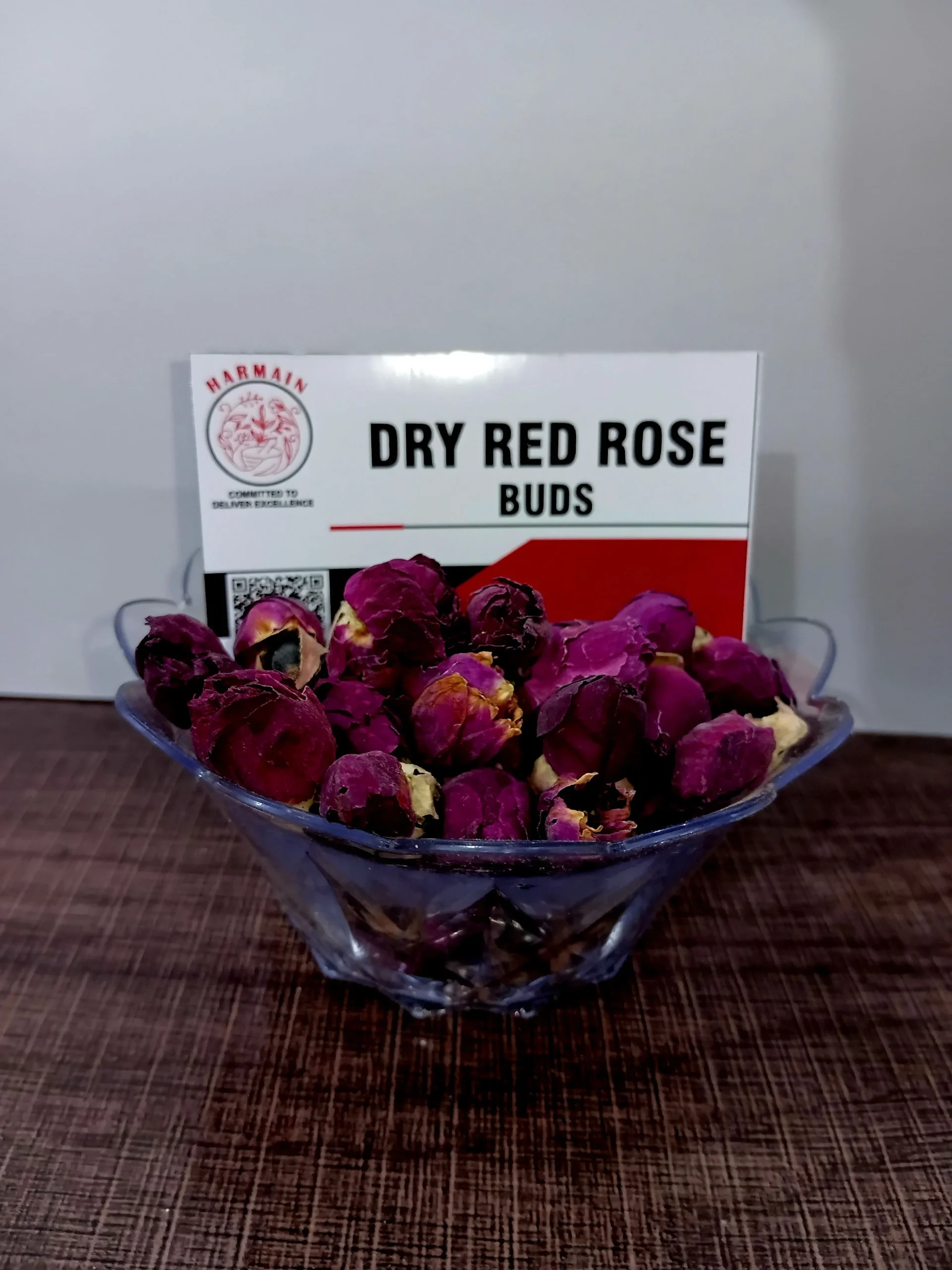
Dry Red Rose Exporter
Dry Red Rose Exporter from Pakistan — Ready to Export Quality, Committed to Deliver Excellence
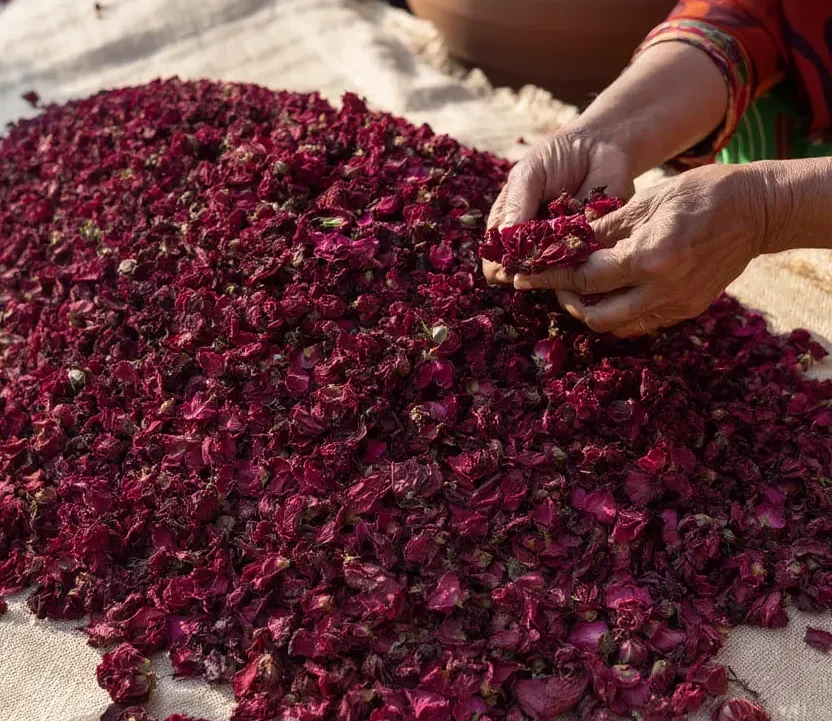
Every spring in the rose fields of Punjab, something happens that the world does not quite see. In the hours before dawn, when the air still has a bite from the night before, families move in rows of dark crimson blossoms with familiar hands, picking only those blooms that have opened up to precisely the right degree — not too young, not so late. When the rest of the world wakes up, the harvest is already on its way to Hyderabad, where it will be cleaned, graded, sun-dried and readied for shipment to buyers in Seoul, Dubai, Cairo, Milan and Colombo.
This is not simply a poetic metaphor. As you move through the real-life supply chain Harmain Global has run since 1985, you see the unique process behind each bloom.
We are Pakistan’s leading Dry Red Rose Exporter, trusted by international buyers in over a dozen countries for consistent quality, honest documentation, and reliable shipments, always as described.
This page will guide you through details of our operations: what we export—such as Dry Red Rose Petals for cosmetics brands, Dry Red Rose Buds for herbal tea manufacturers, or bulk Rose Water for food and beverage companies—how we ensure quality, and why buyers choose Harmain Global repeatedly.
If you are seeking a trustworthy partner to export rose petals in bulk, read on. This page is intended for you.
All Rose Products
Our Premium Rose Product Range
Distinctiveness of Pakistani Dry Red Rose All Over the World
The rose trade is international, but not all roses are created equal. One particular variety of dark red rose, known botanically as Rosa damascena and historically cultivated from local seed for centuries in what are now the fertile plains of Punjab — primarily in the districts of Multan, Khanewal and Pakpattan, where soil meets weather meets generations worth of knowledge cultivated over time to produce a blossom with qualities that buyers in wellness, cosmetics and food industries simply cannot source elsewhere.
People notice the color first, she said. Pakistani dry red roses have a depth of crimson that remains strong after drying, making them exceptional for visual-grade products in cosmetics, culinary decoration, and retail herbal packaging. Their vibrant color enhances product appearance and consumer appeal, which is why South Korea and the UAE are the largest buyers; the color does not fade to a typical brownish red as it does for many competing origins.
A second differentiator is fragrance. Due to the high concentration of essential oils in Pakistani roses, our dry red rose petals are used in perfumeries and aromatherapy products that require authentic botanical scent. This results from growing conditions that stress the plant appropriately, increasing secondary metabolite concentrations.
A third differentiator is the cultivation tradition in this region. Generations of local farmers have mastered rose farming, intuitively knowing when to harvest and how to handle blooms, ensuring quality from plant to post-harvest processing.
The post-harvest processing standards of Harmain Global ensure that the final product you receive was correctly handled at every single step — from the moment that bloom leaves the plant to when the container is sealed at Karachi Port.
If you’re sourcing for a business that relies on quality raw materials, you know, as they say, that origin is everything. Pakistan matters in dry red roses. And inside Pakistan, that origin is accessible to you through a partner whose documentation, volume reliability and processing quality are able to match what other international market participants expect.
What we pass on — All the rose products
As Harmain Global sells four of its core rose products, each one is treated as a separate product with a unique processing flow, quality control metrics and end-user buyer segment.
Dried Roses (Whole Dried Flower)
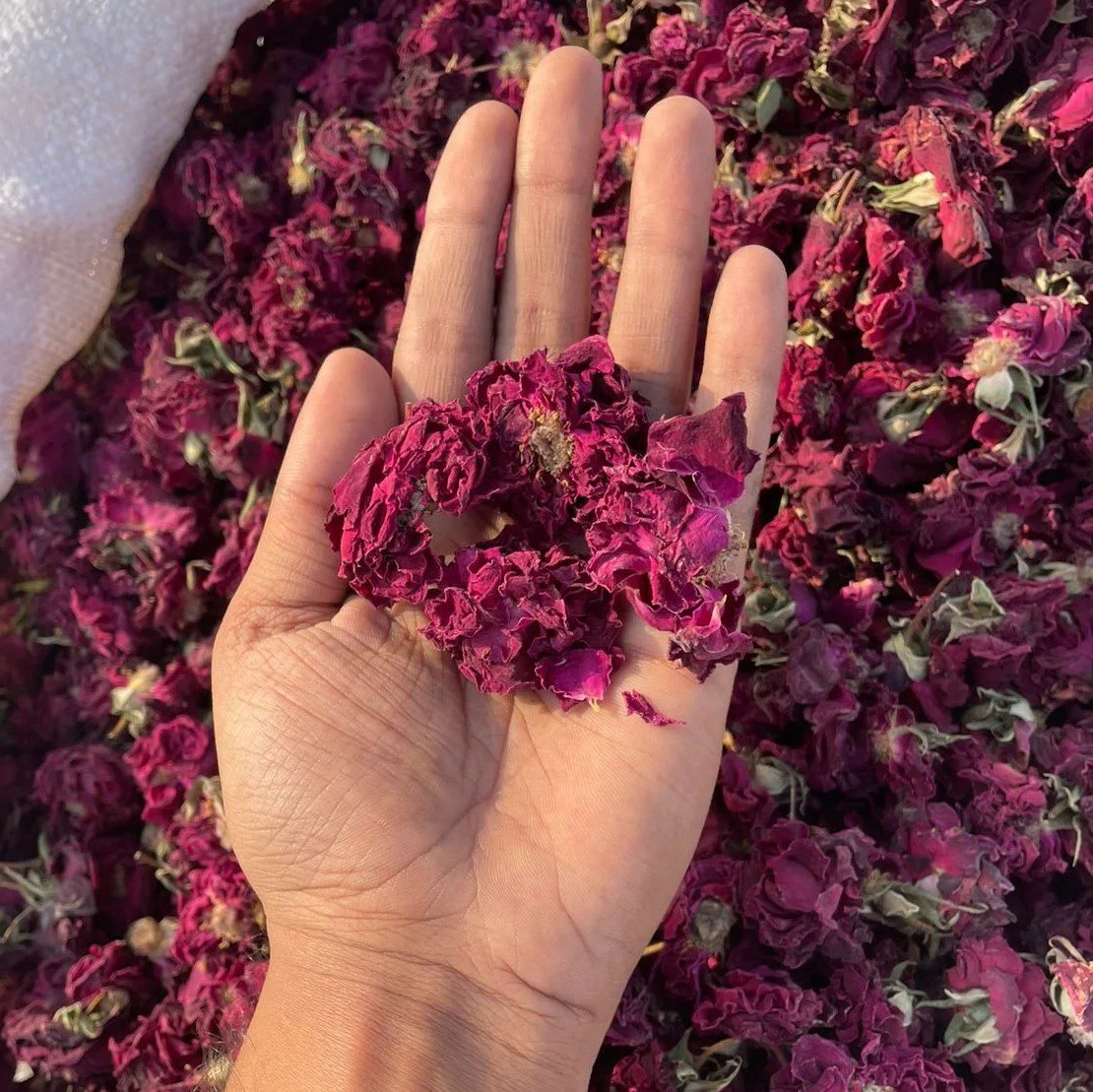
The Dry Red Rose Flower is a fully dried flower with petals whole, stem removed, and the overall shape preserved as well as possible, given the drying process. Buyers, mostly from the retail herbal, home fragrance and decorative craft sectors, are those who purchase this product. This is why the visual aspect of a whole dried rose is what gives it its value, and our processing focuses primarily on color retention and structural integrity. We sun-dry whole roses under controlled conditions on raised mesh racks that provide airflow from all directions, preventing the flattening and discoloration that occurs when you dry roses flat.
Sun-Dried (Separated) Dry Red Rose Petals
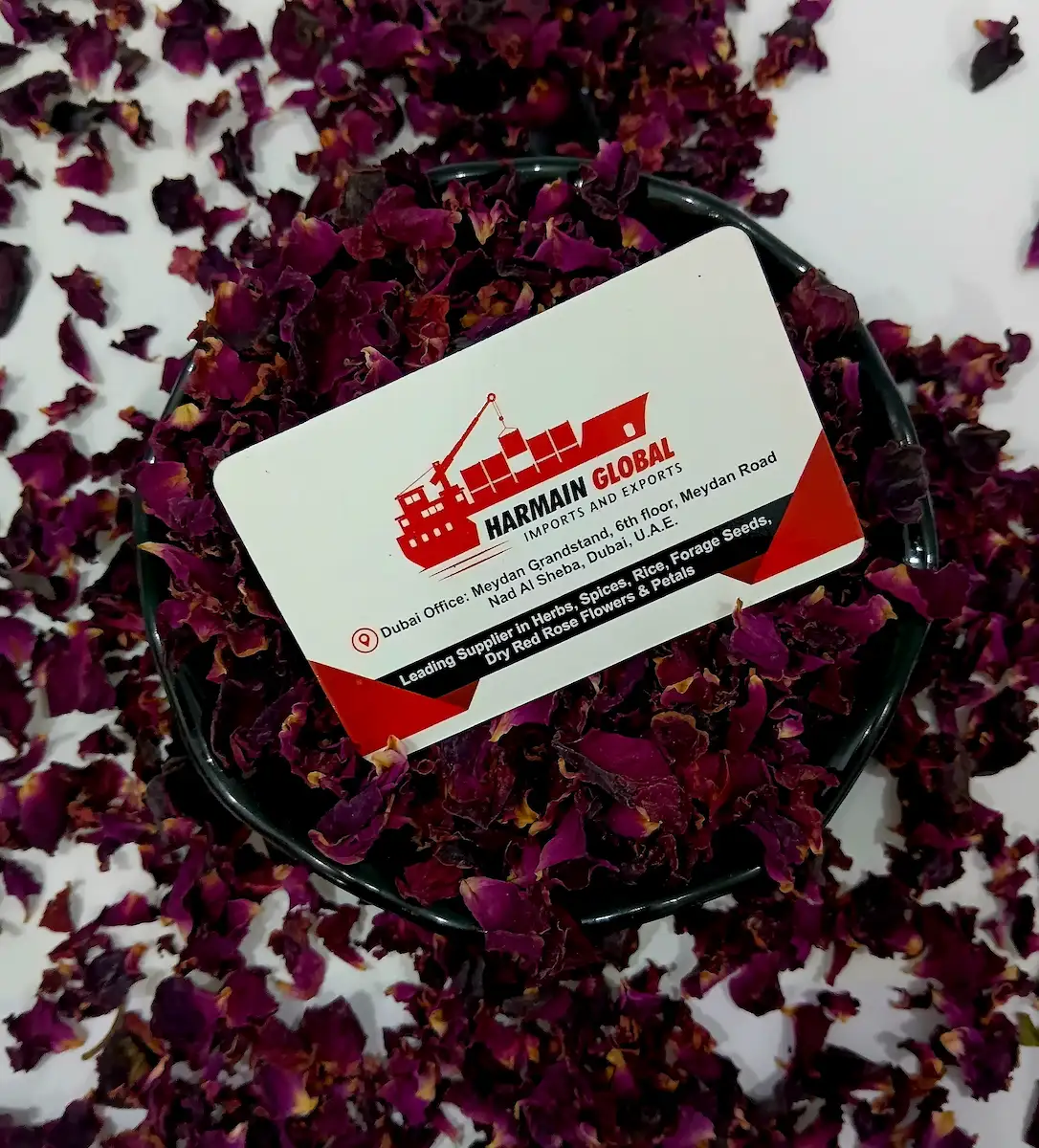
Rose petals are the single most produced export product and the one by which Harmain Global is best known in international markets. These are hand-separated petals from freshly harvested dark red roses, sun-dried and double-cleaned to remove everything else, foreign material, leaf fragments, dust and damaged pieces. The outcome is a uniform, deep crimson petal that retains a strong natural fragrance and moisture content kept between 8 and 12 percent for shelf stability.
Rose petals end up in the pockets of tea manufacturers who mix them into herbal and fruit teas; cosmetic formulators extract rose petals for use in facial toners and creams; food and confectionery
Companies that use them for garnish and flavoring, and wellness brands that provide rose petal bath soaks and aromatherapy kits. If you are looking where to buy rose petals in bulk export quality, this is what most people are talking about when they use that term. One of the world’s most powerful beauty ingredients began its story with precisely this kind of raw material — clean, potent and properly dried rose petals.
Dry Red Rose Buds
Dry Red Rose buds are picked at a very precise moment — the bud is fully formed but has not yet opened. This timing matters because the closed bud holds the concentrated aromatic and biochemical profile of the entire flower in condensed form. Dried properly, rose buds retain their still-furled flowers and bulb-like shape, a dark red hue and scent that is, in many ways, more potent than that of the fully open flat leaf.
Rose buds are the preferred form for high-end loose-leaf teas, traditional medicine preparations, and beauty product lines that wish to display a recognizable whole bud in their packaging. Many buyers in South Korea, where there is a strong tradition of floral tea culture, import dry rose buds from us because of their aesthetic and sensory qualities. Demand has increased each year as the health benefits of rose buds are documented in both traditional wellness systems and modern nutritional research.
Rose Water — Harmain Global Brand
In addition to the range of dried botanicals, Harmain Global also manufacture and exports our own branded rose water. This is steam-distilled from Pakistani red roses via traditional copper distillation devices, producing a product with a genuinely floral scent profile (as opposed to the synthetic approximation that makes its way into most commercially available rose water globally). We offer rose water in spray bottles, short glass bottles, and bulk configurations for brands looking to private-label it or use it in their own formulation process.
The daily uses of rose water include skincare toning, culinary flavoring, hair care, and religious and cultural practices throughout South Asia, the Middle East, and increasingly in European wellness markets. If your brand recognizes the value rose petals bring to skincare, our rose water will complement your sourcing portfolio.
Harvest to Home — Harmain Global Exports
From inquiry to delivery, international buyers often ask us to explain the specific process through which an order will move. Part of what earns trust, we think, is being transparent about the process. So here is how an actual Harmain Global rose export works, step by step.
Stage One: Sourcing and Sustainable Harvesting at the Farm Level
We source directly from rose farming communities in the heart of Pakistan’s Punjab region, with which Harmain Global has worked and built relationships for decades. They are not broker relationships — they’re direct sourcing partnerships where our field supervisors spend the harvest season on-site to regulate picking standards, verify bloom maturity, and assure that flowers arrive at our receiving stations during the tightest possible time window post-harvest.
This one crucial post-harvest handling helps to preserve color and fragrance. The lapse of time between harvest and the first stage of processing allows time for enzymatic degradation to start, both of which have clearly visible effects on color, as well as negative measurable impacts on total oil content (essential oils). Most of our logistics between the farm and the facility exist to remove that lag.
We practice what we consider responsible sourcing — which means that our partnerships with farms are designed to promote sustainable land management practices, fair wages for farm laborers and harvesting volumes that won’t exhaust plant stock. A carefully harvested and properly cared for rose bush continues to produce quality blooms for many seasons. This is something that our suppliers know, and we concretize it in the way we structure our purchase agreements.
Stage Two: Cleaning, Grading & Processing at Our Hyderabad Facility
The processed rose material enters our processing facility in Hyderabad, Sindh (which is where we have immaculate procurement processes on site), and all incoming material goes through a multi-stage cleaning and quality separation process. This starts with an initial pass of removing stems, leaves, bugs and other foreign plant matter that may have come in with the harvest. The material is then all spread to determine initial moisture content, before being transferred into the relevant process stream.
For whole rose flowers, the emphasis is structural — we choose blooms with original petal attachment and consistently full color, and put them through a processed sun-drying cycle. For petals, we separate them by hand so that we can remove any single petal with bruising, discoloration or visible damage before they all go in for drying. For rose buds, we choose only mature, tightly closed buds that display no cracking or browning at the tip.
Sun-drying occurs on raised mesh racks for maximum airflow. We track moisture by layer and stage of product through multiple iterations until we reach the final moisture content within the required destination market specification range. What you end up with is a product that neither grows mold en route nor in storage, and one whose color and fragrance remain preserved through the shelf life of the product.
Once dried, every batch is again cleaned with vibratory sifters and air classifiers to remove small dust particles, broken flakes and other foreign material. It also meets the less than 2 percent foreign matter standard that is typical for importing markets, and we say our batches are comfortably below that.
Stage Three: Laboratory Testing Third-Party Certification
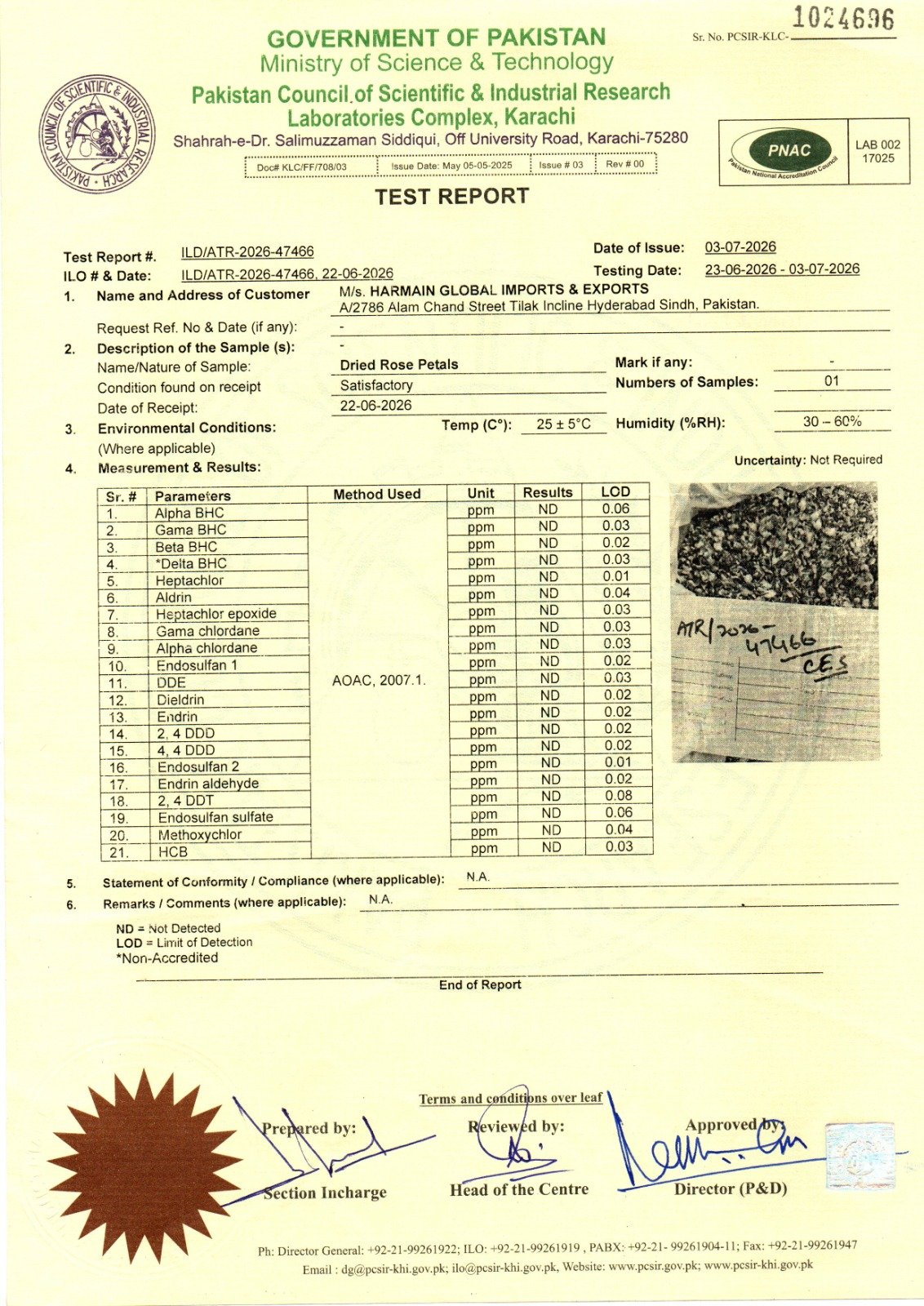
This is the point at which you go from operating a credible export operation to one that just fills bags and sends them out. Before every batch proceeds into our export inventory, it is tested against a defined set of quality parameters before being accepted into stock. We test without exception — every lot is tested, every time.
A usual testing protocol covers: Moisture content, to confirm shelf stability and compliance with destination country import standards; Microbial load, including total plate count, yeast and mold.
- coli, and Salmonella, all assessed against food-grade herbal safety standards; pesticide residue, verifying that there are no unacceptable agricultural chemicals present; heavy metals—lead, arsenic, cadmium, and mercury; color and fragrance grading conducted in-house by our quality team, deploying visual and olfactory comparison against reference standards. Also, provide SGS Pakistan and Bureau Veritas third-party certification for international export shipments. These are the organizations whose test reports are not questioned at customs and quality departments in the EU, South Korea, the UAE, Egypt and nearly every other destination market. That distinction makes all the difference when your own customers, formulators or regulatory agencies require you to show them what is in your raw material.”
Stage 4: Packing for the International Journey
Many suppliers skimp on export packaging, but Harmain Global takes it seriously. Rose products have a strong sensitivity to moisture, light and physical compression. Even if the petals were perfect when they departed Pakistan, a shipment that arrives weeks later from an ocean journey with crushed petals or damaged by moisture or lack of water, or if it arrived without its former color, this is not a successful shipment.
In-house we use food-grade moisture resistant inner bags that are heat-sealed so as to provide full barrier protection for our rose petals and buds, these are then placed into reinforced outer jute bags or polypropylene woven sacks in light of the buyer’s warehousing needs and destination. We wrap whole dried roses in protective packaging that holds the shape of the bloom intact through handling and stacking.
Every package is labeled with the product name, batch number, net weight, harvest season, origin of produce and moisture specifcation. This labeling fulfills traceability requirements and ensures your receiving team and quality department can cross-check the physical shipment with the documentation package.
Custom packaging—branded, in specific SKU sizes or outfit with fulfillment to packaging formats of choice, from destination country labeling compliance requirements are accepted. We have done this for South Korean buyers who required labeling in the Korean language, for EU buyers who needed to include allergen and country of origin declarations on packaging, and for private-label brands that wanted their own branding on retail-facing units.
Stage Five: Export Documentation — Complete and Correct
At Harmain Global, export documentation is more than a mere formality. It is a system that my team has refined over the course of nearly forty years of international trade, and one of the main reasons that our shipments clear customs faster with fewer issues than less experienced exporters.
The following documentation accompanies a typical Harmain Global rose export shipment: commercial invoice (describing the product, quantity, unit price, total value and detailed HS codes needed for customs clearance); certificate of origin signed by the relevant Pakistani chamber of commerce, confirming its Pakistani provenance and enabling access to any trade agreement entitlements applicable to the buyer’s country; phytosanitary certificate issued by Pakistan’s Department of Plant Protection attesting that the consignment is free from pests and diseases of concern; SGS or Bureau Veritas quality certificate with full test results; detailed packing list matching physical shipment; bill of lading for shipping line; any additional certificates required by destination country including fumigation certification, halal certification, organic certificates or non-GMO declarations where applicable.
We prepare all of this documentation with the same attentiveness we apply to the product itself. Mistakes in documentation are as devastating to your business as quality failures in the product
– They lead to customs backlogs, demurrage fees and compliance issues that are costly and time-consuming to sort out. Our documentation team avoids those issues even before they appear.
Stage Six: Shipment from Karachi Port and Real-Time Tracking
We had to collaborate with reputed freight forwarders who have long-term relationships with Karachi Port to facilitate the smooth loading of containers and the booking of vessels on time. For buyers, we offer full container load (FCL) orders with 20-foot options for smaller orders, and 40 ft for larger orders. For smaller commercial orders, we offer consolidation LCL sea freight and air freight for buyers needing a faster transit time or importing sample quantities in advance of larger commercial orders.
After your shipment has been loaded, you are given a bill of lading number, container number, name of the vessel and expected arrival date. We stay in contact throughout the process and also have WhatsApp, email, or phone communication to help your customs broker answer any questions when your shipment arrives at the destination port.
Our customers in South Korea, the UAE, Egypt, Italy and Sri Lanka can rest assured — Harmain Global shipments come with documentation that makes clearing customs easy. This has been one of the most consistent pieces of feedback we have received and something that truly makes us proud.
Specifications for the Product — What You Get with Your Order from Harmain Global
Most foreign purchasers require precise figures, not broad descriptions. Below are what our normal export grades look like, documentation-wise.
Dry Red Rose Petals — Export Quality
The moisture content is kept between 8 and 12 percent, with testing done once before shipment and then again right prior to loading. Color from deep crimson to burgundy, consistent within batch no visible browning primary sign of overheating or improper drying. Foreign matter content is below 2 percent, generally less than 1 percent following dual cleaning. Fragrance profile is bold and quintessentially floral, in accordance with our proprietary reference standard. Product is free from discernible insect material, mold and off-odors. Shelf life is 18 to 24 months if properly stored — sealed and away from direct light and moisture.
In food-grade applications all these specifications apply plus full compliance in microbiological testing against food-safety benchmarks. Certificates of analysis regarding additional testing for heavy metals are available upon request for cosmetic-grade applications.
Grade A Dry Rose Buds — Red
Rose buds are specification-matched on the same parameters as petals, with further requirements around physical form: buds must be completely closed, meaning there should be no appreciable separation between subsequent order or signs of opening at all — they also have to retain a calyx covering of at least 80 percent. For buyers who pack buds for displaying in retail, uniformity of size is graded. Moisture content 8-11%.
Fragrance is assessed as comparable in strength to or more potent than petals from the same harvest batch, which would usually be true considering the concentration of essential oil in the unopened bud form.
Dried Red Rose Flower (Whole Dried) — Export Quality
Counterintuitively, whole dried roses are graded primarily on structural integrity, color uniformity and stem removal. Petals need to be 85 percent intact on the head of the flower. Clear, True to Type Color should be unblemished deep crimson on all faces of the bloom. Foreign matter accounts for under 1 percent. Moisture is in the 8 to 12 percent range. is provided for decorative and retail-buying customers, in which the visual appeal of the product is a large driver in their ability to purchase vertically, and our specifications support that.
Harmain Global Brand Rose Water
Rose water is a product of steam distillation from fresh Pakistani red roses, without any synthetic fragrance, alcohol or chemical preservatives. The pH is kept in a range suitable for cosmetics and food. It comes in 100ml spray bottles, 250ml short glass bottle sachets and bulk for those buyers who want to use it as an ingredient or base in their own products. Halal certification is available. Shelf life: 18 months when kept sealed.
Our 5-Stage Approach — The Harmain Global Assurance Framework
Quality Assurance is not a department or checklist at Harmain Global. It’s the manner in which the whole operation unfolds, from when a harvest comes through our gate to when a container is closed for mailing. How we think about quality is an important context for any buyer assessing us as a long-term supply partner.
Incoming Material Inspection
Each incoming harvest batch must be evaluated against our acceptance criteria before it can enter our facility. Intake rejects batches that do not meet minimum standards for color, freshness and cleanliness. This upstream rejection is the least costly form of quality intervention because it prevents contaminated material from entering the processing pipeline and tainting compliant batches.
In-Process Monitoring
Our supervisors make constant checks at each stage during cleaning, grading and drying. Moisture measurements are recorded at the beginning, midpoint and end of each drying cycle. Color evaluations are conducted through visual inspection by trained graders who are able to detect batch-level color drift before it reaches rejection level. But if any batch starts exhibiting unusual moisture or color behavior, it’s pulled for further inspection instead of being allowed to pass through the process.
Pre-Shipment Laboratory Testing
As outlined in the export journey section, all batches of our export stock are tested for moisture, microbials, pesticides and heavy metals. We maintain batch records of test results, available upon request. The results of these tests generate the certificates we include with every shipment.
Third-Party Verification
SGS Pakistan and Bureau Veritas are responsible for the independent verification of our quality claims. We never require buyers to take our word for it. We offer credentials from organizations that are known and respected in the world of global trade. One speaks to buyers with serious quality requirements; Harmain Global is a large investment, which most smaller exporters do not make, and one of the reasons that those buyers choose Harmain Global over lower-cost alternatives.
Post-Shipment Client Feedback Loop
We keep in contact with clients post-delivery to see if the product/solution worked as intended in their application. If a client reports an issue, we will investigate at the batch level, and once the root cause is identified, our corrective measures will be put in place before the next order. That is how an export operation evolves over decades, rather than becoming static; this is a feedback loop.
After working for many years as a raw material supplier to cosmetics, food and pharmaceutical companies, we learned that the fate of our clients was determined downstream by the decisions made regarding quality. A supplement brand that receives a contaminated batch doesn’t just lose one order — they may also lose regulatory standing, customer trust and retail shelf space. We see the weight of that, and we reflect it in how seriously we treat every phase of the process.
When you read about the unexpected health benefits of rose petals, it’s no wonder that buyers in the wellness industry treat the quality of the ingredient as a non-negotiable — the potency of what’s in your glass or jar depends entirely on how well-preserved its raw state is.
Our Exports — Harmain Global Distribution Network
Harmain products are already being purchased by consumers in South Korea, the United Arab Emirates, Sri Lanka, Egypt and Italy, among others as well as an increasing number of other markets in Southeast Asia and the Gulf region. These destinations have a different buyer profile and require different end-use applications, and our consistent ability to serve them is through an understanding of what each market needs rather than treating all export orders as identical.
South Korea and China are our oldest markets for rose products. Our dried red rose petals and buds are sourced by Korean buyers mainly for high-end herbal tea blends and wellness beverage formulations. Korean food and beverage standards are some of the strictest in the world, and notables such as our products regularly passing customs inspections and quality audits by Korean authorities is a testament to our testing & certification standards. The fact that our Korean clients have collaborated with us for a great number of years, and continue to purchase from us, is the most legitimate endorsement we can provide to any new purchaser.
The UAE is a huge market for dry rose products and rose water. Rose water has deep cultural significance throughout the Arab world — in food preparation, personal care and religious practice. Buyers in the UAE understand the difference between true steam-distilled rose water and synthetics, and they pay accordingly for authentic product. We automatically provide Arabic labeling and halal certification for all our export packaging to the UAE market.
Egypt sources our rose petals primarily for the herbal and traditional medicine sector, as they are widely used in the herbal and traditional medicine market, where dried floral botanicals play a vital role as one of the leading ingredients in CPGs (consumer packaged goods) and practitioner supply. Our consistent color quality and fragrance intensity have been well received by Egyptian buyers, as it is one of the key selling points in a market where product aesthetics play a major role for end-buyers.
This is a developing market, with our rose products used across wellness, cosmetic manufacturing and the artisanal food sector in Sri Lanka. Sri Lankan buyers normally have smaller minimum order quantities than buyers from Korea or the UAE, hence we face this with a flexible LCL shipment.
Italy and wider European Union markets demand the most extensive paperwork, including EU rules on pesticide residues, heavy metals and food-grade safety requirements. With these requirements in mind, our testing protocol was designed to support the needs of EU buyers, and so we will not need to add steps to our normal process to serve them.
For buyers in other markets, or for those interested that are not on the list, please inquire directly. Which country we can export to is a question best answered by our team, who can
determine your country’s particular import requirements and provide guidance on any additional documentation or certification that might be necessary.
The Industries We Serve
And all these industries need quality dry red rose products, which is why they come to Harmain Global, servicing buyers from a truly diverse range of businesses.
Herbal Tea and Beverage Manufacturing is among the top three buyer categories for our rose products. Rose petal tea has been consumed in traditional wellness culture throughout Asia and the Middle East for centuries, but the modern functional beverage industry is rediscovering it with considerable commercial energy. Manufacturers folding rose petals into green tea, chamomile mixes, hibiscus-rose brews or single-press rose petal infusions want consistency of color, fragrance and particle size — not to mention the vegetable-grade documentation that will assure their retail customers of safety. We provide them all of that.” As to why rose petals are a lot more than a frilly addition to a cup of tea, that goes some way towards explaining why this market keeps expanding.
Particularly, the second major buyer category is: Cosmetics and Skincare Formulation. Whether it’s a formulation for a facial toner, rose clay mask, bath soak or artisanal soap, the respective brands require rose petals and/or rose water to not only function as an active botanical ingredient but also act as a visual impact in the brand’s end product. Rose has long played a starring role in skincare rituals at the natural beauty shelf, and so as brands build out product lines based on this tradition, they now have to search for a supplier of raw materials that has an understanding of why purity matters in this application. The story of a skincare company based on finding the right exporter is one we’ve actually seen play out in our own client relationships.
Food and Confectionery is a burgeoning application of rose petals and rose water as gourmet ingredients. From Middle Eastern sweets such as Turkish delight and gulab jamun to European patisserie embellishments and artisanal chocolatiers, the culinary application of rose products crosses cultures and price ranges. Food-grade testing and analysis mean any culinary buyer will only receive a clear understanding of the material for food safety standards in their market. Herbal Practitioners in North and South Korea, the Middle East.
Dried rose petals and buds are used mainly in consumer products, while others are still directly supplied from practitioners of Asia. The poetry and tradition around dry red rose in classical medicine systems is not a mere abstract commodity for these buyers — they require authentic, potent, unadulterated botanical material, and they can taste the difference.
Wellness and Aromatherapy Brands employ whole dried roses, rose petals, and rose buds in bath product ranges (e.g. bath soaks and teas), home fragrances kits (candles), as well as other spa product lines for touch or scented aromatherapy purposes, including the use of complete mindfulness bundles with topical oils/water sprays, etc. This is a rapidly growing sector especially in the EU and North America, where consumers are demanding naturally sourced materials they know originated from traceable sources.
The Private Label and Retail Packaging segment identifies buyers who buy our products to package their brand. We create private label partnerships with flexible packaging configurations and labeling, along with
How to Order — Minimum Orders, Packaging Options & the Buying Process
We know that, alongside the product quality, how an international order is fulfilled is vital. This is how ordering from Harmain Global goes.
Minimum Order Quantities
The minimum order for rose petals and rose buds is 100 kgs and can be shipped via LCL sea freight or airfreight based on your timelines and budget. For Buyers who do their first order, our suggestion is to place a sample shipment of 500 grams to 2 kilograms by DHL/FedEx, including a full certificate of analysis, and confirm that our quality meets your demand before moving forward with commercial quantities. The sample costs are credited toward the first commercial order.
In full container loads, we can load a 20-foot container holding around 3 metric tons of petals / buds, depending on configuration. For bigger orders, you can find forty-foot containers.
Packaging Formats
Even standard export packaging employs a double-layer construction — an innermost food-grade inner moisture-barrier bag, heat sealed inside of an outer reinforced jute or polypropylene woven sack. Normal outer bag sizes are 10kg, 20kg and 25kg (non-standard available upon request).
For retailers that need retail-ready packaging, we can supply vacuum-sealed kraft pouches in 50g, 100g, 200g or 500g configurations with custom label printing. We find this option is popular with buyers who are either retailing our product directly or co-packing their own brand.
The Ordering Process
The first step is to contact our export team on WhatsApp (+92 333 2095256), Phone (+92 3453629580 or 022-6119540), or email (harmainpk92@yahoo.com / info@harmainglobal.com). Share what you want (product), how much quantity, your destination port, and also how you plan to use the product. It ensures that we provide you with a relevant and accurate quotation.
In step two, you will receive our formal quotation, mentioning the product grade, quantity, price of FOB Karachi or CIF basis (depending on your choice), payment terms, estimated delivery time frame and validity.
Step three: Order samples and test for new buyers. We send samples via DHL or FedEx, within three to five days, with the corresponding certificates of analysis. This allows you and your team to validate product quality versus your application requirements, check out our documentation levels and assess communication prior to placing a container order.
Placing the commercial order is step four. For First-Time Buyers, we work on a thirty percent advance payment with the balance due against bill of lading or via letter of credit for large orders. Post-payment security, we proceed towards the final pre-shipping quality check, followed by export documentation preparation, container booking and loading at Karachi Port.
Step five is delivery and starting a long-term relationship. We are not a one-shot deal for our clients, such as Korea, the UAE and Egypt. They return because the experience delivers — the quality is consistent, the documentation accurate, and the communication frank. That is the type of relationship we want to establish with every new buyer.
The Reason Why Buyers Across The Globe Prefer Harmain Global
Almost forty years of business do not occur by chance. It comes from getting it right, over and over, for a long time. And as we look back upon what has pulled buyers on five continents to place orders with Harmain Global Order after order, the explanations are consistent.
Experience that cannot be substituted. There are things about rose export that only decades of doing it teach you — which regions of a farm produce better color in which seasons, how to tweak drying protocols for unusually humid harvest times, what formats every destination customs authority really likes documentation in, how to pack for sea routes passing through tropically humid shipping lanes. This institutional knowledge is embedded in our people, our processes and our systems. It cannot be sourced by a new supplier. It is layered through experience, and ours is approaching four decades.
Vertical farm to container management. We do not buy from a broker that buys from a broker that buys from the farm. Our field supervisors have relationships directly with farming communities, allowing us full control of quality at the moment quality decisions are actually made in a supply chain — during harvest and initial handling. Vertical control is what makes our consistency a certainty rather than a chance.
Documentation that works. For our shipments, our clients seldom have any problems with customs clearance, and for those that do result in questions at the destination port, we are able to assist their customs broker live, thanks to our documentation team. That may seem trivial, until your production line is on hold because a container has been stuck at a port over an incorrect certificate. We eliminate that scenario.
Honest communication. We do not overpromise. In the event that a particular quality is not available in the quantity you require at the time you need it, we inform you before ordering instead of after shipment. When production gets delayed, we proactively communicate an updated timeline. This kind of honesty is at times painful in the short term, but it avoids large issues in the long term.
Competitive pricing with transparency. Our prices reflect real costs and fair margins, not arbitrary markups or hidden fees. In this article, we describe what is included in a FOB or CIF price and what is not. Buyers understand what they’re paying for and why.
And it serves the cultural understanding that improves trade. We had buyers in South Korea, the Arab world, East Africa and Europe. We know that business relationship norms differ among cultures, so we adjust our communication style accordingly. For Pakistani and South
For Asian buyers, we are familiar with the dynamics of a personally known market. We have the professionalism that comes from years of long-term international trade to offer international buyers.
What Our Buyers Tell Us
We take client confidentiality seriously and do not share the names of our business partners unless we are authorized to do so. What we can share are patterns that develop based on buyer feedback across years in business.
The top of buyers in South Korea is feedback, color consistency. Korean buyers handle rose products ranging from cosmetics to tea blending and food manufacturing, and all of them are visually sensitive applications. It is feedback that validates years of investing in our drying and grading process to be told by a long-standing Korean client that the petals we hold, by far, have the most consistent color from all origins they source from.
Rose water and the true nature of its scent profile are amongst the most common things buyers in the UAE say. With synthetic rose water saturating the market and real product demanding a noticeable price, having buyers confirm that our rose water passes the sensory check of an experienced consumer is meaningful.
Documentation is the area that most EU buyers consistently cite as a standout. Having a container clear through EU customs with botanical products is not as easy as it sounds and requires a certain set of certificates that need to be precise and prepared correctly, so our ability to deliver that without mistakes and on time is something EU buyers appreciate.
The strongest statement we can make is this: the majority of our buyers have been loyal to us for more than five years. Many have been with us for more than 10 years. And in the international trade of commodities, where price competition is relentless and switching costs are low, supplier quality at the buyer retention level above that is its truest measure.
Ready to Source? Let’s Begin
For those of you who have read along, now you appreciate why Harmain Global is the name international buyers think of when they think of top-grade dry red rose export from Pakistan. You know what we’re exporting, how we process it, how it’s tested, what records are kept about it and finally how it gets to you.
The next step is simple. Then you get in touch with our export team — tell them what your requirements are, i.e. the product, its quantity, your port of destination and your end application. You will receive a full quotation with available certificates and an invitation to provide you with samples prior to any commercial commitment.
We have been doing this since 1985. We know how to deliver Pakistani rose products at your warehouse in pristine condition, with the kind of documentation attesting to its provenance that gets it through your customs, at a price that reflects fair value.
Now is a better time than ever to learn what the right sourcing partner actually feels like. Contact Harmain Global:
WhatsApp / Phone: +92 333 2095256 | +92 345 3629580 (022) 6119540 Email:
A/2786, Alam Chand Street, Tilak Incline, Hyderabad, Sindh, Pakistan. Email: harmainpk92@yahoo.com | info@harmainglobal.com Office Hours: Monday to Saturday, 11:00 AM to 8:00 PM PST. WhatsApp for urgent inquiries outside working hours.
Frequently Asked Questions
The minimum commercial export order for dry red rose petals is 100 kilograms. For buyers who wish to evaluate quality before placing a commercial order, we offer samples ranging from 500 grams to 2 kilograms, shipped via DHL or FedEx with a full certificate of analysis. Sample costs are credited against the first commercial order.
We currently export to South Korea, the United Arab Emirates, Sri Lanka, Egypt, Italy, and several other markets in Europe, Southeast Asia, and the Gulf region. We are open to discussing
export to any country — contact us directly to confirm whether we can accommodate your destination.
A standard Harmain Global rose export shipment includes a commercial invoice, certificate of origin from a Pakistani chamber of commerce, phytosanitary certificate from Pakistan’s Department of Plant Protection, SGS or Bureau Veritas quality certificate with full test results, packing list, and bill of lading. Additional certificates such as halal certification, organic certificates, fumigation certificates, and non-GMO declarations can be arranged for destinations that require them.
Yes. Our food-grade rose petals are tested for microbial safety, pesticide residue, and heavy metals before export. They comply with food-grade herbal safety standards required by the markets we export to. The health benefits of eating rose petals have been well-documented, but the safety of any edible botanical product depends entirely on the quality of the source, which is why our testing protocol covers all relevant food safety parameters.
Rose petals are separated from opened blooms, offering immediate fragrance release and a wide surface area ideal for tea infusion, bath soaks, and cosmetic formulations. Rose buds are harvested before the bloom opens and carry a concentrated aromatic profile in compact form, making them preferred for premium display tea packaging, traditional medicine preparations, and retail products where the visual integrity of the whole bud adds value. Both products are available from Harmain Global in export quantities with the same certification standard.
Yes. We offer custom packaging in various SKU sizes, including retail-facing vacuum-sealed kraft pouches in 50g, 100g, 200g, and 500g. Custom label printing with your brand name and design is available. We have done this for buyers across multiple markets and can accommodate destination-country labeling requirements.
Consistent color in dried rose petals depends on three factors: the variety and maturity of the rose at harvest, the speed of post-harvest handling before drying begins, and the drying method itself. We source from farms growing traditional dark red rose varieties, handle incoming harvests within hours of picking, and use elevated mesh sun-drying that ensures even color development across the batch without the heat damage that causes browning. Color is assessed visually against reference standards at multiple stages of the process.
Properly stored dry red rose petals and buds maintain their color, fragrance, and quality for 18 to 24 months. Storage conditions should include an airtight sealed container, away from direct light and heat, in a cool, dry environment. Our moisture specifications at the time of shipment are set conservatively to maximize shelf stability across varying storage conditions in different markets.
Yes. Harmain Global produces and exports our own branded rose water, available in 100ml spray bottles, 250ml short bottles, and bulk configurations for formulators. Our rose water is steam- distilled from Pakistani red roses with no added synthetic fragrance or chemical preservatives.
Halal certification is available as standard.
Contact our export team via WhatsApp at +92 333 2095256, by phone at +92 345 3629580 or
(022) 6119540, or by email at harmainpk92@yahoo.com or info@harmainglobal.com. Let us know which product you are interested in, the quantity you require, your destination country, and the intended application. We will respond with a complete quotation and can arrange sample shipments via DHL or FedEx for quality evaluation before commercial orders are placed.