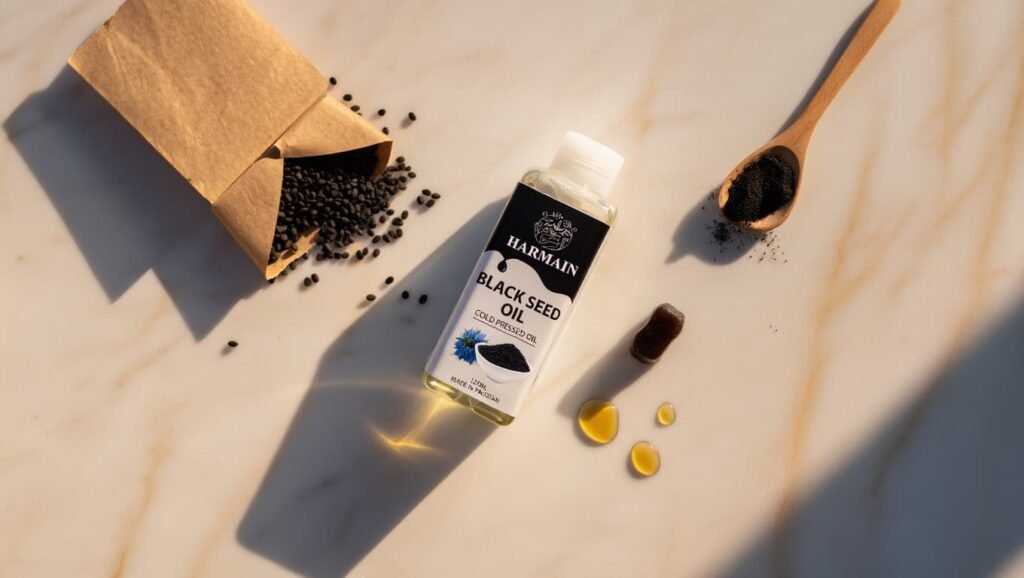
Fourteen centuries ago, the Prophet Muhammad (PBUH) said something so specific, so confident, so quietly extraordinary that scholars, herbalists, and eventually scientists never stopped thinking about it. Recorded in Sahih Bukhari, the hadith reads: “In the black seed there is healing for every disease except death.” Seven words of prophetic medicine. No footnotes. No clinical trial registration. Just a statement that planted itself in human consciousness and never left.
That is the kind of opening that is impossible to top — and honestly, we are not even going to try. Because the story of black seed oil does not need embellishment. It just needs telling.
The seed in question, Nigella sativa — an unassuming annual flowering plant from Southwest Asia and the Mediterranean that has apparently been slowly invading spice racks, medicine cabinets and beauty shelves for longer than most civilisations have had names. In Pakistan and across South Asia it goes by kalonji. In Arabic it is Habbat al-Barakah — the seed of blessing. Depending on the corner of the world, in English it gets called, black seed, black cumin, Roman coriander and fennel flower. It has more pseudonyms than a leading character in a spy thriller and is found in more archaic manuscripts than the majority of modern medicines have published peer-reviewed studies. Egypt had it. Rome had it. Persia had it. And Pakistan? Pakistan grows some of the world’s finest.
For a very long time, the only people loudly insisting on the seed’s power were the ones who had been using it for generations. Then the scientists arrived. And what they discovered inside Nigella sativa was, to say the least, intriguing. In every study, they kept returning to its active compound: thymoquinone — a bioactive molecule that exhibited anti-inflammatory properties, antioxidant activity, antimicrobial behaviour, and immune-modulating effects. In addition to: dithymoquinone, thymohydroquinone, thymol, and a heavy omega 3 and omega 6 fatty acid profile. If you want the full deep dive into what thymoquinone actually does once it enters your system, check this out — the biology gets genuinely fascinating. But the short version is that science spent decades looking for an explanation for what the Prophet already said in seven words. The research keeps catching up.
Now here is where things get interesting for the modern buyer. Because whole black seeds are wonderful — you toss them in bread, brew them in tea, grind them at home, use them the way your grandmother did — but the world has a way of wanting things in new formats. Cold-pressed black seed oil became the cosmetic formulator’s obsession, the supplement brand’s hero ingredient, the wellness consumer’s daily ritual dropped under the tongue or massaged into the scalp. It sits beautifully among other therapeutic oils — and if you are navigating the wider world of carrier and essential oils, learn more here about how black seed oil fits into that universe. Then came black seed powder, which opened the door for tea companies, herbal capsule manufacturers, and food formulators who needed the seed’s goodness in a blendable, scalable format. And then, because this is the 21st century and chewables are winning, along came black seed gummies — the ancient remedy arriving at your wellness retailer shelf in a format that requires zero convincing for the modern consumer.
Harmain Global carries all four. Whole seeds for the traditionalists and bulk buyers. Pakistan’s best black seed oil for formulators and supplement brands who know that thymoquinone concentration matters, that cold pressing matters, and that sourcing directly from Pakistani growers matters. Kalonji powder, Pakistan producers swear by, for the tea blenders and herbal manufacturers who need consistency batch after batch. And premium black seed gummies for the brands building modern supplement lines for a consumer who has heard about black seed on three different podcasts and is finally ready to try it in a format that tastes like something other than ancient tradition.
So why is this Harmain’s most requested product? Honestly, the question answers itself once you see the demand map. Gulf buyers have been sourcing prophetic medicine products for generations — Habbat al-Barakah is not a trend for them, it is a staple, and they want it verified, certified, and traceable. The UK Muslim wellness market is one of the most sophisticated herbal supplement communities in the world, and they want bulk black seeds for wellness brands that can prove Halal certification before the order is even discussed. European herbal-supplement manufacturers prefer nigella sativa suppliers from Pakistan that include both SGS or Bureau Veritas third-party testing alongside a COA they can literally hand to the regulatory team. Cosmetic formulators have been scouring for oils with the real thymoquinone profile – not diluted blends. Tea companies want wholesale black seed powder of Pakistani quality that holds flavour and potency in every blend. Everyone, it turns out, wants black seed. And Pakistan grows a spectacular black seed.
Pakistan’s climate and the country’s deep traditional cultivation knowledge are not marketing talking points — they are genuine supply-chain advantages. Harmain Global sources directly from trusted Pakistani growers, which means fewer middlemen, more traceability, and the kind of consistent quality that a supplement brand or cosmetic manufacturer building a product line actually needs. Alongside every batch, there is a degree of documentary evidence: Halal, food grade, Certificate of Analysis, MSDS, and FDA. Third-party inspection by SGS or Bureau Veritas. Export-ready, GCC-compliant, EU-ready, UK-ready. This is not a sack of seeds from a market stall. This is agricultural heritage meeting modern export standards.
Fourteen centuries is a long time for a remedy to stay relevant. https://harmainglobal.com is where you can explore the full range — whole seeds, cold pressed oil, powder, and gummies — from a supplier that takes both the Prophet’s endorsement and your quality requirements seriously. Some products have a history. This one has a hadith.