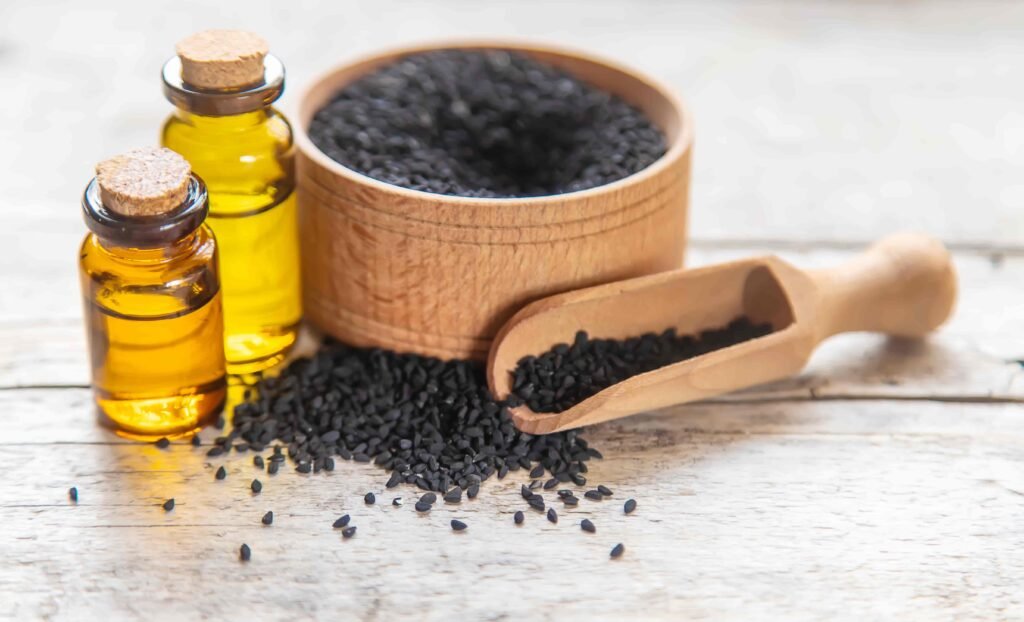
When a supplement brand or health food buyer starts sourcing Nigella sativa, the first question is rarely “how much.” It’s “which country.” Increasingly, the answer is Pakistan.
That shift isn’t accidental. It’s the result of buyers getting burned by inconsistent potency, missing documentation, or a certificate of analysis that says nothing useful and adjusting their sourcing criteria accordingly. At Harmain Global, sourcing black seed since 1985, we’ve watched this buyer behavior change firsthand, and we’ve built our export operation around what serious buyers now require.
Why Origin Determines Potency, Not Just Price
Thymoquinone (TQ) is the compound that makes black seed commercially valuable; it’s what formulators, supplement brands, and Islamic wellness (habbatus sauda) manufacturers are actually paying for. TQ content is not fixed across Nigella sativa; it varies meaningfully by origin, soil composition, and growing conditions.
This is why experienced buyers now specify a minimum TQ% on their CoA and, more importantly, ask for that TQ to be HPLC-verified, not just listed on a generic lab sheet. A CoA without HPLC data is a claim. A CoA with HPLC data is evidence.
Pakistan’s Sindh and Punjab regions grow Nigella sativa in alluvial soil deposited by the Indus River system. That soil composition produces naturally consistent TQ levels harvest after harvest; this is a verifiable agronomic fact, not a marketing line. Every commercial CoA we issue includes HPLC-verified TQ, because that’s the standard our buyers in the USA, UK, and Germany now expect before they’ll place a first order.
The Market Behind the Demand
The global Nigella sativa market is growing at a 10.45% CAGR and is projected to reach $4.59B by 2034. The USA, UK, and Germany consistently rank as the top three importing countries, and the reasons behind that concentration are structural rather than seasonal:
- Health food retail expansion across North America and Western Europe, where black seed oil and capsules have moved from niche to mainstream shelf space.
- Supplement market growth, with formulators looking for standardized, TQ-verified raw material rather than commodity-grade seed.
- Demand tied to Islamic wellness traditions (habbatus sauda) in diaspora and halal-conscious consumer segments.
- The halal food sector broadly, where black seed appears in oils, seasonings, and functional food products.
One detail that matters for EU-facing buyers specifically: cold-pressed black seed oil is not classified as a novel food in the EU, which means it can be marketed without novel food authorisation a compliance shortcut that isn’t available for every botanical import.
What Pakistani Origin Delivers on Paper
Buyers in regulated markets aren’t just sourcing seed; they’re sourcing documentation. Pakistani origin, done properly, delivers:
- ISO 22000 certification
- GACC registration for the Chinese market
- FDA-registered facility status
- Halal certification
- Organic certification, where required
- Cold-pressed extraction only — no solvent-extracted oil
- Pesticide-free growing regions
- HPLC-verified TQ on every commercial CoA
This documentation stack is what separates an exporter a buyer can build a supply chain around from one they’ll use for a single trial order and never again.
Four Formats, Four Buyer Profiles
Black seed export from Pakistan isn’t a single SKU; it’s four distinct product lines, each serving a different type of buyer:
- Black seed whole (HS 1212.99) — the format food manufacturers and re-processors buy for milling, extraction, or private-label packaging.
- Black seed powder — ground for direct incorporation into food products, capsules, or bakery applications.
- Cold-pressed black seed oil (HS 1515.90) — the format oil brands and supplement companies purchase in bulk for bottling or further formulation.
- Black seed gummies — a finished, GMP-manufactured consumer product for retail distributors who want a shelf-ready SKU rather than a raw material.
Buyers rarely need all four. Knowing which one matches your supply chain position is the first sourcing decision and it’s one we help every new buyer make correctly.
| Format | HS Code | Primary Buyer | Typical Use |
|---|---|---|---|
| Whole seed | 0909.31 (Spice), 1212.99 (Sprout) | Food manufacturers, re-processors | Milling, extraction, private-label |
| Powder | 1212.99, 1211.90 | Food/capsule manufacturers | Direct incorporation, bakery |
| Cold-pressed oil | 1515.90 | Oil brands, supplement companies | Bottling, further formulation |
| Gummies | 2106.9090 | Retail distributors | Shelf-ready consumer SKU |
Where Pakistan Outpaces Other Origins
Ethiopia, Egypt, and Syria all export Nigella sativa, and all three appear in global trade data. But origin availability isn’t the same as origin readiness. Buyers in the US, UK, and Germany increasingly require GACC registration, FDA facility status, and HPLC-verified TQ data as baseline conditions for a purchase order and these three origins largely lack the documentation infrastructure to meet that bar consistently.
Pakistan’s regulatory compliance posture built over decades of exporting into demanding markets — is what allows buyers to skip the qualification headaches that come with sourcing from origins that are cheaper on paper but undocumented in practice.
Start With a Verified Sample
If you’re formulating, distributing, or manufacturing with black seed and haven’t yet seen an HPLC-verified CoA from your current supplier, that’s worth addressing before your next order. Request a sample with CoA and evaluate Pakistani-origin black seed against whatever standard you’re currently sourcing to.
FAQs
Why does black seed origin affect TQ content?
Thymoquinone content varies by soil composition and growing conditions, not just genetics. Pakistan’s Sindh and Punjab regions grow Nigella sativa in alluvial Indus soil that produces consistent TQ levels harvest after harvest.
What should I ask for on a black seed CoA?
Request HPLC-verified TQ%, not a generic lab sheet. A CoA without HPLC data is a claim; a CoA with HPLC data is evidence.
Is cold-pressed black seed oil a novel food in the EU?
No. Cold-pressed black seed oil is not classified as a novel food in the EU, meaning it can be marketed without novel food authorisation — a compliance advantage not available for every botanical import.
How does Pakistani origin compare to Ethiopia, Egypt, or Syria for black seed?
All four countries export Nigella sativa, but buyers in the US, UK, and Germany increasingly require GACC registration, FDA facility status, and HPLC-verified TQ data as baseline conditions — documentation infrastructure that Ethiopia, Egypt, and Syria largely lack at consistent scale.