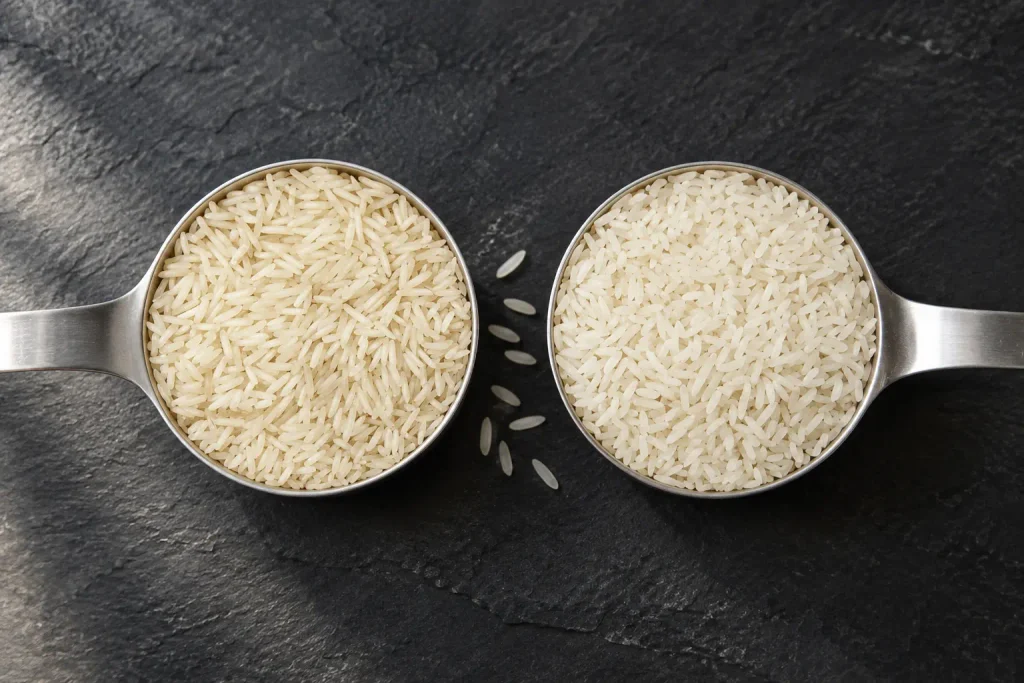
Choosing between new-crop and aged basmati is a choice about cooking behavior and about supply timing. This article will explain what published research indicates about the effects of ageing, what it costs to hold inventory, and how to define the choice in a purchase order so that both parties understand exactly what is meant by “aged”.
What “aged” means, and why no single definition exists
Pakistan’s primary basmati harvest occurs during the months of October through December. During these months, new-crop rice is processed (milled) and marketed. On the other hand, older or “old-crop” rice is stored after harvest until such time as it is ready to be marketed. There is no set standard regarding the duration of this storage time; however, there are several studies that have investigated the effects of storing rice on its quality. For instance, one study referenced in our article examined paddy stored for five months while another study examined rice stored for twenty-four months. Furthermore, market listings typically provide their own estimates for the length of time that rice has been aged, but again, these estimates are not standardized, therefore we do not treat any of them as one.
We maintain the stocks of our premium long-grain basmati grades for a minimum of 6 months up to a maximum of 12 months in our temperature-controlled warehouses. Additionally, each mill that provides us with our rice is visited regularly by members of our procurement team so they can inspect the quality of the warehouse facilities. The main takeaway for buyers is that instead of using the term “aged” to describe the length of time that the rice has been stored, it should be stated as a minimum number of months and the harvest year. Our old crop basmati rice page lists the grades we sell.
What changes in the grain
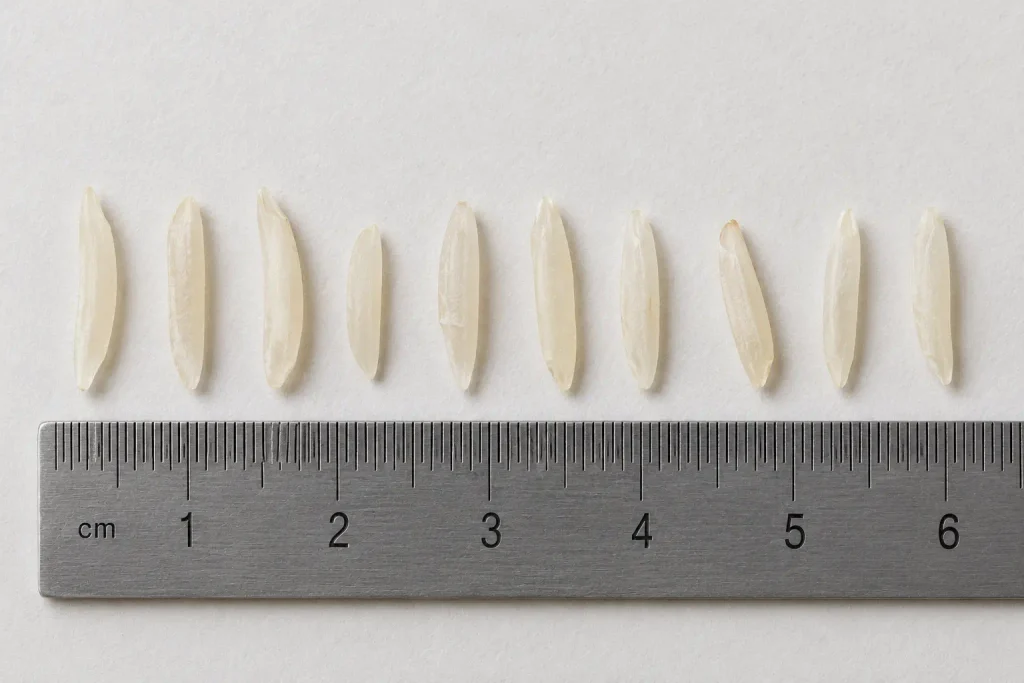
The most direct evidence we found for basmati paddy is a study by Kaur and Chand (2011) in the Journal of Agricultural Engineering. They stored Basmati-386 paddy for five months in gunny bags and in two types of polyethylene bag. Over that period, the aroma measure, cooking coefficient, elongation ratio and water absorption rose markedly. Amylose content, cooking time and the solids lost into the cooking water all fell. The textural measures of hardness, cohesiveness, springiness, gumminess and chewiness all increased.
Another study was conducted in Pakistan by Ali and colleagues (2004, Pakistan Journal of Agricultural Research). They studied the changes that occurred in Basmati 385 rice over a period of 24 months. That study showed that water uptake and volume expansion kept increasing through the storage period. Grains bursting during cooking decreased from 11.5% to 2.0% over the storage period. Although amylose content decreased slightly, it remained within the intermediate amylose group. Unlike the first study, there were no significant effects on cooking time, and protein content, alkali spreading value, and gel length were not significantly affected.
The two studies agree on the direction for water uptake and amylose, however, they do not agree on cooking time. They each cover one variety, and neither study reports testing 1121 or parboiled rice. You should view both studies as being examples of patterns, rather than as actual numbers for your specific lot. In addition, the aroma aspect of ageing, and the compound responsible for it, is discussed within our guide to basmati aroma and authentication.
What changes in the pot
This article does not contain any comparative data from a controlled study of new-crop versus aged cooking tests. However, research indicates that aged rice absorbs more water; increases in size (volume) more than new-crop; breaks or bursts less frequently; and results in a firmer, separate grain when cooked. On the other hand, new-crop rice usually displays characteristics that are opposite of those found in aged rice: less swelling/expansion; more breakage/bursting of grains; and a softer texture.
The simplest way to see the difference on your own lots is to run the comparison on samples. Take the same variety in new crop and in aged. Cook them in the same manner (same water ratio, same soaking time, same pot), and perform a minimum of 3 replicates per variety. Measure the length of 10 whole grains before cooking, and again after cooking. Also, record the soaking time, cooking time, and make a short note regarding the texture of the grain. To find the elongation ratio of the grain, divide the cooked length by the dry length. If the two lots differ in more than age, such as milling degree or processing type, then the result will not tell you much about age alone.
What ageing costs
The initial cost is time. When the harvesting of the current crop ends in December and you store it for six to twelve months before selling, the rice from this crop won’t be ready to sell until late in the next season, whereas the new crop can be sold immediately. The other issue is space and handling; with climate controlled storage, stock rotation, and records that identify each batch.
The third risk is quality risk. Rice in storage can also lose quality through moisture pick-up or insect infestation, and ageing does not repair a weak lot. Therefore, we check the moisture content of the rice, inspect the storage facilities, and encourage buyers to inquire about the storage history of the rice in addition to the length of time it has been stored. Some loss through handling and rejected batches is inevitable. We cannot provide estimates for these losses as they are dependent upon the type of storage facility being used and the time of year.
Which uses justify aged stock
Aged stock is appropriate when the quality of the cooked product can be determined from its appearance and texture: such as restaurant-prepared biryani and pulao; catering businesses that require long, individual grains; and retail packs sold on elongation. Additionally, aged stock has a higher rate of water absorption and volume expansion, which are important factors for those who price their products based on the number of portions they produce. On the other hand, new crop is suitable for dishes where the rice is part of a larger recipe and the separation of each grain is not the main concern, or when the availability of the new crop is more important than its texture. We believe this represents our interpretation of the scientific studies and is not intended to represent a law or regulation, therefore we suggest testing samples prior to placing orders for large quantities.
Processing type matters too. Parboiled and steam grades are compared in our guide to steam and sella basmati.
Our basmati specifications
Whether stock is new crop or aged, the specification is the baseline you measure against. These are the figures listed on our product pages. We supply 1121 in steam, creamy Sella, golden Sella and parboiled grades, 1509 Sella, Super Kernel basmati and PK-386. Grain length is measured before cooking, so it is the figure to use as the dry length when you work out elongation in your own cook test. Where a product page lists a crop year, as our 1509 Sella page does (2025), tie that figure to your purchase order.
| Grade | Average grain length (before cooking) | Broken grains | Moisture | Other listed limits |
|---|---|---|---|---|
| 1121 Creamy Parboiled | 8.2 mm | 1% max | 10% | None listed |
| 1121 Steam | Up to 8.3 mm | On request | On request | None listed |
| 1121 Sella | 8.4 mm and above | On request | On request | None listed |
| 1509 Sella | 7.2 mm | 1% | 10% | Crop year 2026; damaged 1.0% max; chalky 3.0% max; contrasting varieties 7.0% max |
| Super Kernel Basmati | 7.0 to 7.5 mm | 5% premium, 7% standard | 10% | Basmati fragrance retained |
| PK-386 | 6.8 to 7.2 mm | 5% premium grade | 10% | Mild aroma |
Figures marked “On request” are given in the specification sheet for the lot. We also supply IRRI-6, a non-basmati long grain, which this article does not cover. Every export batch is tested for grain length, broken-grain percentage, moisture, chalky grains and foreign material before shipment, and bags are packed in 25 kg, 40 kg or 50 kg sizes.
How to specify it in a purchase order
Most disputes over “aged” rice come from an undefined term. These are the points we suggest writing down.
| Term | What to write | How it is proved |
|---|---|---|
| Crop year | The harvest season, for example “2025 kharif” | Lot records showing the harvest season |
| Minimum age | Whole months, stated as “not less than” | Dates on the lot records |
| Age counted from | End of harvest or date of milling | Stated in the contract |
| Ageing form | Aged as paddy or as milled rice | Supplier’s written declaration |
| Storage | Type of store and climate control | Supplier’s description and inspection |
| Moisture | A maximum percentage at loading | Laboratory test report for the lot |
| Traceability | Batch linked to a mill and production date | Batch number and packing date on the bag |
| Sample approval | Pre-shipment sample cooked by the buyer | Buyer’s cook test on the agreed sample |
Our company tracks each lot back to its original mill and when it was produced. Each bag has a batch number and the date it was packaged. This allows us to fill in the proof column on your order form based upon our own records. Request this same information from every vendor you deal with.
If you would like to find out about crop years, sample sizes and quality standards for your imports, please email us on info@harmainglobal.com.