Every chilli jar says “hot”. How hot is hot? 🌶️
Picture a home cook in Kuwait City, another in Riyadh, another in Sanaa and another in Dubai. Each one holding a jar full of dried red chilli with the same word on the label: hot. One of them wants a gentle warmth in the pot. One wants a proper kick. One is cooking for a table of mixed courage. And not one of them can tell from the jar whether “hot” means a tickle or a house fire. 😅
The word is the problem. Hot to whom? Hot compared with what? The honest question every cook ends up typing into a search bar is how hot is dried red chilli, and the honest answer is a number, a unit and a ladder to put it on. Good news: such a ladder exists, it has a charming origin story, and by the end of this piece you will be able to read a heat figure the way a buyer does. Grab a glass of water anyway. 💧
A pharmacist, a taste panel and 1912 🧪
Our story starts with a pharmacist, which is not where most people expect a chilli story to start. Wilbur Scoville was an American pharmacist working at Parke-Davis, and in 1912 he devised what is now called the Scoville organoleptic test. That detail comes from Wikipedia’s entries on the Scoville scale and on Wilbur Scoville, and from Scoville’s own 1912 note in the Journal of the American Pharmaceutical Association.
Organoleptic sounds like something you would need a license to pronounce, but it simply means judged by the senses. The original test used human tasters and dilution. Real people, real tongues, real chilli. 👅 It was clever for its day, because it gave a vague feeling a number to hide behind. The trouble is that mouths are not laboratory instruments. One taster is brave, another is tired, a third had a very spicy lunch, and the same sample can earn three different verdicts. A scale that depends on how your Tuesday palate is feeling needed a replacement eventually.
How a lab measures heat today 🔬
The replacement is a machine, and its name is a mouthful: high performance liquid chromatography, or HPLC for everyone who values their breath. Instead of asking a panel how much it hurts, the lab measures the chemicals that cause the heat, the capsaicinoids, with capsaicin and dihydrocapsaicin among the best known. The HPLC test quantifies particular capsaicinoids, and it does so the same way on a Monday, a Friday or a very sleepy Sunday.
The result is reported in ASTA pungency units, which are parts per million of capsaicinoids. ASTA Method 21 is an HPLC method for capsicums. To get back to the familiar Scoville number, the ASTA figure is converted to SHU, commonly by multiplying by about 15 or 16. Sources differ on which multiplier to use, which is a gentle reminder that this conversion is a bridge between two systems and not a law of nature. A sample reading 2,000 ASTA units would land near 30,000 SHU at a factor of 15 and near 32,000 at a factor of 16. All of this comes from Wikipedia’s Scoville scale entry, the sizes.com entry on the Scoville unit and Know The Pepper.
For scale, pure capsaicin sits at about 16 million SHU. Sixteen million! 🤯 That is the ceiling the ladder is measured against, which is why nobody eats it by the spoonful.
The heat ladder 🪜
Time to climb. The reference ranges below come from Wikipedia’s Scoville scale entry, and they are ranges on purpose, because published figures vary from source to source.
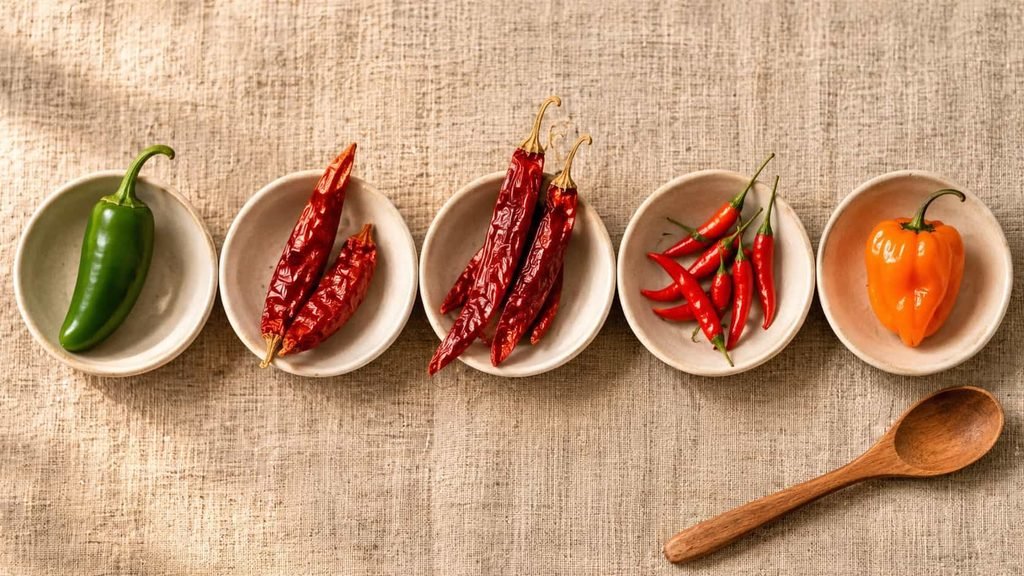
At the bottom rung, the jalapeño and the guajillo sit at 2,500 to 10,000 SHU. This is the friendly end, the place where a cook can be generous with a spoon. One rung up, Tabasco and cayenne climb to 25,000 to 50,000. Now the pot starts to notice you. Next comes the bird’s eye chilli, also called the Thai chilli, at 50,000 to 100,000. That is the answer to how hot a Thai chilli is: very, and not shy about it. Above it, the habanero and the Scotch bonnet reach 100,000 to 350,000, and way up at the top of this ladder the Red Savina habanero stretches from 350,000 to 750,000. 🔥
Now for the part you came for. Where does dried red chilli sit? The published pungency figures for the dried chillies in question come from their own product pages. The Dry Red Chilli (Long) page gives SHU of dried chilli as 30,000 to 45,000, which overlaps the Tabasco and cayenne rung, with the top end brushing the bottom of the bird’s eye band. The page for crushed red chilli flakes SHU reads 20,000 to 40,000, a little gentler, reaching down toward the jalapeño end of the cayenne rung. Flakes are generally a blend of heat and convenience, and the number tells you which way the blend leans.
The Dry Red Chilli main page lists the Dundicut round whole chilli at 55,000 to 65,000 SHU, which lands inside the bird’s eye range. And the Kunri Hybrid, with a product page figure of 80,000 to 100,000 SHU, sits at the upper edge of that same band, just under where the habanero begins. If you want the story behind that variety, there is a post on the Kunri Hybrid that covers it. Each of these numbers is attributed to the page it comes from, so check that page for the current figure before you rely on it. ✅
Is a cook in Qatar, Oman or Bahrain choosing between a gentle flake and a long whole chilli for a slow simmer? The ladder gives them a first answer without anyone needing to take a nervous taste test. 😄
Why one lot differs from the next, and how to read a heat figure 📋
Here is the twist that every honest spice buyer knows: SHU is not exact for every lot. Heat varies with season, variety and batch. The same field can give a slightly different result in a dry year than in a wet one, and two lots of the same named chilli can land at different points inside the same range. That is exactly why published figures arrive as ranges and not single numbers. A range is not a dodge. It is the truth, written in a form that survives contact with a real harvest. 🌾
So how do you read a heat figure on a spec sheet? Start with the unit. A number in SHU and a number in ASTA pungency units are not the same thing, and the conversion between them uses a multiplier that sources put at about 15 or 16. Then look at the range instead of fixating on one number, and check which lot or variety the figure describes. 🧐
One more trap deserves a mention: heat and colour are two different questions. A deep red chilli can be mild and a paler one can be fierce, and each answer comes from its own test. If you want the colour side of the story, the post on ASTA colour is the place to go. For the differences between the varieties themselves, you can learn more here.
So the next time a jar says “hot”, you now have a pharmacist, a lab and a ladder on your side. The jar becomes a range, the range becomes a rung and the rung tells you what to expect, whether you are cooking in Saudi Arabia, the UAE, Kuwait, Yemen or anywhere else. 🎉
If you buy dried chilli and want the published figures for the long, round whole, flakes or hybrid, you can contact Harmain Global through its contact page, which sets out the current ranges for each product. The company’s site is at https://harmainglobal.com. Ask for the figures, check the lot and enjoy knowing exactly how hot hot is. 🌶️