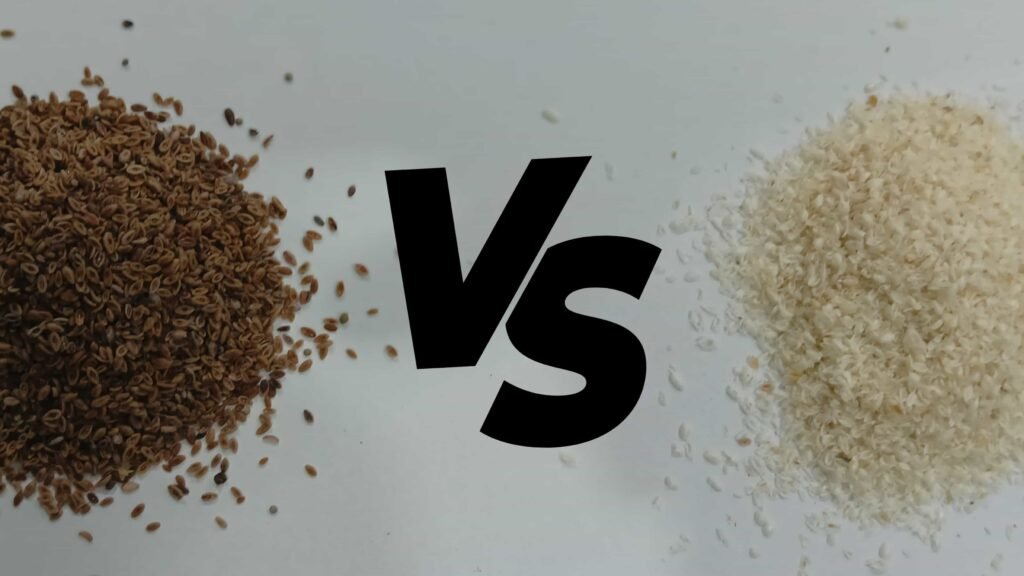
A large share of psyllium RFQs arrive with the same problem: the buyer searched “psyllium,” found a supplier, and requested a quote — without first working out whether they actually need whole seed, husk, or powder. These are three different commercial products, sold into three different buyer categories, at three different price points. Getting the format wrong doesn’t just cause a shipping delay — it can mean the material you receive is structurally unusable for what you’re trying to make.
Here’s how to sort that out before your first purchase order, not after.
| Feature | Psyllium Seed | Psyllium Husk |
|---|---|---|
| What it is | Whole, intact seed as harvested | Outer seed coat, mechanically separated from the seed |
| Fiber type | Mix of soluble and insoluble fiber | Almost entirely soluble fiber (mucilage) |
| Processing level | Raw / minimally processed | Processed — separated, cleaned, graded |
| Typical form sold | Whole seed | Husk (whole flake) or milled powder |
| Main buyers | Milling operations, pharma seed prep, Ayurvedic/Unani formulators, animal feed | Supplement brands, fiber product manufacturers, pharmaceutical bulk-forming laxative producers |
| Price position | Lower cost, raw input | Higher cost — processed, yield-reduced output of the seed |
| Common grading | Sortex purity %, moisture % | Purity grade (95%, 98%, 99%), swell volume/viscosity |
| Consumed directly? | Rarely — usually processed or milled first | Yes — the standard fiber-supplement form |
Seed, Husk, and Powder Are Not Interchangeable
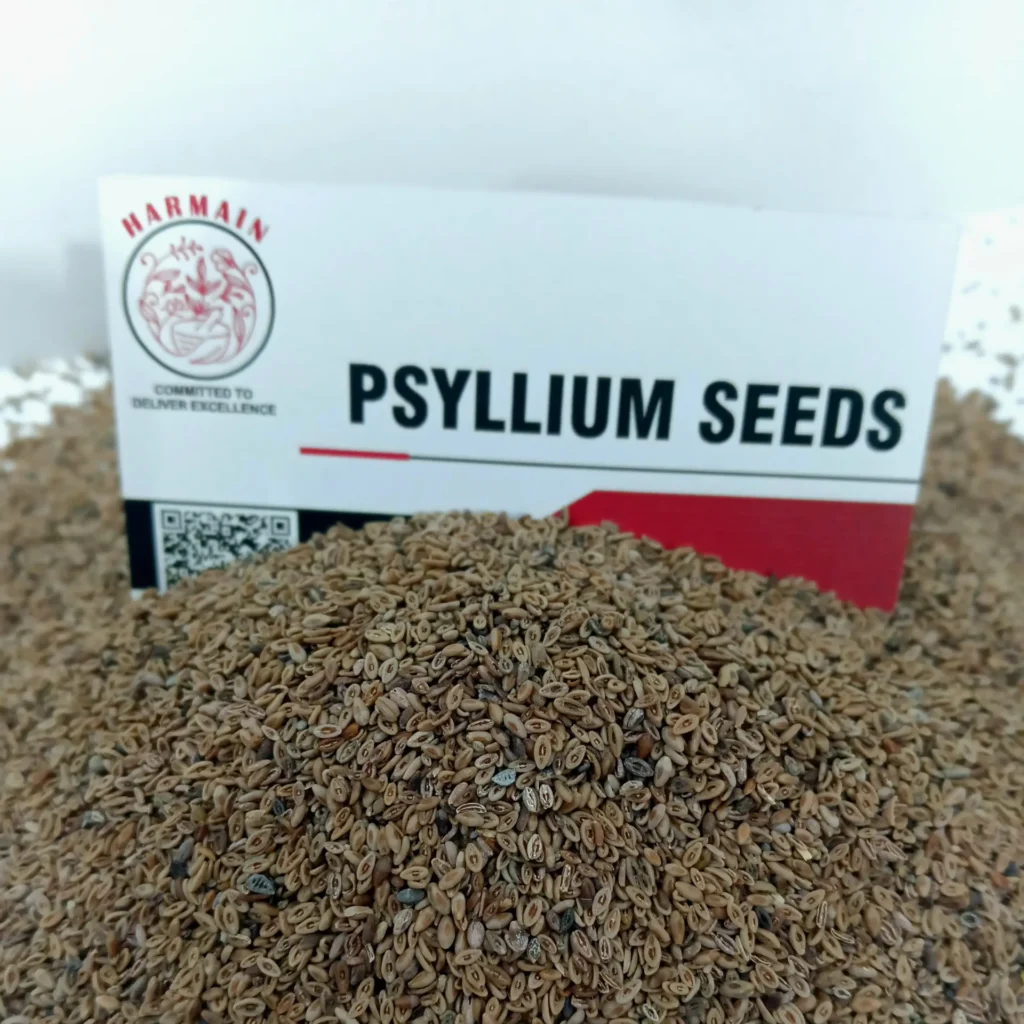
Whole psyllium seed (Plantago ovata) is the raw agricultural commodity — the intact seed as harvested, before any husk separation. Buyers who need whole seed include pharmaceutical companies running their own seed preparations, Ayurvedic and Unani formulators working with traditional whole-seed processing, animal nutrition manufacturers, and — critically — husk milling operations that buy seed specifically to process it themselves.
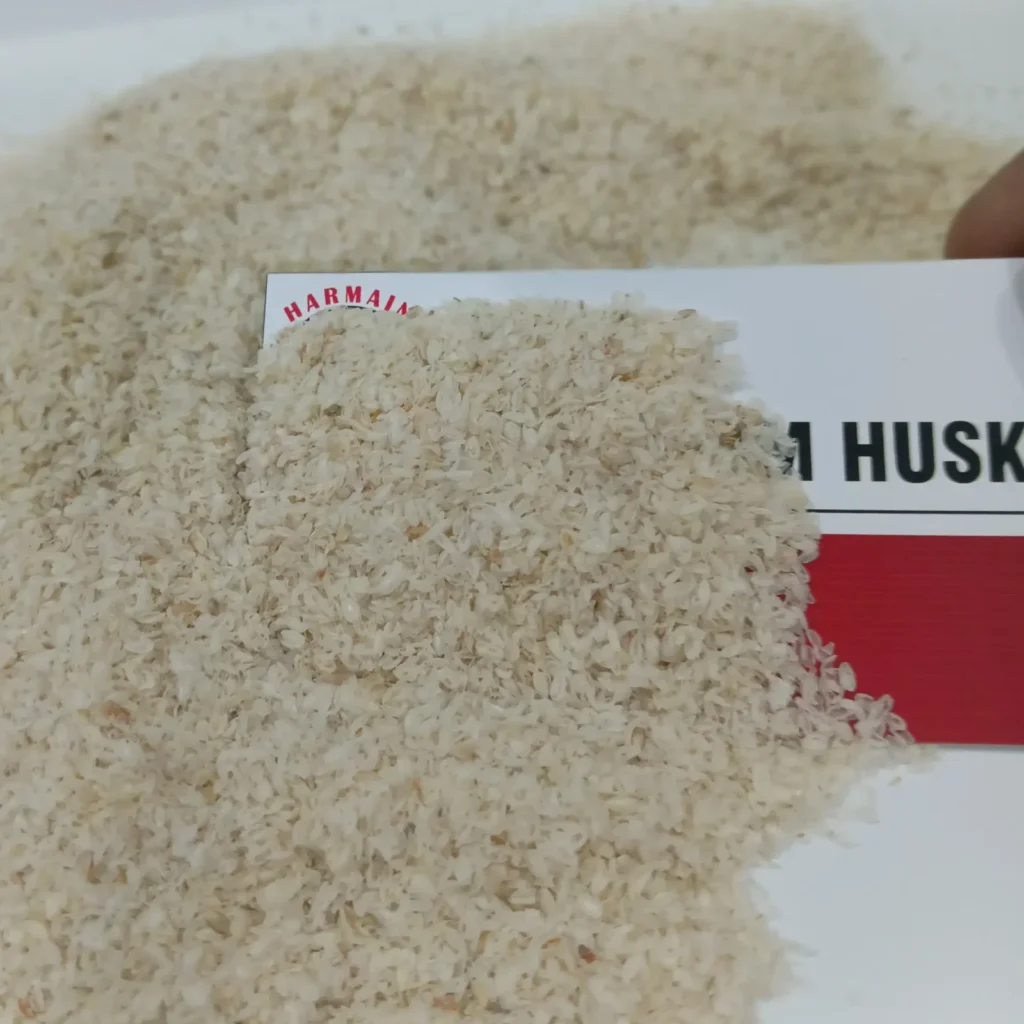
Psyllium husk is the outer seed coat, mechanically separated from the seed’s inner endosperm and embryo. This is the fraction that carries the mucilage — the soluble fiber that gives psyllium its functional value in supplements, fiber products, and pharmaceutical bulk-forming laxatives. Husk is what most supplement brands and fiber product manufacturers actually want, and it’s sold by husk purity grade (commonly referenced as 95%, 98%, or 99% purity, depending on residual seed particle content).
Psyllium powder is milled husk, ground to a finer particle size for easier incorporation into capsules, drink mixes, and food applications. It’s functionally the same material as husk in terms of mucilage content, but the particle size and handling characteristics differ, which matters for buyers running automated capsule-filling or blending lines.
The mistake importers make most often is requesting a quote for “psyllium” generically, getting a seed price back, and being confused when it doesn’t match the husk price they saw quoted elsewhere. These are not comparable numbers — seed is the raw input; husk is a processed, yield-reduced output of that input, and it costs more per kilo for good reason.
This traces back to fiber composition itself: whole seed contains both soluble and insoluble fiber plus the seed’s natural oil, while husk — once separated from the endosperm and embryo — is almost entirely soluble fiber (mucilage). That’s the functional property fiber supplements and pharmaceutical bulk-forming products are built around, which is why husk, not whole seed, is the format used in nearly all consumer-facing fiber products.
Why Whole Seed and Husk Buyers Should Never Compare Prices Directly
This is the single most common pricing confusion in psyllium sourcing. Husk yield from whole seed typically runs in a defined range depending on seed quality and milling efficiency — meaning it takes meaningfully more than one kilo of raw seed to produce one kilo of husk. A husk buyer comparing a seed quote to a husk quote and concluding the seed supplier is “cheaper” is comparing two different points in the supply chain, not two prices for the same product.
If you’re a husk buyer, your relevant comparison is husk-to-husk pricing at a matched purity grade. If you’re a milling operation buying seed to process yourself, your comparison is seed-to-seed pricing plus your own milling cost and yield loss — and you need to model that yield loss accurately before assuming self-milling is cheaper than buying finished husk directly.
Seed Purity and Sortex Grading
For psyllium seeds intended for husk milling, pharmaceutical seed preparations, or direct planting stock, seed purity is the first quality gate. Commercial-grade seed is Sortex-graded — passed through optical sorting equipment that removes foreign matter, discolored seeds, broken seed, and other crop contaminants based on color and size differentiation. Sortex grading is what separates export-grade seed from field-run seed that still carries chaff, stones, and off-type material.
For milling operations specifically, seed purity has a direct downstream effect: contaminated or inconsistent input seed produces lower, less consistent husk yield and can compromise husk color and purity grade in the finished product. If you’re buying seed to mill husk yourself, ask for the Sortex purity specification and moisture content — not just a general purity percentage — before committing to volume.
Moisture Control and Mucilage Integrity
Moisture content is the variable that determines shelf stability and, for husk specifically, mucilage performance. Psyllium husk’s functional value comes entirely from its mucilage — the substance that swells and gels on contact with water. That mucilage is sensitive to storage conditions; excess moisture in the husk promotes microbial activity, clumping, and gradual degradation of gelling capacity over time.
Export-grade psyllium, whether seed or husk, should carry a moisture specification in the range processors expect for stable long-term storage, verified on the certificate of analysis rather than taken on trust. For husk buyers specifically, ask your supplier for a swell volume or viscosity indicator alongside moisture — this is the closest proxy available for confirming mucilage integrity has been preserved through processing and storage, rather than relying on moisture percentage alone as a stand-in for functional quality.
What Your CoA Should Actually Contain
A generic certificate of analysis that lists only “psyllium husk, good quality” tells a buyer almost nothing. A CoA worth basing a purchase decision on should specify, at minimum: purity percentage (with the testing method referenced), moisture content, foreign matter percentage, and — for husk specifically — a swell volume or viscosity figure. If you’re buying seed for milling, germination rate and seed size uniformity are additional data points worth requesting, since both affect your own downstream yield.
The Documentation Stack Beyond the CoA
Psyllium is a regulated agricultural export, and the CoA is only one piece of the paperwork that should accompany a compliant shipment:
- Phytosanitary certificate — confirms the shipment is free from regulated pests and meets the plant health import requirements of the destination country. Most destination customs authorities will not clear an agricultural seed or husk shipment without this document.
- Certificate of origin — issued through Pakistan’s Chamber of Commerce, confirming Pakistani origin. This matters both for customs clearance and for buyers who need to substantiate origin claims on their own product labeling.
- Pesticide residue report — increasingly requested by pharmaceutical buyers, EU importers, and supplement brands operating under stricter regulatory frameworks. This report confirms residue levels are within the destination market’s permitted thresholds, tested against a defined pesticide panel rather than a general statement of compliance.
A supplier who can produce all four documents — CoA, phytosanitary certificate, certificate of origin, and pesticide residue report — as a matter of routine, rather than after being asked repeatedly, is generally a signal that their export operation is set up for regulated markets rather than commodity trading alone.
Matching the Format to Your Actual Use Case
Before sending an RFQ, it’s worth answering one question honestly: are you buying an ingredient to process, or a finished ingredient to formulate with directly? Milling operations, pharmaceutical seed-preparation manufacturers, and Ayurvedic/Unani producers working with traditional seed-based formulations need psyllium seeds. Supplement brands, fiber product manufacturers, and pharmaceutical bulk-forming laxative producers need psyllium husk — and should specify purity grade and particle form (husk vs. powder) at the RFQ stage, not after receiving a sample that doesn’t match their production line.
Getting this right at the RFQ stage saves a round-trip of sample requests and pricing confusion, and it means the quote you receive is actually comparable to the one you’re benchmarking it against. For a full view of how documentation moves alongside the shipment itself, see our export documentation process.
FAQs
Is psyllium husk better than psyllium seed?
Neither is “better” — they serve different purposes. Husk is the concentrated soluble-fiber fraction used in supplements and pharmaceutical products. Whole seed is the raw input used for milling, traditional formulations, and animal feed.
Can psyllium seeds be used instead of husk?
Not directly for most fiber-supplement applications. Whole seed has a different fiber composition and isn’t typically formulated the same way husk is — it’s generally an input to be milled or processed, not a drop-in substitute.
Why is psyllium husk more expensive than psyllium seed?
Husk is a processed, yield-reduced output of seed — it takes more than a kilo of raw seed to produce a kilo of finished husk.
What purity grade should I request for psyllium husk?
Common commercial grades are 95%, 98%, and 99%, based on residual seed particle content. Pharmaceutical and premium supplement buyers typically require the higher end.
What documents should accompany a bulk psyllium shipment?
At minimum: a CoA (purity, moisture, foreign matter, swell volume/viscosity for husk), a phytosanitary certificate, a certificate of origin, and increasingly a pesticide residue report.