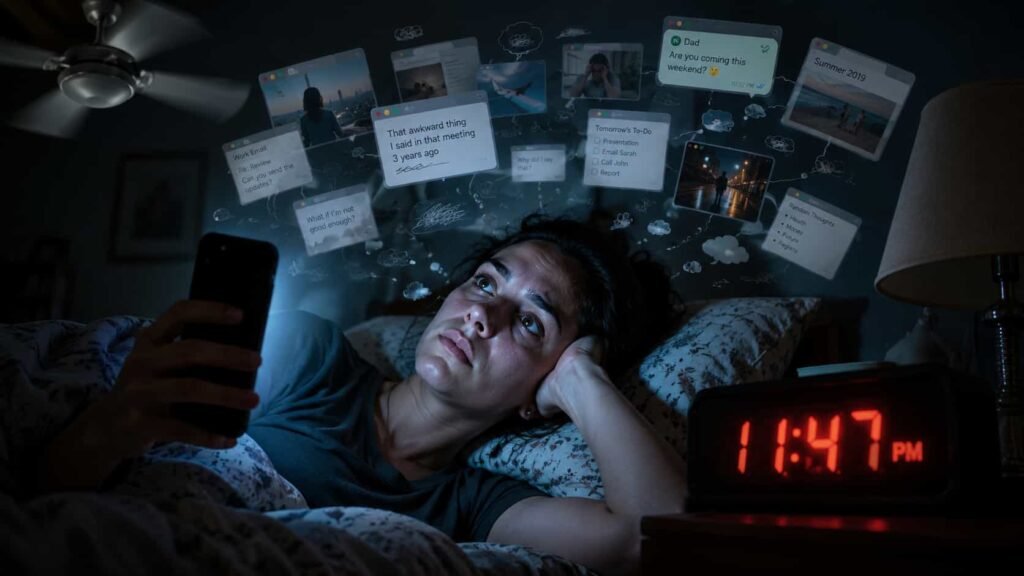
It’s 11:47 PM. You’ve Been Tired Since 8.
You’re lying there, phone glowing in one hand, eyes dry, neck stiff, the kind of tired that should mean unconscious in three minutes flat. But your brain? Your mind has opened roughly nineteen tabs and decided that now is the ideal moment to rehash that mildly uncomfortable thing you said at your job three years ago.
The ceiling fan is spinning. You are not sleeping.
This situation happens so frequently that it almost seems like a design defect of the human body. You’re clearly tired. Your eyes are basically sandpaper. Your thoughts are slow and draggy. And yet something is keeping you wide awake in that strange, buzzing, low-level alertness that refuses to switch off.
You are not broken. But your signals are crossed — and understanding why can change how your evenings actually feel.
Sleep Is Not a Switch. It’s a Conversation.
The first thing worth knowing: your body does not go to sleep because you decided to. It goes to sleep because you gave it such continuous and unwavering messages that sleep was the right thing to do..
This is much less like flipping a light switch and more like doing your best to lure a skittish cat into your lap. You can’t force it. You have to make it feel both safe and natural.
These conditions are: real darkness/dim light; cooler body temperature; slower breathing; decreased stimulation; less food in the stomach (lighter foods); and hopefully a reproducible pattern of evening activities that your body identifies as signalling time to transition into rest mode.
According to the Sleep Foundation and wider sleep-health literature, the circadian rhythm responds strongly to environmental and behavioural cues — not just to how physically tired you feel. Light, food timing, activity, and temperature all play a role. Read more at the NIH.
The Tired-But-Wired Problem
The frustrating paradox: you can feel profoundly, deeply worn out, and still be completely incapable of going to sleep. The reason for that is that tiredness and sleepiness are totally different phenomena.
Tiredness is physical depletion — low energy, sore muscles, sluggish thinking. Sleepiness is the body’s biological readiness to enter sleep. You can have the first without the second.
What keeps the second one away? A few very familiar culprits.
1. Screens and the Blue Light Problem
Phone screen, laptop screen, TV screen — all these screens emit a light in the blue spectrum which signals the brain to suppress melatonin, the hormone that tells your body it is time to sleep. To put it another way, that glowing rectangle in your hand has literally been fooling your nervous system into believing that it is daytime.
This is not a design flaw in your phone. It was optimised for engagement, not for sleep. Using it right up until bedtime is a bit like asking your body to run a race and then immediately asking it to nap.
The Harvard Health Blog has written clearly about screen light and melatonin suppression — it’s worth reading if you want the full picture. See Harvard Health here.
2. Caffeine Has Terrible Timing
The half-life of caffeine is about five or six hours. The 3 PM coffee you drank then was still nearly half alive in your blood system at just after 9 PM. The 5 PM Coffee — still alive and kicking at midnight.
This does not mean caffeine is the enemy. It means timing matters enormously. Many people who struggle with the tired but can’t sleep loop simply have caffeine in their system far later than they realise. Switching to a warm, caffeine-free drink after lunch — a simple herbal blend, a mild floral tea — is one of the easiest adjustments with one of the fastest payoffs.
3. Stress Hormones Do Not Respect Your Schedule
Stress triggers cortisol, the alert hormone. Especially helpful if you have to get something done for a deadline or are approaching someone with whom it is difficult to hold a conversation. But when you want to lie down and stop the mind from being conscious it is not helpful.
The real issue is that cortisol does not switch off just because the stressful experience has ended. Your cortisol is raised way beyond the point that your eyes were starting to droop if you spent your evening doom scrolling or in a heated WhatsApp group chat, watching something heavy and doing the old replay of worries over and over.
Mental fatigue is not the same as physiological calm.
4. What You Ate and When
If you have eaten a big, heavy meal too close to sleeping, your digestive tract is still working when you really want your body to be shutting down. Blood is diverted to digestion. Your internal temperature rises slightly. When you want silence, the entire system is active.
That does not mean you should go to bed hungry. Yet a lighter dinner, eaten some hours before sleep definitely helps the body slow down.
Evening Cues That Actually Work
The best thing you can do is create a routine that sends signals as often as possible to the body. Not a complicated ritual. Not an Instagram-perfect wind-down. A series of little repetitive movements that your body begins to identify as the prep for sleep.
This is what that might look like in practice.
Dim the Lights
About an hour before bed, drop the overhead lights. Use lamps instead. Warm-toned bulbs rather than cool white. This is genuinely one of the simplest and most effective things you can do. Darkness tells the body to increase melatonin production. You are not meditating. You are just making your living room a little less like a surgery ward.
Put the Phone Somewhere Boring
Face-down, in another room, on a shelf — whatever works. The goal is to remove it from the decision loop for at least 30 minutes before bed. If this feels impossible, start with 15. The point is not perfection. The point is a small, consistent reduction in stimulation at a time when your nervous system is trying to downshift.
Make Something Warm and Caffeine-Free
This might be chamomile. It might be a mild floral herbal blend. It might involve a handful of traditional botanicals for evening rituals that you have come to associate with the end of the day. The drink itself matters less than the act — the kettle boiling, the steam, the warmth in your hands. The body starts to recognise the cue.
Avoid: anything with caffeine. Avoid: strong flavours that stimulate digestion. Choose ingredients that feel calm and familiar.
A Simple Skincare Ritual as a Transition Cue
The skin is the body’s largest organ, and caring for it before sleep can function as a very effective transition ritual — not because of what any product does to your face, but because of what the process does to your pace.
A gentle cleanse with a few drops of pure rose water — patted gently on the face after washing — is something many people include in their evening routine for its light, calming scent and skin-refreshing properties. It does not treat anything. It does not promise anything. It is simply a sensory moment that belongs to the end of the day, not the beginning.
A couple of dry rose petals on the bedside — just for smell, just for the softness. The reason is that the nose is one of the Direct routes into our nervous systems. However over time a familiar, soft fragrance that we associate with downtime can essentially ease us into those winding-down moments.
Natural Oils – An Evening Ritual
Others use a dab of natural oils — rubbed into pulse points, mixed with bath water or diffused in the room — before bed. A simple guide to calming ingredients can help you figure out what fits your routine, your skin, and your preferences without overcomplicating things.
Sleep Starts Earlier Than You Think
Here is the most important reframe: bedtime is not the moment sleep begins. Sleep begins with the signals you send two or three hours earlier.
The caffeine you did or didn’t drink at 4 PM. The lights you did or didn’t dim at 9 PM. The phone you did or didn’t put down at 10 PM. The heavy dinner you did or didn’t eat at 8 PM. The warm drink you did or didn’t make at 10:30 PM.
Sleep is not a reward you collect at the end of a busy evening. It is a biological state the body moves toward gradually, and it needs help getting there. A steadier routine can include clean sensory ingredients for wellness brands and individual routines alike — simple, recognisable botanicals that have been part of evening rituals for generations in many parts of the world.
Whether it is a warm cup of something herbal, a quiet skincare moment, or simply turning your phone face-down and sitting in a dimly lit room for ten minutes — the ritual matters because repetition matters. And repetition, over time, becomes the signal.
A Simple Evening Wind-Down Routine
Step 1 — Around 2 PM: Cut the Caffeine
Swap the afternoon coffee for a caffeine-free herbal drink. Your future 11 PM self will thank your 2 PM self for this decision.
Step 2 — About 1 Hour Before Bed: Dim the Lights
Lamps on. Overhead off. Warm light only. The body clock responds to this faster than most people expect.
Step 3 — 30 to 60 Minutes Before Bed: Phone Away
Not on silent. Not face-down on the pillow. Ideally, in another room, or at least out of your direct reach. If you use it as an alarm, consider a cheap alarm clock.
Step 4 — Make a Warm, Caffeine-Free Drink
Chamomile, a mild herbal blend, or a simple preparation using herbs and botanicals you enjoy. Hold it. Drink it slowly. Give yourself permission to just exist for a few minutes.
Step 5 — Simple Skincare
Wash your face. Pat dry. Use a gentle skincare routine if that fits your habit — something light, something that signals end-of-day. Then lie down.
Step 6 — Lie Down at the Same Time
The body clock loves repetition. You do not have to be asleep at the same time every night, but lying down in the same window trains the system more than almost anything else.
When Is It More Than a Habit Problem?
The majority of nights with bad sleep are attributable to habit and improve with changes in your behaviour. However if you have felt like this for weeks, the fatigue is affecting your job or relationships, or other symptoms are present — such as breathing difficulties while sleeping, persistent anxiety or low mood — it may be time to visit your doctor. The NHS offers straightforward advice on when sleep problems require professional support. Establishing a routine can benefit many – but is not a replacement for medical assistance in situations that truly require it. The Mayo Clinic provides additional context about sleep hygiene and when to seek care.
The Bottom Line
Your mind is tired because it has worked hard. Your body is awake because the signals have not told it otherwise yet.
That is fixable. Not with one perfect product, not with a strict 47-step protocol, not with a wellness influencer’s bedtime routine you will never actually maintain. With small, consistent, sensory cues that tell your nervous system the same thing, evening after evening: the day is done. You are safe. It is time to stop.
Simple ingredients. Simple rituals. Consistent timing. If you are curious about the quality of what goes into your evening routine — from botanicals to rose ingredients to dried herbs — Harmain Global works with natural ingredient sourcing for wellness brands, food producers, and retailers who care about what goes into their products.
You can explore our range at https://harmainglobal.com/
Disclaimer
For information purposes only This is not medical advice, and never should it be relied on to diagnose, treat or cure any condition — especially sleep disorders. If you suffer from a health issue or are on medication, please always consult a qualified health professional before making any changes. Individual results vary.