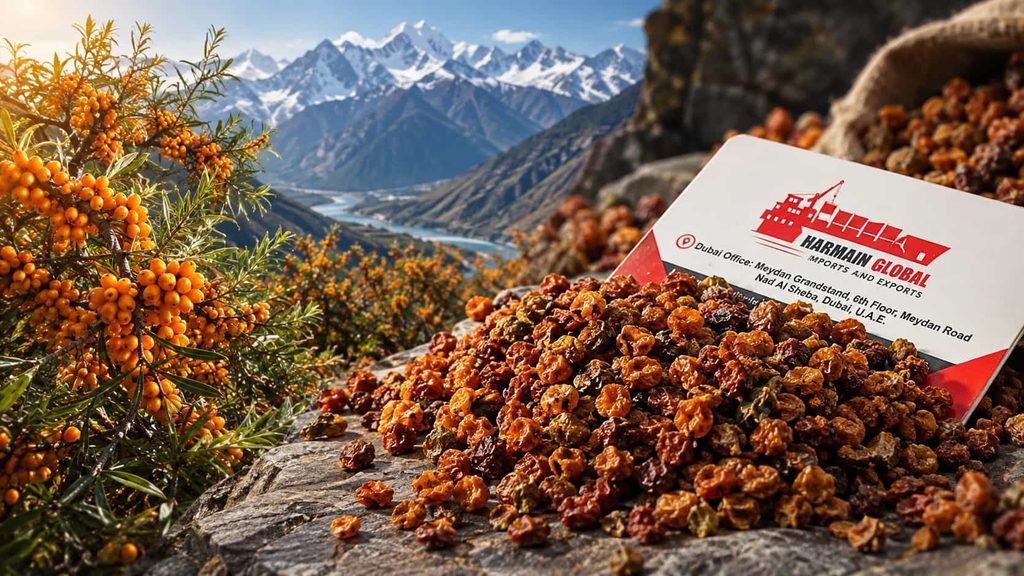
In parts of Gilgit-Baltistan, a berry that sells in Europe for real money gets burned for heat instead, and honestly, once you understand the economics behind that choice, it makes perfect sense to the household making it, even if it makes zero sense to anyone tracking global superfruit demand. This is the strange, slightly maddening story of sea buckthorn Pakistan holds an enormous amount of and does almost nothing commercial with, and if you buy raw botanical ingredients for a living, this is exactly the kind of gap worth paying attention to before everyone else notices it too 🔥
The scale of the resource, and it is genuinely a lot bigger than most people assume
Research and government surveys on the region put the numbers at more than 12 million wild sea buckthorn plants spread across roughly 5,700 hectares of Gilgit-Baltistan, a figure that consistently shows up across independent reporting and field studies on the area rather than being anyone’s marketing estimate. And here is the part that should make any ingredient buyer sit up. Of that entire wild resource, only a small fraction actually gets harvested each year, with reporting on the region putting unharvested waste as high as roughly 95 percent. That is not a rounding error, that is nearly the entire commercial value of a wild superfruit population sitting untouched year after year. To put a number on what even partial development could mean, one regional study area alone was found to produce close to 6,000 metric tonnes of fresh berries annually, with researchers estimating that better management could multiply that output several times over and generate tens of millions of dollars in additional value for the region. This is not a hypothetical resource that might exist somewhere. It is standing on hillsides right now, mostly unharvested, mostly unmonetized.
Why it has stayed this underutilized for so long
The honest answer has nothing to do with the plant and everything to do with market structure. Sea buckthorn Gilgit-Baltistan collectors have historically been paid very little for their harvest, with documented farmgate prices sitting at roughly two US dollars per kilogram or less in field research on the region, a price that barely justifies the labor of hand harvesting thorny bushes on a mountain slope. Add to that a lack of coordinated market access, meaning individual households have no reliable buyer, no price floor, and no aggregation infrastructure connecting them efficiently to processors or exporters, and you get exactly the outcome you would expect. Rational households facing low, unpredictable prices for a labor intensive harvest simply do not prioritize it, especially when the same plant already serves a reliable, zero market risk purpose right where it grows.
What it is actually used for right now, versus what it could become
And that brings us to the slightly painful part of this story. In its current underutilized state, sea buckthorn in mountainous parts of Gilgit-Baltistan gets used primarily as firewood for cooking and heating, as informal animal feed, and as fencing material to mark and protect land boundaries. All three of those are genuinely useful local functions, and nobody should treat rural households as making an irrational choice when reliable heat and functional fencing beat an uncertain harvest income. But the opportunity cost is enormous when you consider that the exact same plant, harvested, dried properly, and channeled into export markets, is the raw material behind a growing global category of nutraceutical and cosmetic products built around omega-7 and antioxidant content. The plant has not changed. What changes everything is whether there is a functioning, fairly priced channel connecting the mountainside to the buyer who actually wants it.
What other countries did with the exact same plant
This is where a little international context is genuinely useful, not as a claim that Pakistan should copy anyone else’s playbook, but as a reminder that this underutilization is a solvable problem elsewhere has already solved to different degrees. China took the industrial route decades ago, expanding organized sea buckthorn cultivation from roughly 667,000 hectares in the mid 1980s to about a million hectares by 1990, and has remained the world’s largest producer of sea buckthorn products ever since, built on sustained government backed cultivation and processing investment. Mongolia has followed a similarly organized, if smaller scale, path, leaning on the plant’s usefulness for soil stabilization alongside its commercial fruit value. India’s Ladakh region took a different but equally instructive route, and the timeline there is worth sitting with for a moment. Organized berry collection in Ladakh only really got underway around 2001, when a Defence Research and Development Organisation laboratory in Leh developed processing technology that turned the wild, sour, highly perishable berry into something with genuine shelf stable commercial value. That technology got licensed out to processors over the following years, entrepreneurs built local businesses around juices, chutneys, and capsules under names like Leh Berry, and by 2023 the region had earned a formal Geographical Indication tag for its sea buckthorn, essentially two decades from disorganized wild harvest to a nationally recognized, protected superfruit brand. Pakistan is starting this conversation later than all three of these, but the Ladakh timeline in particular shows that two decades is a realistic window for a wild, underutilized resource to become a genuine branded export category, not an impossibly distant fantasy.
Why global demand makes this a meaningful moment specifically now
None of this would matter as urgently if global demand for the plant’s key compounds were flat, but it is not. Growing interest in omega-7 and palmitoleic acid as a rare, largely plant sourced fatty acid for cosmetic and nutraceutical formulation, combined with continued broader interest in natural antioxidant superfruits generally, means ingredient buyers are actively searching for new, credible origin countries rather than relying on a small handful of established suppliers. That is genuinely useful timing for a Pakistan superfruit export opportunity this large and this underdeveloped, because the demand side of this equation is already growing, and what has been missing on the supply side is not the raw plant material, it is the organized channel connecting it to buyers who want it.
What responsible development of this resource would actually require
Getting from where Pakistan’s sea buckthorn resource sits today to something closer to Ladakh’s trajectory would require a few specific, unglamorous things done properly rather than any single dramatic breakthrough. Real drying infrastructure that moves collection away from inconsistent open sun drying and toward more controlled processing that preserves nutrient quality. Actual quality standards and grading so that buyers know what they are getting lot to lot rather than treating every bag of dried berries as identical. And fair, transparent pricing to collectors that reflects the real value their harvest carries once it reaches an export market, rather than pricing set by whoever happens to be the only buyer within reach of a given valley. None of these are exotic requirements. They are exactly the kind of infrastructure and market development work that turned Ladakh’s wild berry into a Geographical Indication protected export category, and there is no obvious reason Gilgit-Baltistan could not follow a comparable path with the right investment and the right buyers willing to engage seriously with the region rather than just its lowest available price.
Harmain Global has been exporting agricultural and botanical raw materials out of Pakistan since 1985, working across dry fruits, herbs, seeds, and botanicals for B2B buyers in the Gulf, EU, UK, USA, China, and South Korea. Building a genuine, fairly structured export channel for an overlooked resource like wild sea buckthorn resource Pakistan holds in such abundance is exactly the kind of long-term sourcing work worth doing properly rather than rushing, and it starts with treating collectors, quality standards, and buyer transparency as the actual foundation rather than an afterthought. If you are researching untapped botanical export Pakistan opportunities or looking for a sea buckthorn sourcing partner willing to have a direct conversation about origin, harvest practices, and current development stage rather than an overpolished sales pitch, that conversation is worth having now while this resource is still genuinely underexplored by most international buyers. Reach out to a verified sea buckthorn exporter Pakistan buyers can ask real questions of, check this out alongside the rest of the dry fruit and botanical catalog, or learn more here about how HarmainGlobal.com is approaching sourcing from this region before the opportunity gets a lot more crowded than it is today.