Dry Red Rose - Bulk Export
Wild-harvested and farm-grown Rosa damascena and red rose varieties from Sindh, Multan, Khanewal, and Pakpattan — Pakistan’s rose belt. Food-grade petals, premium rose buds, whole dried flowers, and steam-distilled rose water. Calyx-free option available. ISO 22000 · Halal. MOQ 100 kg. FOB Karachi.
Pakistan's Rose Belt — Sindh, Multan, Khanewal & Pakpattan
Pakistan’s dried red rose export is concentrated in Sindh & southern and central Punjab — the districts of Multan, Khanewal, Pakpattan, Vehari, and the Tibba Sultanpur market area — where generations of farming families have cultivated dark red rose varieties under conditions that produce the deep crimson colour and natural fragrance that international buyers specifically seek. The primary harvest runs from late March through May, with the majority of annual production concentrated in April — a tight window that demands fast post-harvest handling to preserve colour and aroma before enzymatic degradation begins.
Harmain Global has sourced directly from these farming communities since 1985. Our dry red rose export range covers four distinct product forms — dried rose petals, dried rose buds, whole dried rose flowers, and rose water — across three quality grades (food, cosmetic, and decorative) with full third-party testing, proper documentation, and accurate HS classification per shipment.
The research is clear: Pakistani dried red rose has a genuine commercial opportunity but only when treated as a documented, cleaned, and tested botanical ingredient — not as an undifferentiated commodity. The premium comes from calyx-free petal separation, controlled drying that preserves colour and fragrance, batch-traceable testing, and the kind of consistent quality that makes buyers in South Korea, UAE, and Europe return order after order. That is precisely what Harmain Global delivers.
- Rosa damascena — Verified
- Calyx-Free Option Available
- Organic Available
- Halal Certified
- Multan · Khanewal · Pakpattan
- Controlled Drying
- Private Label / OEM
- Amazon FBA Ready
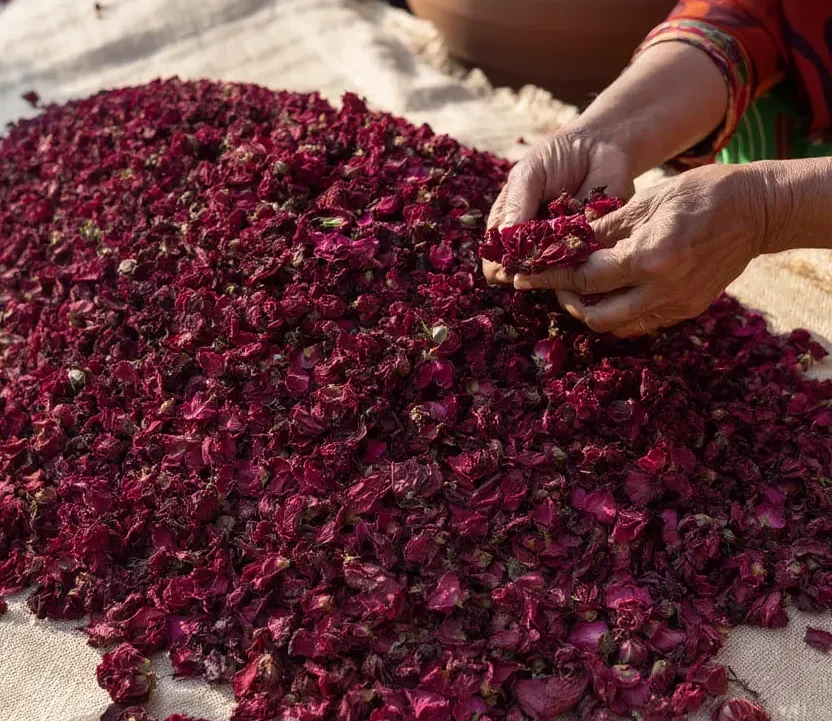
Red Rose Product Range
 Quick View
 Quick View
 Quick View
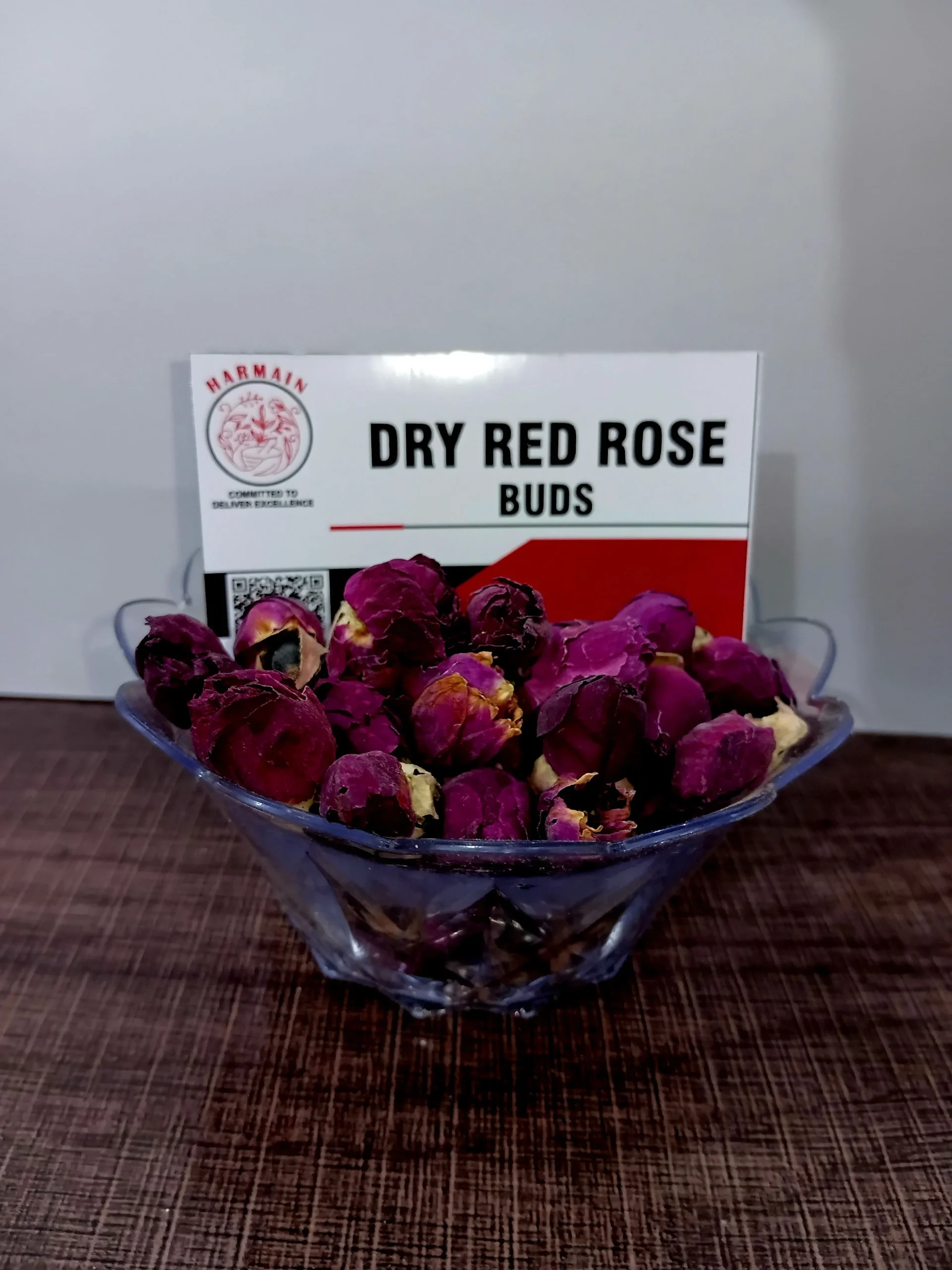
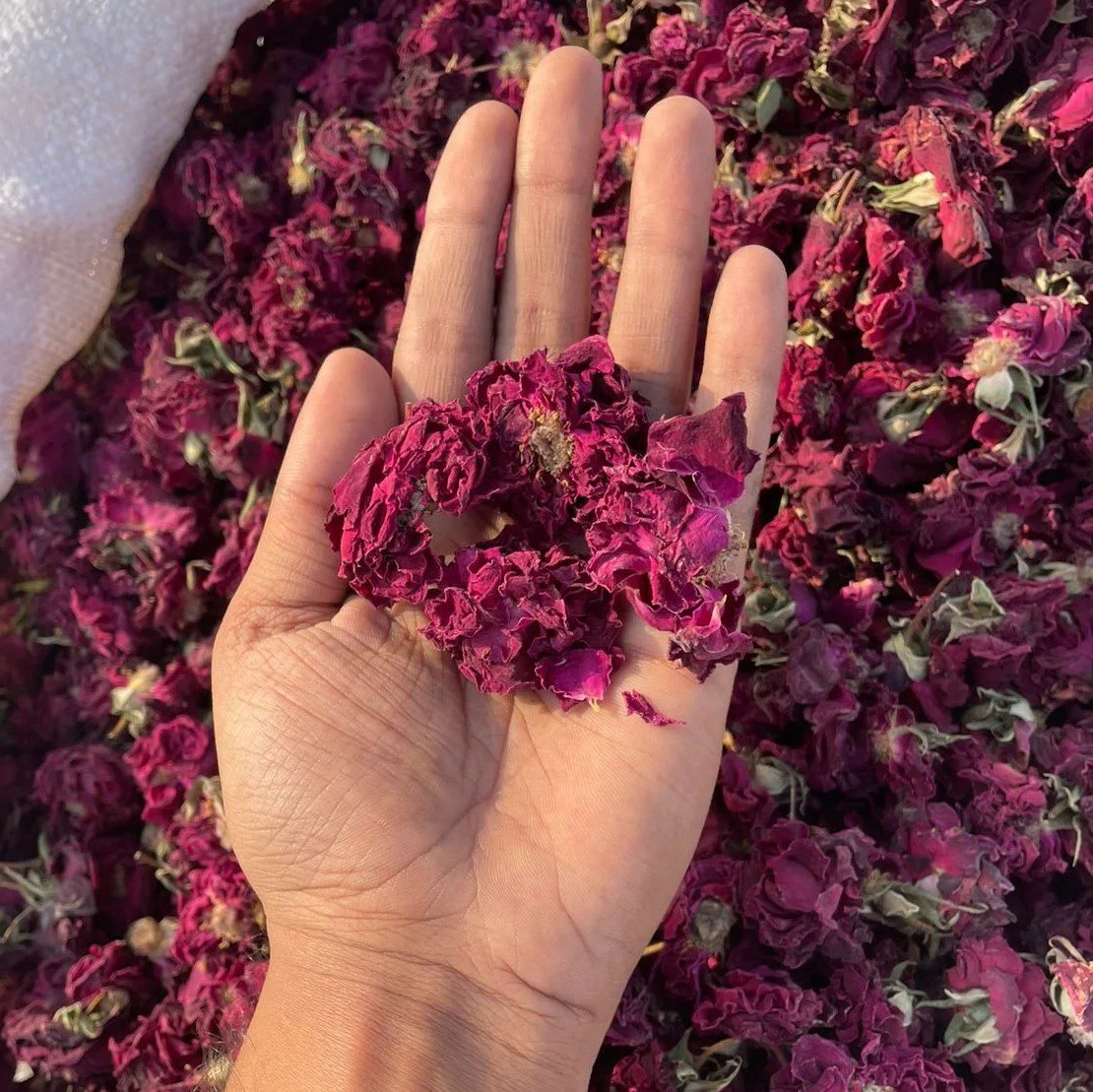
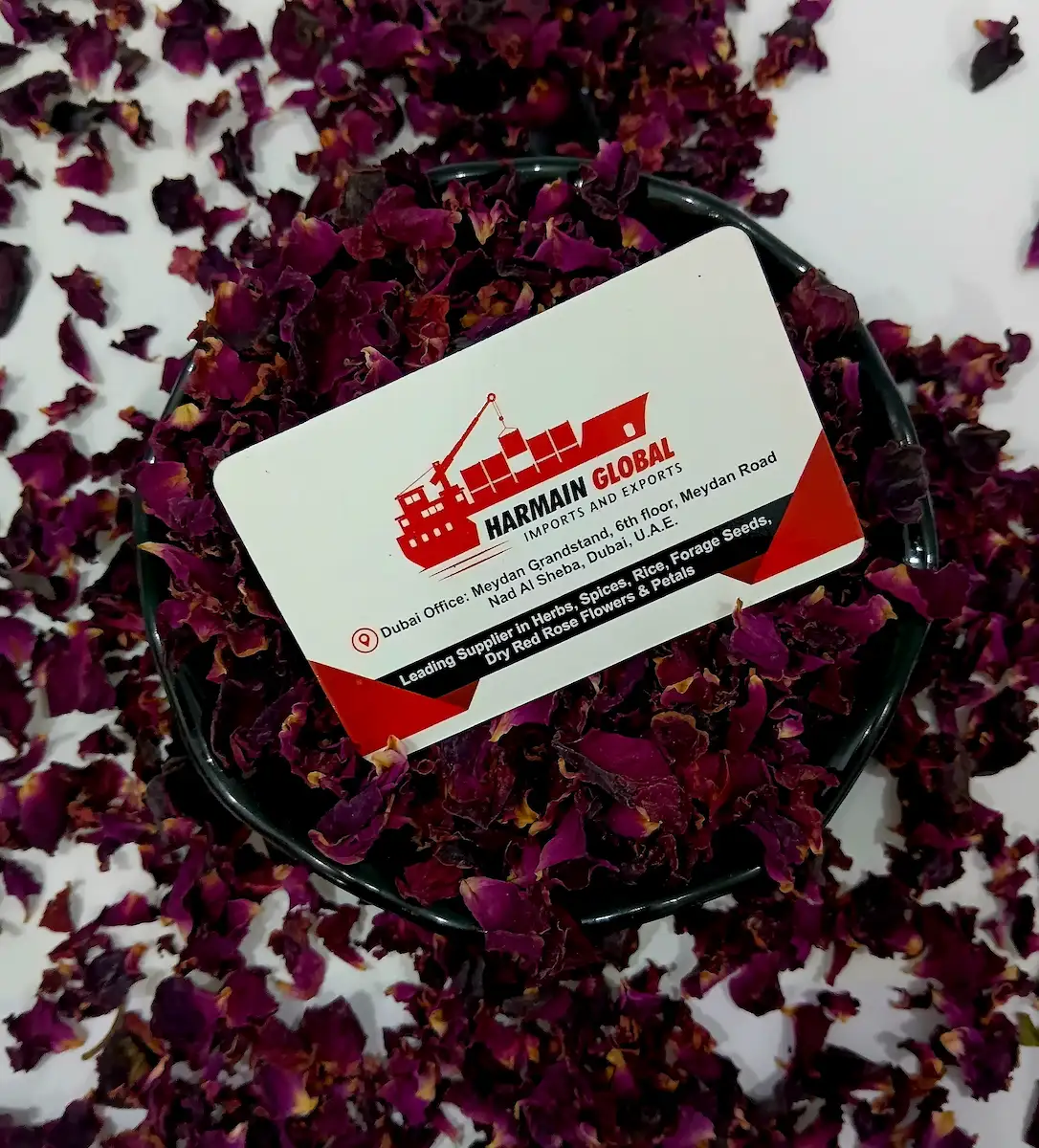
Red Rose Water
 Quick View
- Quick View
 Quick View


– Quality Grades
Three Grades — Food, Cosmetic & Decorative
The research is explicit: florist roses must never automatically be treated as edible — ornamental flowers may be sprayed with pesticides not approved for food crops. Correct grade classification protects both buyer and exporter legally and commercially.
Food-Grade Rose Petals & Buds
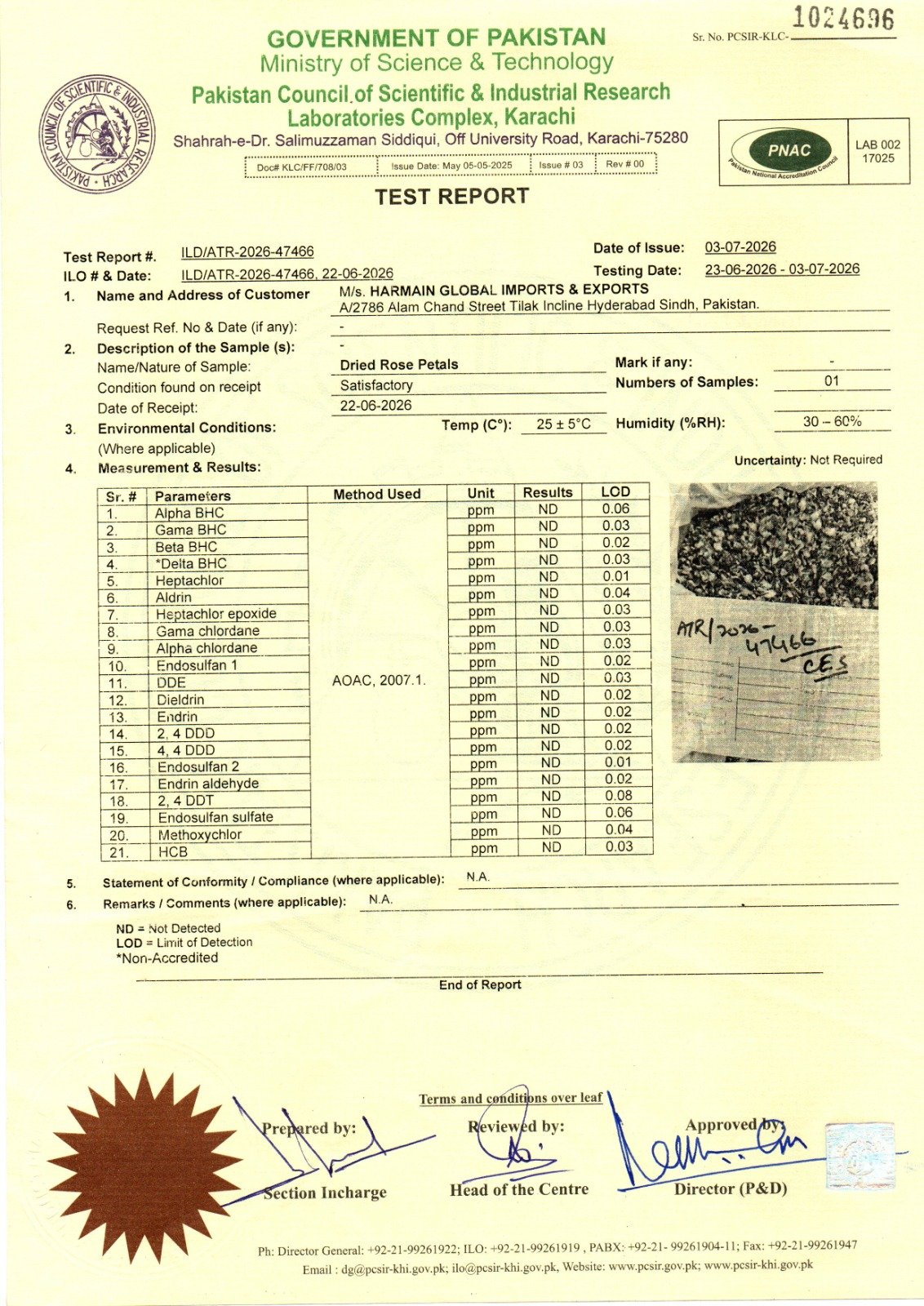
Grown and handled for food use from farm level. Multi-residue pesticide testing to destination MRL. Microbial safety tested (Salmonella absent, E.coli absent, TPC, yeast & mould). Heavy metals tested. No sulphites, no synthetic colour. Moisture ≤10% (food-grade tight). HACCP-compliant processing. Full food-safety CoA from SGS or Bureau Veritas. Required documentation: food-facility registration, phytosanitary, CoA, food-grade statement. For herbal teas, confectionery, bakery decoration, culinary garnish, and food and beverage formulation.
Cosmetic-Grade Petals & Powder
Prioritises colour and aroma alongside safety testing. Heavy metals (Pb, Cd, As, Hg) tested and documented — required for cosmetic buyers following EU Cosmetics Regulation (EC) 1223/2009 and similar standards. Microbial load within cosmetic-grade limits. Dermal safety documentation available on request. For facial masks, bath salts, soaps, scrubs, body powders, transparent-pack botanicals, and toner/extract production. Specify "cosmetic grade" at inquiry to receive appropriate CoA and documentation package.
Decorative & Craft Grade
For non-food applications: potpourri, wedding confetti, gift boxes, candles, resin crafts, and floral art. Broken petals acceptable. Does not require full food-safety testing stack. Labelled "not for human consumption" where not produced to food standards — a legal protection for both exporter and importer in destination markets. Typically lower-cost than food or cosmetic grade. HS 060390 (decorative dried flowers) may apply instead of HS 121190 — correct classification depends on exact form and intended use; confirm with your customs agent before shipping.
Critical: Florist Roses Are Not Automatically Food-Safe
Ornamental and florist roses are regularly treated with pesticides that are not approved for food crops. EU pesticide MRL rules apply equally to imports — where no specific MRL exists, the EU default of 0.01 mg/kg applies. Testing after harvest may be too late if prohibited pesticides were applied during cultivation. Harmain Global sources from farms under food-production protocols — registered farms, documented pesticide programmes, and pre-harvest intervals. This is not a standard industry practice; it is the specific step that prevents the EU border rejection scenario that ends export relationships.
– Export Specifications
| Parameter | Rose Petals | Rose Buds | Whole Flower |
|---|---|---|---|
| Botanical Name | Rosa damascena and dark red cultivars — declared and verified per shipment | ||
| Origin | Pakistan — Sindh and Punjab belt: Multan, Khanewal, Pakpattan, Vehari, Tibba Sultanpur and neighbouring Sindh areas | ||
| Colour | Natural deep red to burgundy; no browning (overheating indicator); uniform within batch | Dark red; uniform across closed buds | Deep crimson on all faces; 85%+ petals intact |
| Calyx/Stem Content | Calyx-free option: ≤2% calyx · Standard: declared percentage | 80%+ calyx covering retained (bud quality indicator) | Stem removed; shape preserved |
| Moisture Content | 8–12% (food grade: ≤10%) | 8–11% | 8–12% |
| Water Activity | Preferably ≤0.60 (prevents mould during transit) | ≤0.60 | ≤0.60 |
| Foreign Matter | <1% (post double-cleaning); ≤2% standard | <1% | <1% |
| Aroma | Characteristic bold floral aroma — assessed against reference standard | Potent — concentrated aroma from closed bud | Characteristic rose fragrance |
| Added Colour | Absent — no synthetic dye | Absent | Absent |
| Sulphites | Absent — undeclared sulphites are a rejection risk; tested | Absent | Absent |
| Salmonella | Absent in 25g (food grade) | Absent in 25g | Tested where food-grade claim |
| E.coli | Per destination limits | Per destination limits | — |
| Total Plate Count | Per food-grade herbal safety standards | Per standards | — |
| Yeast & Mould | Per buyer/destination limit | Per limits | — |
| Pesticide Residues | EU MRL compliant — farm-level programme; multi-residue panel; EU default 0.01 mg/kg where no specific limit | EU MRL compliant | Per destination |
| Heavy Metals | Pb, As, Cd, Hg — per EU food and cosmetic limits; tested per batch | Per EU limits | On request |
| Mycotoxins | Per destination and buyer limits — tested on request; moisture control prevents development | On request | — |
| Insects | None visible — sieving, aspiration, metal detection applied | None visible | None visible |
| Shelf Life | 18–24 months — sealed, cool, dry, away from light | 18–24 months | 18–24 months |
| Testing Lab | SGS Pakistan or Bureau Veritas — ISO/IEC 17025 accredited. Batch-specific CoA, not a reference sample. | ||
| HS Code | HS 121190 (petals/buds for pharma, perfumery, herbal use) or HS 060390 (decorative whole flowers) — final code depends on form, use, and destination; confirm with licensed customs agent | ||
| MOQ | 100 kg commercial · 500g–2 kg samples via DHL/FedEx with full CoA (sample cost credited to first order) | ||
| Packaging | 5–25 kg food-grade lined cartons or lined woven bags (calyx-free: rigid carton preferred to prevent compression); retail 50g–500g kraft pouches available | Rigid cartons, food-grade inner liner, minimal compression, smaller inner bags | Rigid cartons, protective inner packaging, minimal compression |
| Incoterms | FOB Karachi · CIF · CFR · EXW | ||
| Certifications |
ISO 22000
HACCP
Halal
Organic Available
SGS / Bureau Veritas CoA
Phytosanitary | ||
– Harvest To Export
Six Stages from Rose Fields to Your Warehouse
This is how premium dried rose petals are made — not just sun-dried in a field. Every stage addresses a specific quality risk that causes rejection or buyer loss.
1. Farm-Level Controls — The Quality Decisions Happen Here
Our field supervisors are present during the harvest season at contracted Sindh and Punjab farms. Farm-level controls include: registration of each farm and plot, recording of cultivars or species, documentation of all pesticides and fertilisers used, enforcement of pre-harvest intervals, and verification that edible-flower farms are kept separate from ornamental-flower spray programmes. This last point is critical — ornamental rose farms routinely apply pesticides that are illegal on food crops. Without farm separation and documentation, there is no way to guarantee food-grade compliance at the export stage. We train farmers on hygiene — clean crates instead of fertiliser sacks, no harvesting from roadside or polluted locations, exclusion of diseased or insect-damaged blooms. We harvest during cool morning hours, never wet flowers after rain or heavy dew, and move product to our facility within hours of picking. The faster roses enter controlled drying, the better the chance of preserving colour and fragrance.
2. Intake Inspection & Sorting — Rejection Before Processing
Every incoming harvest batch is assessed at our Hyderabad facility against acceptance criteria before entering the processing stream. Intake inspection covers: colour depth and uniformity (pale or brown blooms rejected), freshness, absence of visible mould or insect damage, foreign matter percentage, and variety consistency. Batches that do not meet intake standards are rejected — contaminated material does not enter the processing pipeline and cannot taint compliant batches. This upstream rejection is the least costly form of quality intervention. After acceptance, blooms are separated by product stream: whole flowers go to one line, petals to another, buds to a third. Each stream has different quality criteria and handling requirements.
3. Petal Separation, Cleaning & Calyx Removal
For petals, trained sorters hand-separate each petal from the calyx, removing any single petal showing bruising, discoloration, or visible damage before drying. This is skilled manual work — it cannot be automated without unacceptable colour and fragrance loss. For calyx-free orders, separation is more rigorous, achieving ≤2% calyx content. For rose buds, only mature tightly closed buds showing no cracking or browning at the tip are selected — size uniformity is graded for retail-display buyers. After petal separation, material goes through vibratory sifting to remove small dust particles, broken flakes, and other foreign material. Air classification (aspiration) removes light debris. Target: ≤1% foreign matter after double-cleaning.
4. Controlled Drying — The Method Determines the Quality
Open sun drying on soil is unsuitable for premium food grade — dust and insect exposure, colour variation from uneven heat, and mould risk during humid weather. We use elevated mesh sun-drying racks that provide airflow from all directions and prevent the flattening and soil contamination that causes the most common quality complaints. Moisture is measured by layer and stage through multiple iterations until the final moisture content meets specification (8–12% petals; 8–11% buds). Solar tunnel drying is our preferred upgrade — better temperature and airflow control than open-air, without the colour-browning and aroma damage that excessive heat causes in forced hot-air systems. For premium buds, shade drying may be used where aroma preservation is prioritised. Each drying method is selected per product grade and end-use application, not applied universally.
5. Laboratory Testing — SGS & Bureau Veritas Per Batch
Every export batch is tested before entering export inventory. No exceptions. A standard testing protocol covers: moisture content (shelf stability and destination market compliance); microbial load — total plate count, yeast and mould, E.coli, Salmonella, assessed against food-grade herbal safety standards; pesticide residue multi-residue panel — verifying no unacceptable agricultural chemicals are present at or above destination MRL limits; heavy metals (Pb, As, Cd, Hg) — per EU food regulation and cosmetic regulation limits; sulphites (undeclared sulphite treatment is a common adulteration); and colour/fragrance grading assessed in-house against reference standards. All critical safety testing is conducted by SGS Pakistan or Bureau Veritas at ISO/IEC 17025-accredited facilities. These are the organizations whose test reports are accepted at EU, South Korean, UAE, and US customs without challenge. The CoA references the specific batch number and export lot — not a historical reference sample.
6. Packaging & Export Documentation
Rose products have strong sensitivity to moisture, light, and physical compression. Food-grade moisture-resistant inner bags are heat-sealed before being placed into reinforced outer jute or PP woven sacks. Whole dried roses are wrapped in protective packaging that preserves bloom shape through handling and stacking. Rigid cartons (not compressed flexible bags) are used for premium buds and whole flowers where shape retention is commercially important. Every package carries: product name, botanical name, batch number, net weight, harvest season, origin, moisture specification, and best-before date. Export documentation per shipment: commercial invoice (HS 121190 or 060390 as applicable), packing list, certificate of origin (Chamber of Commerce), phytosanitary certificate (Pakistan DPP), SGS or BV quality certificate, bill of lading, and market-specific documents (Halal, Organic, fumigation, non-GMO) arranged on request. Our documentation team has refined this over nearly four decades — customs clearance delays from documentation errors are the most common problem with less experienced exporters, not product quality.
– Certifications & Compliance
The Certification Stack That Opens Markets
Important distinction from the research: ISO 9001 does not prove food safety. Halal does not prove pesticide safety. Organic does not mean pathogen-free. Buyers increasingly ask for a package of controls rather than one logo. We provide the package.
FDA Registered Facility
FDA-registered for food and dietary supplement exports to the USA. Compliant with FSMA. FDA food-contact packaging (EC 1935/2004 equivalent) documentation available.
ISO Certified
Food Safety Management System. HACCP is the minimum commercial expectation for food-grade supply. Covers farm sourcing, processing, packing, and export — required baseline for EU, Korea, UK, USA, and GCC food buyers.
Halal Certified
For UAE, Saudi Arabia, Qatar, Kuwait, Malaysia, and Indonesia markets. Arabic labelling available. Required for GCC distribution of food-grade petals and rose water. Standard with rose water exports.
Organic Certified
EU Organic-aligned and USDA NOP-aligned organic supply available for food-grade petals and buds. Chain-of-custody from farm to export. NOP Import Certificate for US organic buyers. Available on request — confirm current stock availability at inquiry stage.
GACC Registered
Registered with China's General Administration of Customs for direct export to Chinese food manufacturers, wellness brands, and distributors.
On-Demand Documents
Phytosanitary Certificate · Kosher · Non-GMO Declaration · No Irradiation Declaration · Steam Sterilization Certificate · Fumigation Certificate · Allergen Declaration · Vegan Declaration · Botanical Name Declaration · HACCP Plan · Traceability Statement · Free-Sale Certificate
– Export Markets
Where Harmain Global Supplies Dried Rose Products
Shipment data confirms Pakistan-origin dried rose exports to Sri Lanka, Turkey, China, and the USA. In 2024, broad HS 121190 imports reached USD 835M (EU), USD 537M (USA), USD 290M (Japan), and USD 82M (Saudi Arabia) — these are the buyer ecosystems we are positioned within. Our current proven markets are South Korea, UAE, Sri Lanka, Egypt, and Italy.
Herbal Tea & Beverage Manufacturers
The largest buyer category. Tea brands folding rose petals into green tea, chamomile, hibiscus-rose blends, or single-press rose infusions require: calyx-free option for less bitterness, consistent colour for visual-grade retail packs, food-grade microbial and pesticide testing, and no sulphites. Korean, Japanese, and EU buyers in this segment have some of the world’s strictest sensory and safety standards. Rose buds (whole, intact) are the premium tea product — visually striking in transparent packaging and more aromatic than open petals.
Cosmetics & Skincare Formulators
Facial masks, bath salts, soaps, scrubs, body powders, toners, and transparent visible botanicals in skincare products. Cosmetic buyers require: heavy metals testing (EU Cosmetics Regulation), no synthetic colour, no added fragrance, batch traceability. Some require dermal safety data. Rose petal powder for capsule-filling or cream incorporation requires consistent particle size and moisture control to prevent caking. Cosmetic-grade petals need not meet food microbial limits, but cannot carry banned cosmetic contaminants.
Food & Confectionery
Bakery decoration, confectionery, chocolate, ice cream, syrups, milk drinks, traditional desserts, restaurant garnishing, and spice blends. Food buyers require the most complete documentation stack: farm registration, food-grade pesticide programme, full microbial and heavy-metal CoA, food-contact packaging compliance, and correct HS classification as food ingredient. Florist roses are never a substitute — food-grade roses come from food-production farming protocols.
Botanical Extract Manufacturers
Petals extracted with water, ethanol, or other permitted solvents for cosmetic, food, or research ingredients. These buyers care about: declared botanical species (Rosa damascena vs generic “red rose”), polyphenol profile, essential oil concentration, pesticide residues (which concentrate in extracts), and batch consistency across multiple supply lots for ongoing production. Whole calyx-free petals preferred for maximum usable petal percentage and cleaner extraction yield.
Decorative, Potpourri & Crafts
Wedding confetti, potpourri, gift boxes, candles, resin crafts, and event decoration. Decorative-grade material does not require full food-safety testing. Must be clearly labelled “not for human consumption” where not produced to food standards — this is a legal requirement in most markets and protects both importer and exporter. HS 060390 (decorative dried flowers) may apply instead of HS 121190 — important for correct customs classification and applicable import duties.
Traditional Medicine & Herbal Wellness
Ayurvedic, Unani, and South Asian traditional medicine markets, plus aromatherapy and wellness brands. The EMA recognizes dried rose petals (Rosa gallica, centifolia, damascena) as a traditional herbal medicinal product for mild inflammation of the mouth and throat and minor skin inflammation — based on traditional use, not clinical trial evidence. Important: any claim that dried rose petals treat, prevent, or cure a disease converts the product into an unapproved medicine in most markets. Export as an ingredient — not as a medicine.
– Logistics & Ordering
FOB Karachi — Sample First, Then Scale
The research confirms that dried rose buyers typically start with small samples (500g–2 kg) then trial orders (100 kg+) before container volume. We are built for this pattern — our MOQ of 100 kg accommodates real buyers at the trial stage.
🚢 Sea Freight
LCL consolidated — small and trial orders from 100 kg
20ft FCL — approx. 3 MT petals/buds
40ft FCL — larger commercial orders
Port of loading: Karachi (PKKHIA)
Incoterms: FOB · CIF · CFR · EXW
Transit: Gulf 5–8 days · Korea/EU 18–28 days
✈️ Samples & Air Freight
500g–2 kg samples via DHL / FedEx (3–5 days)
Full CoA accompanying every sample
Pesticide, microbial, and heavy metals documented
Retention sample kept at our facility from every lot
Sample cost credited to first commercial order
📦 Packaging Options
5 kg food-grade lined cartons (calyx-free premium)
10 kg · 20 kg food-grade lined cartons (petals)
25 kg lined woven bags (standard bulk)
Rigid cartons — buds and whole flowers (shape preservation)
Retail: 50g · 100g · 200g · 500g kraft pouches (private label)
Rose water: 100ml spray · 250ml bottle · bulk format
📄 Documentation
Commercial Invoice (HS 121190 or 060390)
Packing List (batch numbers per unit)
Certificate of Origin (Chamber of Commerce)
Phytosanitary Certificate (Pakistan DPP)
Bill of Lading
Halal · Organic · Fumigation on request
Custom destination-language labelling available