Importers and customs brokers often ask a supplier to “send the documents”, which usually means three separate certificates: a phytosanitary certificate, a certificate of origin and a certificate of analysis. They are usually requested together and submitted together, so buyers often confuse them. However, each of these documents has a distinct purpose and will answer a single question regarding your shipment. None of these documents will answer questions that the other two will. This guide explains what each of these documents proves, who produces each of these documents, and which document to request when you have an unresolved issue with your shipment of herbs, spices, seeds or dry fruit.
Why the three get confused
Each of the three documents refers to the same shipment, includes many of the same headings (e.g. “Exporter,” “Consignee,” “Product Description”) and is usually requested by the importer’s customs broker when the entry is filed. Therefore, a first-time importer often considers them to be three copies of the same certificate. This is incorrect. The three documents originate from different sources, are issued by different bodies and exist for different purposes.
The one-question test
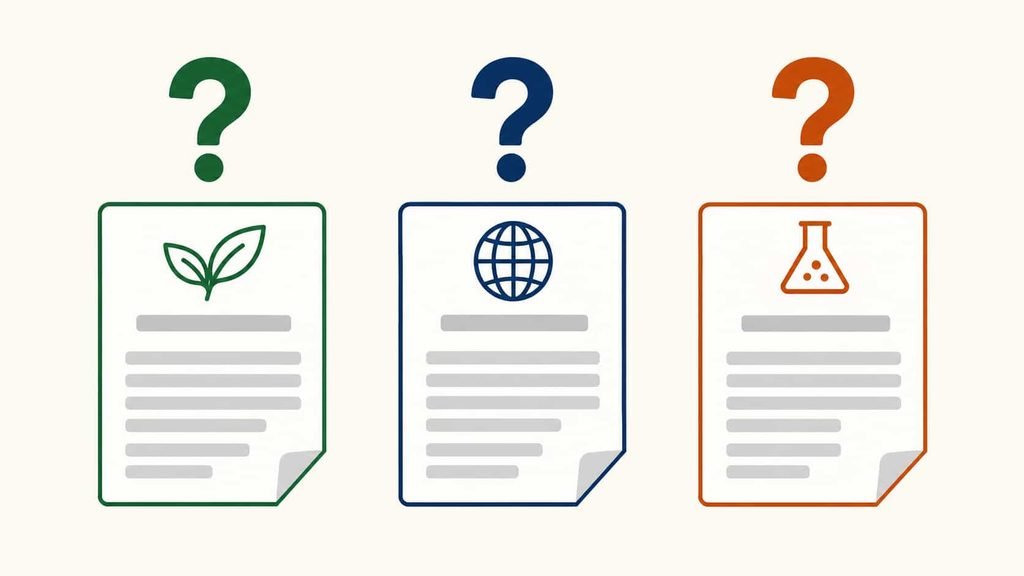
The simplest method of separating the documents is to determine what question each document was designed to provide an answer to. A phytosanitary certificate provides an answer to the following question: was this plant product examined and found to comply with the plant-health requirements of the country that will receive the goods? A certificate of origin provides an answer to the following question: where did the goods originate? A certificate of analysis provides an answer to the following question: what measurements were performed by a laboratory on a sample taken from this particular batch? When your concern relates to insects/pests, request the phytosanitary certificate. When your concerns relate to where the goods were made or if they are eligible for a tariff reduction, request the certificate of origin. When your concerns relate to measured quantities like moisture content, contaminant levels or color, request the certificate of analysis. A common error is to use the wrong document to settle a dispute. A buyer can hold all three documents and still not have the answer to the question being asked.
The phytosanitary certificate
A phytosanitary certificate is issued by the exporting country’s National Plant Protection Organization (NPPO). Pakistan has been a signatory of the International Plant Protection Convention since 1954, and an IPPC page on Pakistan’s plant quarantine law records the Department of Plant Protection as functioning as its NPPO. In July 2025, Profit (Pakistan Today) reported that the Ministry of National Food Security and Research had merged the Department of Plant Protection and the Animal Quarantine Department to form the National Agri-Trade and Food Safety Authority (NAFSA). Because the institutional set-up has been changing, the name in the heading of a certificate may depend on when it was issued, so read the heading on the certificate you receive instead of relying on an article like ours.
The certificate is limited in scope. It states that the consignment was inspected or tested, that it is free from the quarantine pests the importing country specifies, and that it meets that country’s phytosanitary import requirements. It is not a quality grade or a pesticide-residue test, and it is not a certificate of origin for customs purposes, although it does state a place of origin. It records what was inspected, not the quality of the product.
Ask your agent what form of documentation (paper or electronic) the destination authority requires for your shipment.
The certificate of origin
The certificate of origin states the country where the goods were grown, produced or manufactured. It says nothing about plant health or measured quality. The purpose of this document is commercial: customs agencies will use the certificate of origin to determine the appropriate amount of duty to impose upon the imported goods; in addition, if there is an existing trade agreement between two nations, the certificate of origin may serve as evidence to support a claim for reduced duty (preferential duty).
Our certificates of origin are issued through the Hyderabad Chamber of Commerce and Industry. Trade agreements can specify different issuing routes, some of them electronic, so before shipment we confirm which route the destination’s agreement requires. We suggest you ask any supplier to do the same instead of assuming.
The certificate of analysis
A Certificate of Analysis (COA) is provided by the testing laboratory rather than the regulatory authority who inspects the shipment or certifies its origin. The laboratory that issues a COA depends on the analysis the buyer requires. The analysis performed within the COA is based upon the requirements of the buyer. The COA provides information regarding the results obtained through laboratory testing of a single sample taken from a defined batch. The analysis is completed using specific methodology on a specified date. Therefore, the COA does not establish origin; nor does it provide evidence of the health status of plants; and it can only provide information related to the sample tested. Our Red Chili Export Testing article shows how color, aflatoxin and ochratoxin results appear on a COA, so we do not repeat the contents here.
The three side by side
| Phytosanitary certificate | Certificate of origin | Certificate of analysis | |
| Question it answers | Does the product meet the destination’s plant-health conditions? | Where do the goods come from? | What did a laboratory measure in a sample of this batch? |
| Issuer | National plant protection organization (NPPO) | Chamber of commerce, or the electronic trade-agreement route | A laboratory |
| What it proves | Inspection finding on plant health at the time of issue | Country of origin of the goods | Measured values for the tested sample |
| What it does not prove | Quality, residues, customs origin, or that customs will clear the goods | Plant health, quality or composition | Origin, plant health, or the condition of untested lots |
| Who usually asks for it | Importing country’s plant health authority and customs | Customs, and the buyer claiming duty preference | The buyer, and sometimes the destination authority |
| When it is issued | Varies by destination and order | Varies by destination and order | Varies by destination and order |
None of the three guarantees customs clearance. Each is one input among several that an importing authority weighs, and which documents a given destination requires is set by that country’s own rules, so we do not state requirements by country here.
Mismatches that stop a release
The three documents refer to the same shipment; therefore, all information provided in these three documents should match as closely as possible to each other as well as to the commercial invoice and bill of lading. The areas of discrepancy that cause issues are typically limited to several common areas such as: spelling of the consignee’s and exporter’s names and addresses, product description and botanical name, quantities and weights, dates, and batch or container reference. If a certificate shows one quantity and the invoice another, for example 20 tons against 19.8 tons (a hypothetical case), a container may be held while the difference is resolved. Documents are checked against each other, so have your agent confirm the exact wording of names and product descriptions before any of the three is issued.
What to ask a supplier before the order
When deciding on a supplier, find out who issues each document and how it appears in the header. Also, inquire about the format (paper, electronic, or both) of the phytosanitary certificate and whether your destination accepts either. Then, inquire about the route for obtaining the certificate of origin and if your shipment qualifies for preferential treatment through a trade agreement. Next, find out the laboratory where the COA was produced and if it pertains to the specific batch you purchased or a generic sample. Lastly, request a redacted copy of each document so that your agent can compare the formatting to the requirements of the destination country. A supplier who answers these questions clearly gives you more than any single document could.
To get a better idea of what else to look for when buying products, as well as checking your paperwork, please read What Does Export Quality Actually Mean? When sending in an initial inquiry, please use the contact page to send it to the export team.