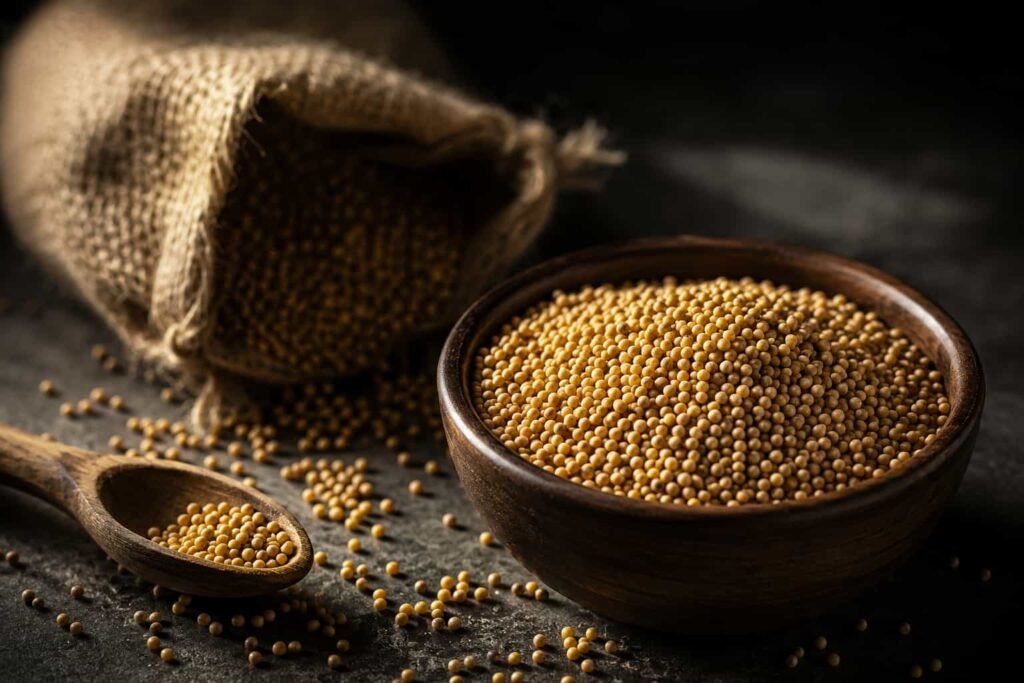
Two offers for yellow mustard seeds arrive at the same time, at similar prices. One shipment performs consistently in pickle production, season after season: uniform colour, clean specification, documentation that sails through customs. The other arrives with uneven seed colour, a foreign matter reading above the buyer’s limit, and a Certificate of Analysis that references a different batch number than the delivery. The price difference on those two offers was negligible. The cost difference, measured in production delays, failed incoming inspections, and a quarantined container, was not.
That gap between two visually similar lots of Pakistan yellow mustard seeds is not random. It is specification control, processing discipline, laboratory testing, and shipping preparation. This guide explains each of those elements so procurement teams can evaluate suppliers accurately and source export-grade product without surprises.
What Pakistan-Origin Yellow Mustard Seeds Are
Yellow mustard — Sinapis alba Linnaeus, also known as white mustard — is a cool-season annual oilseed crop. The seeds are round and solid yellow to light tan, larger than brown mustard (Brassica juncea) or black mustard seed (Brassica nigra); they are described as milder in pungency compared with these other species. In condiment manufacturing, these are not interchangeable commodities: pungency chemistry, emulsification behavior, oil composition, and flavour profile in the finished product are determined botanically. A supplier who cannot confirm species on a COA is not providing species-verified product.
Mustard is mainly harvested from March to May in large swathes of the agricultural belt of Punjab and Sindh in Pakistan. The product is exported as food-grade, whole seeds that were cleaned and graded. The supply chain from there can support various formats: whole seeds for pickle and condiment use, mustard seed powder for seasoning and processed food applications and oil-extraction lots that fit the pressing specification. There are separate quality criteria for mustard oil production compared to the requirements to supply food-grade seed.
Note too: yellow mustard is not the same as black mustard. Black mustard Seed (Brassica nigra) has a more pungent and shaper similar to that of brown but is distinct in its own ways to be used in South Asian cuisine as well as European cuisines. Mustard seeds without colour and a botanical name on a specification sheet are ambiguous. Add an extra layer of caution before ordering a production lot.
Where Yellow Mustard Seeds Are Used
Among the many processors using whole yellow mustard seeds, pickle manufacturers top the commercial purchasing list. Its mild pungency, firm texture under brining, and clean flavour release make it ideal for flavouring ingredients found in a wide variety of bread-and-butter pickles, giardiniera seasonings, sauerkraut seasoning preparations and vinegar-brined vegetables across European and North American production. The seed is added whole, steeped in brine, or lightly cracked (depending on the recipe brief).
Prepared mustard and condiment producers use yellow mustard as the primary seed species for yellow mustard paste — the classic stadium mustard and deli mustard formats. Seed purity and colour uniformity matter here because the finished condiment’s colour is partly a function of seed quality. Spice blenders and seasoning manufacturers use yellow mustard in dry rubs, barbecue seasonings, seafood boil blends, and pickling spice mixes. Bakeries incorporate whole or cracked seeds into artisan bread crusts and savoury biscuits.
Mustard powder manufacturing and wholesale repackaging are volume applications where specification tolerance may be slightly wider, but purity, moisture, and freedom from live infestation remain non-negotiable regardless of grade. Oil extraction is a commercial application where seed oil content and free fatty acid level become the primary commercial parameters alongside food safety compliance.
Quality Parameters: What to Examine Before Approving a Shipment
| Botanical identity | Species determines pungency profile, legal classification, and application suitability | Physical morphology, COA declaration, species-specific analysis if required | Sinapis alba stated on COA or specification sheet. Do not accept “yellow mustard” alone without species confirmation |
| Country and region of origin | Affects tariff treatment, phytosanitary requirements, and traceability claims | Certificate of origin from chamber of commerce | Pakistan origin declared. Region (Punjab/Sindh) confirmed for traceability |
| Crop year | Old-crop seed loses aroma potency, has higher rancidity risk in oil content, and may be below moisture spec if stored poorly | Supplier declaration, harvest documentation | Current or previous season clearly stated. Avoid unspecified crop year |
| Seed colour and uniformity | Off-colour seeds indicate damage, age, or variety mixing. Affects condiment appearance | Visual inspection, colour sorter output report | Pale yellow to light tan, uniform. Maximum off-colour percentage per buyer spec |
| Seed size | Size consistency affects processing behaviour, brine absorption, and appearance in finished products | Sieve analysis (mesh size) | Confirm seed diameter range or sieve specification matches application |
| Purity (%) | Higher purity means less foreign material diluting the lot and reduced allergen cross-contact risk from other seeds | ISO 927 method (extraneous matter separation and weighing) | Request minimum purity percentage in written specification. ISO 1237 extraneous matter limit: max 0.7% (m/m) |
| Foreign matter (%) | Stones, dust, stems, weed seeds, and insect fragments cause production line problems and regulatory failures | Hand separation and weighing; metal detection inline | Define maximum foreign matter tolerance per grade. Confirm lab result is numerical, not “pass” |
| Moisture (%) | High moisture promotes mould growth and aflatoxin development in storage and transit. ISO 1237 sets max 10% (m/m) | Loss in mass at 103°C (ISO standard method) or Karl Fischer titration | Confirm moisture on arrival sample and pre-shipment COA. Request target moisture ceiling in specification |
| Damaged and shrivelled seeds | Increase rancidity risk; affect oil yield; fail quality inspection at customer intake | Visual separation and weighing. ISO 1237 limit: max 2% (m/m) | Specify maximum damaged seed tolerance per grade in purchase specification |
| Live infestation | Any live insect presence triggers automatic rejection at most food facilities and under EU food hygiene law | Visual inspection of representative sample | Must be zero. Fumigation certificate required where destination or transit country mandates it |
| Aroma and pungency | Ground, moistened yellow mustard should yield pungent, fresh odour (p-hydroxybenzyl isothiocyanate). Musty or rancid odour signals age or poor storage | Sensory panel; volatile oil content (ISO method) | ISO 1237 requires fresh, pungent odour free from rancidity and mustiness |
| Oil content | Commercially relevant for oil-extraction buyers. Yellow mustard typically carries approximately 28-31% non-volatile ether extract on dry basis per ISO 1237 | Soxhlet extraction (ISO 1108 method) | Required only for oil-extraction contracts. Confirm with supplier whether lot is food-grade or oil-grade specification |
| Pesticide residues | EU MRL Regulation 396/2005 sets limits by compound. Exceedances generate RASFF alerts and border rejections | LC-MS/MS multi-residue panel (500+ compounds) | Results must list compounds tested and numerical values. “Pesticide-free” without lab data is not acceptable |
| Aflatoxins | EU Regulation 1881/2006 limits apply. Aflatoxin can develop in improperly dried or stored seed | HPLC-FLD or LC-MS/MS from ISO/IEC 17025-accredited laboratory | B1 and total aflatoxins must be numerical values, not “within limits” |
| Microbial safety | Salmonella, E. coli, and TPC determine food safety compliance and buyer acceptance | Per Codex CXC 75-2015 methods | Salmonella: absent in 25g. TPC within buyer or destination-market specification |
| Heavy metals | EU Regulation 1881/2006 sets limits for Pb, As, Cd, Hg. Required by most EU and professional buyers | ICP-MS from accredited laboratory | Numerical results per compound. Required on COA for EU destination |
| Allergen handling | Mustard is a recognised food allergen in the EU (Regulation 1169/2011) and other markets. Label declarations and cross-contact controls are mandatory | Allergen risk assessment at processing facility; label review | Confirm allergen labelling requirements for destination market before ordering |
| Batch and lot traceability | Required for recalls, regulatory audits, and professional buyer compliance teams | Documented batch coding from farm intake through processing to export container | Batch number on COA must match batch number on packing list and commercial invoice |
Allergen notice: Mustard is classified as a major food allergen in the European Union under Regulation (EU) 1169/2011 and in several other regulated markets. Buyers must verify destination-specific labeling requirements and allergen cross-contact controls before importing and repacking. This obligation rests with the importer.
Sampling and COA Evaluation
There are four sample types in an export transaction, and confusing them is how buyers end up approving a lot they have not actually seen. A reference sample is drawn from a previous production lot to demonstrate product character. A pre-shipment sample is drawn from the lot being shipped, before container loading, and is the sample that should be matched against the COA you receive. An exporter holds on to a retained sample of the same draw for dispute resolution. Third-party Laboratory: This independently accredited testing facility confirms the COA parameters.
A yellow mustard seed COA should include: the product’s name and botanical species; lot or batch number; date of testing; name and accreditation number of the testing laboratory. Results for each parameter in the specification must be included quantitatively. If the number on your packing list and commercial invoice doesn’t match the COA batch number, then it has nothing to do with your shipment. When your item is passed through customs, ask for a revised document. Mustard seed processing standards that include ISO/IEC 17025-accredited testing are the baseline for EU and professional buyer compliance.
Cleaning, Sorting, and Export Preparation
Export buyers won’t accept yellow mustard arriving raw out of the field—stones, soil particles, chaff, damaged seeds, and weed seeds. At HarmainGlobal.com, the processing sequence logic from farm intake to export-grade product follows a consistent path. Inspection and moisture spot-check, gravity destoning, air separation to remove chaff and light debris, sieving to classify by seed size, colour sorting when uniformity of seed is important to the buyer specification, hand-sorting for premium-grade lots, final verification of moisture content followed by inline metal detection, batch coding and laboratory sampling before packing starts.
Each step is documented. The batch code assigned at intake travels with the lot through every processing stage to the container seal. Without this chain, the COA cannot be connected to the shipment with confidence, and that connection is exactly what a professional buyer’s compliance team will ask for.
Bulk Packaging for International Shipment
Export shipping packages containing yellow mustard seeds must protect against moisture ingress, insect access and physical contamination over delivery times from air-transit periods of about a week to ongoing sea shipments to European or North American ports lasting from five to six weeks. Through standard bulk export packaging, food-grade inner liners are heat sealed and placed into outer woven polypropylene bags. Palletization with stretch-wrap and corner boards protects bag integrity during container loading & port handling.
Packaging weight, inner liner specification, pallet configuration, and outer bag printing (including lot number, weight, country of origin, and HS code) should be agreed in writing before production begins. Custom packing requirements — retail-ready inner packs, buyer-branded outer bags, specific net weights — must be confirmed with the supplier before production scheduling, not after. For detailed export-grade yellow mustard seeds packaging options and confirmed specifications, contact Harmain Global directly.
How to Import Yellow Mustard Seeds from Pakistan
The commercial process for importing bulk Pakistani mustard seed supply follows a logical sequence that protects both parties if every stage is documented.
Import Process Checklist
- Submit your written specification: botanical species, grade, purity minimum, moisture ceiling, packaging format, certifications required, destination port.
- Confirm intended application so the supplier can match the correct grade.
- Request a pre-shipment sample from the available lot, with COA from an accredited laboratory.
- Approve the sample and agree COA parameters in a written specification or purchase order.
- Agree quantity, packaging, packing marks, and net weight per unit.
- Request a proforma invoice with FOB, CFR, or CIF quotation for your destination port.
- Check the requirements on import permits and food safety documents with your local customs broker or corresponding authority before ordering.
- Approve the proforma invoice and pay as per the commercial terms agreed.
- Quality check on documentation set: commercial invoice, packing list, bill of lading (B/L), certificate of origin, phytosanitary certificate (if applicable), fumigation certificate (if applicable), COA and insurance for relevant Incoterms
- Get tracking information (Vessel, BL number, Container no., ETA) and track shipment to destination port.
Destination-specific requirements vary. EU buyers should confirm European food safety import documentation; US buyers should confirm FDA import alert status for the product category; GCC buyers should confirm Halal and Gulf Standards Organization requirements. Confirming these requirements with your local authority or a licensed customs broker before placing the order avoids the most common import clearance problems.
How to Evaluate a Yellow Mustard Seed Exporter from Pakistan
Evaluation of a yellow mustard seed exporter Pakistan should focus on what the supplier actually controls and not what their website says. Find out whether they buy straight from farmers or wholesale commodity markets. Traceability to the growing region means direct sourcing; unknown origin after the first middleman is commodity market sourcing. Question if their COA comes from an ISO/IEC 17025 accredited laboratory, and request to view the accreditation number on the document header. Inquire whether they provide a batch-specific COA for your specific batch shipment, or do they send you a reference COA from another batch.
Realistic communication is a signal. A supplier who confirms specifications precisely, acknowledges what they can and cannot certify, and responds to technical questions in writing is operating with more transparency than one who answers every question with a yes and provides no supporting documentation. A written specification sheet, a track record of supplying to your target market, and willingness to provide a genuine pre-shipment sample before a bulk commitment are the three minimum standards for any supplier evaluation.
Harmain Global has supplied bulk food and spice ingredients to buyers in 28+ countries since 1985. Every commercial mustard seed shipment is sourced from documented growing regions, processed at our Hyderabad facility, and tested by ISO/IEC 17025-accredited laboratories for the full parameter set relevant to the destination market.
Start with a Specification, Not a Price Request
Every successful bulk import relationship begins with a written specification, not a price inquiry. A price without a specification is meaningless: the exporter does not know what grade they are quoting, and the buyer cannot compare offers fairly. The specification is the contract anchor. Get it in writing first.
Ready to request a sample or quotation?
Send Harmain Global your required quantity, intended application, target purity or grade, destination port, required packaging format, documentation requirements, and preferred Incoterm. We will confirm specification options, sample availability, and lead time within 24 hours.
View the full product range or contact the export team to request a mustard seed quotation.
You can also reach us directly at https://harmainglobal.com/ or info@harmainglobal.com.