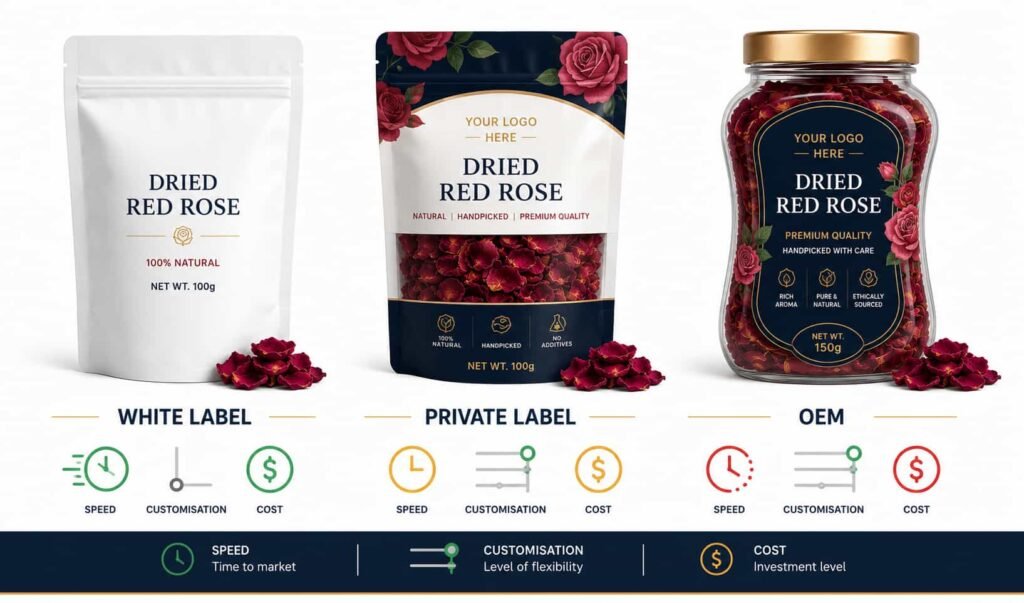
Talk to five suppliers about sourcing a herbs or spices product under your brand and you will hear all three terms — OEM, private label, white label — used in different ways by each of them. Some treat OEM and private label as synonyms. Others use white label to describe what is actually a private label arrangement. The terminology confusion is real, it is industry-wide, and it has practical consequences: brands end up selecting the wrong supplier model, budgeting incorrectly, and discovering months into development that what they asked for and what they are getting are not the same thing.
The definitions below are how these models actually work in food and natural products manufacturing — herbs, spices, dry fruits, seed oils, and wellness products. Understand the distinction and the sourcing decision becomes straightforward.
White Label: Speed Over Differentiation
White label means the manufacturer has already made the product. The formulation is fixed, the grade is standard, the processing specification does not change. Multiple brands can buy the same product from the same production run. What changes is the label — your brand name goes on packaging that the manufacturer or a packaging partner applies at fulfilment.
This is the fastest and cheapest entry point. Minimum order quantities are low because the product already exists. Lead times are short because there is no development phase. The investment is in branding and distribution, not in product creation.
White label is the right model when you are testing demand in a new market, launching with limited startup capital, or validating whether a product category works for your audience before committing to custom development. Amazon sellers proving a niche before scaling, and distributors filling a gap in a product catalogue quickly, are typical white label buyers.
The trade-off is direct: your product is identical to every other brand using the same manufacturer and the same grade. If a competitor is sourcing from the same facility on the same specification, your products are interchangeable on the shelf. Your differentiation has to come entirely from marketing, positioning, channel, and story — not from the product itself.
Private Label: Specification Control, Your Product
Private label is where specification enters the conversation. You define what the product is — the grade, the origin, the processing standard, moisture content, grain size, certifications required, blend ratios for multi-ingredient products. The manufacturer produces to your specification, and that production run is yours. Another brand cannot order the same product from the same run because the product does not exist in a standard form — it exists to your brief.
A German organic retailer specifying pesticide-free hulled sesame with an EU Organic Certificate of Analysis is doing private label, not white label. A supplement brand requiring black seed cold-pressed to a specific thymoquinone percentage with Halal and Kosher dual certification is doing private label. The product is genuinely different from what would come off a standard production line, and it is made for that client alone.
Private label carries higher minimum order quantities, longer lead times (typically 4–8 weeks depending on the spec), and higher per-unit cost than white label. It also delivers what growing brands actually need: a consistent, documented product that belongs to them, meets specific market compliance requirements, and can be defended on quality grounds if a buyer or regulator asks for evidence. The global private label food supplement market grew 4.4% in 2025 — that trajectory reflects exactly this shift: brand owners who started on standard products moving to specification-controlled supply as they scale.
At Harmain Global, most clients start on private label. They come with a target market, a compliance requirement — EU organic, FDA supplement GMP, a retailer’s own brand standard — and a product brief. We work backward from those requirements to a specification, then manufacture to it.
OEM: Full Custom Development
OEM — Original Equipment Manufacturer — means you are not specifying an existing ingredient or product category. You are bringing a concept, a formula, or a product idea that does not yet exist in manufactured form, and the manufacturer develops it and then produces it exclusively for your brand.
A restaurant chain wanting a proprietary spice rub that no other brand can replicate is an OEM client. A food distributor building a signature curry paste to anchor their product line is an OEM client. An established wellness brand developing a custom adaptogen blend with a proprietary ratio of ashwagandha, black seed, and turmeric — exclusively theirs, not available anywhere else — is an OEM client.
OEM requires the most investment: development time, formulation iterations, stability testing if required, higher minimums to justify the development cost, and longer lead times before the first production run. It also delivers the strongest competitive moat. A product that was created for you and is manufactured only for you cannot be replicated by a competitor placing an order with the same supplier.
OEM is the right model for brands with a clear product vision, the budget to develop it properly, and a market large enough to absorb the minimum volumes. It is not the starting point for most new brands — but it is where successful brands often end up.
Three Questions That Make the Decision Clear
| Question | Answer | Model |
|---|---|---|
| Do you need a unique formula, or is specification control sufficient? | Unique formula you own → OEM. Specification control over an existing product type → Private Label. | OEM / Private Label |
| How quickly do you need to launch, and what is your initial budget? | Fast launch, low capital → White Label. Controlled product with compliance documentation → Private Label. | White Label / Private Label |
| Is your brand’s differentiation in the product itself, or in your marketing, story, and channel? | Product is the differentiator → OEM or Private Label. Story and channel are the differentiator → White Label is sufficient. | OEM / PL / White Label |
Applied to Pakistan-origin natural products, the distinction becomes concrete: white label means taking a standard-grade black seed or sesame in manufacturer-standard packaging with your logo applied. Private label means specifying organic-certified Hunza-origin apricots, or hulled sesame to your exact moisture specification, with your custom label carrying the correct EU allergen declarations for your target market. OEM means your proprietary custom masala blends or wellness formula, developed from your brief and manufactured exclusively under your brand — a product that does not exist anywhere else.
At Harmain Global, most clients start on the private label programme and move to OEM as their brand scales and their product vision sharpens. The two models are not competing options — they are natural stages of brand development. White label validates that a category works for you. Private label builds a brand with real product integrity behind it. OEM protects that brand from replication. Most successful brands in herbs, spices, and natural wellness move through all three, in that order.
Not sure which model fits your next product?
Whether you are launching your first SKU or expanding an existing line into a new market, the sourcing model shapes everything that follows — cost, timeline, compliance, and competitive position. Talk to us about which model fits your product, your market, and your timeline. We will give you a direct answer.
One Response
Every time I read one of your posts, I come away with something new and interesting to think about. Thanks for consistently putting out such great content!