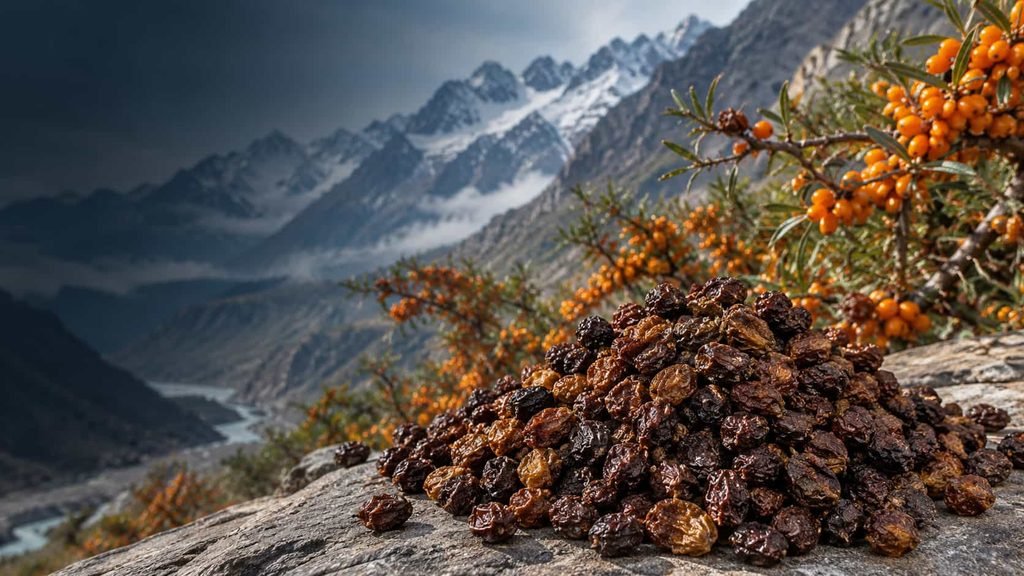
Picture a thorny bush clinging to a slope above Hunza, orange berries packed so tightly along its branches that from a distance it almost looks like the shrub caught fire. Now picture that same berry, months later, sitting in a nutraceutical lab halfway across the world, dissolved into a capsule formulation or standardized into an oil, with absolutely nobody in that lab picturing the mountain it came from. That gap, between a wild thicket on a Karakoram slope and a finished ingredient on a formulator’s bench, is the entire story of a sea buckthorn supply chain, and it is a much longer, messier, and more human journey than most product pages ever let on 🏔️
The landscape that makes this fruit possible in the first place
Start with why this berry even grows here. The Karakoram range running through Gilgit-Baltistan is about as extreme an environment as agriculture gets, cold desert conditions, thin soil, brutal winters, and a growing season squeezed into a short stretch of the year. Most crops would not bother showing up. Sea buckthorn does not just tolerate that environment, it thrives in it, spreading wild across slopes in Hunza, Ghizer, and Skardu without anyone planting it or watering it or doing much of anything except eventually deciding to pick it. That is genuinely rare in agriculture. Most valuable crops need irrigation systems, fertilizer schedules, and constant intervention. Sea buckthorn in this region largely takes care of itself, which is exactly why it has quietly become one of the more interesting alternative livelihood crops for mountain communities looking for income sources that do not require competing for the region’s extremely limited arable land 🌄
Who actually harvests it, and the honest economics behind that harvest
Here is where the story gets a lot less glamorous than any superfruit marketing campaign wants to admit, and also a lot more worth knowing. The people physically harvesting Gilgit-Baltistan sea buckthorn sourcing depends on are, by and large, smallholder village collectors, and a substantial share of them come from poorer households for whom this seasonal harvest is a genuine, if modest, income opportunity rather than a side hobby. Academic field research covering the region interviewed over a hundred collectors and more than a dozen commission agents across Gilgit-Baltistan and found the picture to be, frankly, tougher than most consumer facing brands would want printed on their packaging. Farmgate prices paid to collectors have been documented at roughly two US dollars per kilogram or less, which is a genuinely thin margin once you account for how labor intensive hand harvesting thorny wild bushes on a mountainside actually is. This is not a criticism of anyone specific in the chain, it is simply the honest starting economics of a wild harvested crop in a region with limited local demand and no coordinated pricing mechanism, and any buyer serious about ethical sourcing should want to know this rather than be shielded from it.
What happens after the berries leave the bush
Once harvested, the fruit does not travel straight to an exporter’s warehouse. It typically moves through informal village level collection points first, where local commission agents aggregate small individual harvests into quantities actually worth transporting, taking their own cut along the way as the connective tissue between scattered collectors and downstream buyers. From there, drying is the make or break step, and it is also where a lot of quality gets lost before an exporter ever sees the fruit. Traditional processing in the region has historically relied heavily on open sun drying, which is cheap and requires no equipment, but the same field research that documented collector pricing also found that sun drying versus shade drying produces measurably different chemical outcomes, with prolonged sun exposure degrading vitamin C content more than more controlled shade drying does. That single processing choice, sun versus shade, made at a village level with whatever equipment is actually available, ends up shaping the nutritional profile of the fruit long before it reaches any lab testing anywhere downstream.
Where the real bottlenecks sit today
None of this is a hidden secret in the industry, it shows up consistently in the research literature on the region. The core bottlenecks are quality inconsistency driven by variable drying practices, non coordination among the different actors in the chain from collector to commission agent to processor, and a persistent lack of coordinated infrastructure, meaning no widespread standardized drying facilities, no unified grading system, and no consistent price floor protecting collectors from a bad harvest season. Development organizations including ICIMOD and Gilgit-Baltistan’s own rural support programs have run training initiatives specifically aimed at improving processing skills and creating better income stability around this crop, which tells you plainly that the industry itself recognizes these are real, unresolved gaps rather than settled problems. For a buyer sourcing bulk sea buckthorn export Pakistan shipments, this context matters enormously, because it means quality consistency cannot simply be assumed from one shipment to the next unless an exporter is actively managing for it rather than passively accepting whatever arrives at their door.
What genuine traceability actually requires, beyond the marketing phrase
This is the part where “traceable” stops being a word on a product page and starts being an actual operational commitment. Real traceability in a supply chain shaped like this one means an exporter can answer specific questions rather than gesturing vaguely at a mountain range. Which district or valley did this specific lot come from. Was it wild harvested or collected from managed thickets. How was it dried, and by whom, and under what conditions. How long between harvest and drying, since that gap affects quality as much as the drying method itself. Does documentation exist connecting a specific export batch back to its collection point, or does the paper trail conveniently stop somewhere in the middle. A single origin sea buckthorn supplier worth working with should be able to answer these questions specifically for the lot being quoted, not just point at Gilgit-Baltistan generally and call that traceability, because the region is large, the practices vary meaningfully from valley to valley, and “grown in northern Pakistan” is a starting point for a real traceability conversation, not the end of one.
Where the fruit ends up once it leaves the mountains
After processing and export, this berry fans out into a surprisingly wide set of downstream industries. Nutraceutical formulators use it for capsules and functional food products built around its antioxidant and fatty acid profile. Cosmetic manufacturers extract oil for skin barrier and anti-aging formulations. Food processors turn it into juices, jams, and functional beverage ingredients. Every one of those buyers, whether they are sourcing for a supplement line, a skincare brand, or a functional food product, is ultimately depending on decisions made months earlier by a village collector deciding how long to leave berries drying in the sun, which is exactly the kind of upstream detail that never makes it into a finished product’s marketing copy but absolutely shapes what ends up in the jar or capsule.
Harmain Global has been exporting agricultural and botanical raw materials out of Pakistan since 1985, working across dry fruits, herbs, seeds, and botanicals for B2B buyers in the Gulf, EU, UK, USA, China, and South Korea. The picture of collection, drying, and pricing described above reflects how this supply chain has generally been documented to operate across Gilgit-Baltistan as a region, and if you are evaluating a traceable sea buckthorn exporter for your own sourcing, the right move is to ask directly which parts of that picture match a specific supplier’s actual practice rather than assuming any exporter’s operation by default. If you want to know exactly how Harmain Global’s own sourcing works for Hunza sea buckthorn or other wild harvested sea buckthorn Pakistan lots, from collection method through to drying and documentation, that is exactly the conversation worth having directly with the sourcing team. You can learn more here about the broader dry fruit and botanical catalog, reach out to a verified sea buckthorn exporter Pakistan buyers can ask hard questions of, or visit this page to start that conversation directly with HarmainGlobal.com before committing to a lot based on origin claims alone.