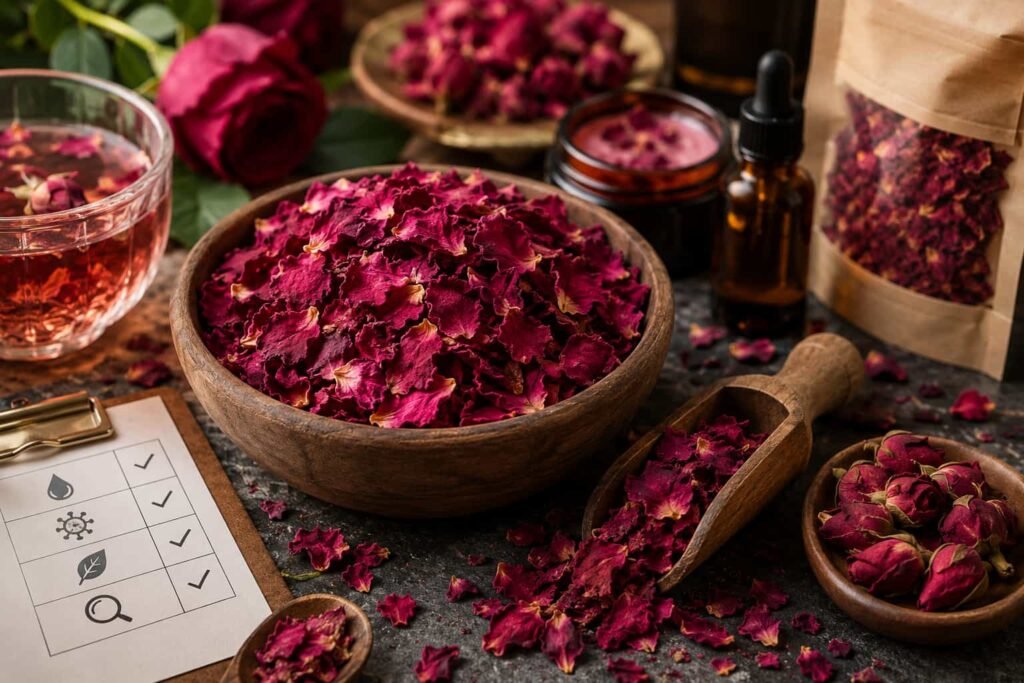
Ask most buyers what makes a good dried rose petal, and the answer comes back in one word: red. It’s not wrong, exactly; color matters but it’s an incomplete way to evaluate a raw material that different industries are buying for entirely different reasons. A tea brand, a cosmetic formulator, and a ritual product distributor are all purchasing “dried rose petals,” but they’re evaluating three different quality profiles under that single name, and color retention is only one variable in a longer list that determines whether a batch actually performs once it’s in a tea bag, a facial product, or a ceremonial packet on a shelf.
Petal Integrity Starts Before Drying Even Begins
Quality is determined largely before the petals ever reach a dryer. Harvest timing, picking at the right bloom stage, before petals begin to naturally degrade on the stem and handling during collection determine how much structural integrity the petal retains going into processing. Petals bruised or crushed during harvest and transport to the drying facility will show damage that no amount of careful drying afterward can fully reverse: darkened edges, uneven color, and a tendency to fragment further during subsequent handling and packing.
This is why petal integrity and drying method aren’t separate topics; poor handling upstream compounds every quality risk downstream, from color loss to microbial exposure.
Drying Method Determines Both Colour and Aroma Outcome
The drying method used has a direct, measurable effect on two things buyers care about most: color retention and aroma retention, and the two don’t always move together.
Shade-drying, at controlled temperature and airflow, tends to preserve both pigment and volatile aromatic compounds better than direct sun-drying, which accelerates color fading through UV exposure even as it dries the material efficiently. Fast, high-heat mechanical drying can lock in color reasonably well but risks driving off more of the volatile aroma compounds that give rose its characteristic fragrance a real problem for fragrance houses and tea brands where scent, not just visual appeal, is the point of the purchase.
The practical implication for buyers: ask which drying method was used, not just what the finished moisture percentage is. Two petals with identical final moisture content can carry very different aroma intensity depending on how they got there.
Colour Retention as a Quality Spec, Not a Cosmetic Detail
For cosmetic formulators specifically, color retention isn’t about aesthetics alone; it affects formulation consistency. A cosmetic product built around a visible rose petal inclusion (in a scrub, a bath product, or a packaging window showing the botanical) needs consistent color batch to batch, because visible fading between production runs shows up as an inconsistency the end consumer notices directly.
Color degrades over time even in a well-dried batch if storage and packaging afterward aren’t controlled which is why color retention needs to be evaluated as an ongoing spec through the supply chain, not just a one-time check at the point of drying. A supplier who can speak specifically to how petals are stored and packed after drying is addressing a real risk, not offering a marketing reassurance.
Aroma Retention: The Spec That’s Hardest to Fake
Aroma is the most perishable quality attribute in dried rose, and it’s the one most vulnerable to poor storage even after a good drying process. Volatile aromatic compounds continue to degrade slowly during storage, accelerated by heat, light exposure, and poor packaging that allows air exchange. A batch that smelled strong at the point of drying can arrive at an importer’s warehouse months later with noticeably diminished fragrance if it wasn’t packed and stored correctly in between.
For tea brands and fragrance houses, this means asking not just “how was it dried” but “how long has it been stored, and in what packaging” before a shipment leaves origin. Fresh drying and poor storage afterward produce the same disappointing result as a mediocre drying process to begin with.
Moisture and Microbial Safety: The Foundation Underneath Everything Else
Moisture content is the variable that determines shelf stability, and it interacts directly with microbial risk. Rose petals dried to appropriate moisture levels and packed in moisture-barrier materials resist mold and microbial growth during transit and storage; petals left slightly too moist, or repackaged in materials that allow humidity ingress, are at real risk of microbial contamination well before any visible spoilage is apparent.
Microbial testing covering total plate count, yeast and mold count, and pathogen screening where relevant matters most for buyers using rose petals in tea (an ingestible product) or in cosmetic formulations that will be applied to skin, both of which carry regulatory expectations around microbial limits that a purely decorative or ritual-use product might not face to the same degree. Buyers should request moisture percentage and microbial results as a matched pair on the CoA, not moisture alone.
Pesticide Residue: A Non-Negotiable for Food and Cosmetic Buyers
Pesticide residue testing has become a standard requirement for buyers in regulated markets, and it matters differently depending on end use. A tea brand is selling an ingestible product directly to consumers, which typically brings the strictest residue threshold expectations. Cosmetic formulators face a somewhat different but still meaningful regulatory framework depending on destination market. Ritual and décor buyers, by contrast, often face the lightest residue scrutiny, since the product isn’t ingested or applied to skin though reputable suppliers test consistently across all end uses rather than only when a specific buyer requests it.
Buyers sourcing for food or cosmetic applications specifically should request a pesticide residue report tested against a defined panel relevant to their destination market, rather than accepting a general “pesticide-free” claim without supporting data.
Foreign Matter and Broken-Petal Percentage
Foreign matter stems, leaves, dirt, or other plant material mixed into the petal batch and broken-petal percentage are both quality specifications that affect usability differently depending on the buyer’s application.
For tea brands packaging whole or large-fragment petals visibly in a tea blend, broken-petal percentage matters directly: a high proportion of small fragments and dust reads as lower quality to the end consumer, even if the aroma and color are fine. For cosmetic formulators grinding petals into a powder or extract base, broken-petal percentage matters far less, since the material will be processed further regardless of starting fragment size. Foreign matter, by contrast, matters across every end use; it’s a consistent quality defect regardless of whether the buyer wants whole petals or ground material.
Buyers should specify their tolerance for broken-petal percentage explicitly based on their actual application, rather than assuming “premium grade” means the same physical specification across every use case.
Food-Grade vs. Cosmetic-Grade: Not Always the Same Material
It’s worth being direct about a common misconception: food-grade and cosmetic-grade dried rose petals aren’t automatically interchangeable, even when they come from the same harvest. Food-grade material typically carries tighter pesticide residue and microbial thresholds appropriate for ingestion, while cosmetic-grade material may be processed or graded differently depending on whether it’s destined for topical formulation versus decorative inclusion. Buyers should confirm which grade they’re actually receiving and request documentation matched to their specific application. A tea brand accepting “cosmetic-grade” petals without verifying food-safe residue thresholds is taking on unnecessary regulatory risk.
Packaging: Where Good Processing Gets Undone
A well-dried, well-tested batch of rose petals can still arrive faded and stale-smelling if it’s packed in materials that don’t protect against light, air, and moisture during transit. Long sea freight routes expose product to temperature swings and humidity variation for weeks; packaging that isn’t a genuine moisture and light barrier undoes much of the quality work completed during drying and initial storage. Buyers should ask specifically what packaging format is used for export shipments not just for domestic storage since the two often differ, and transit is where color and aroma loss most commonly happens unnoticed until the shipment is opened at destination.
Buying With the Full Spec Sheet, Not Just Colour
Dried rose petal quality is a composite of drying method, color retention, aroma retention, moisture, microbial safety, pesticide residue, foreign matter, broken-petal percentage, and export packaging evaluated against the buyer’s specific end use, whether that’s tea, cosmetic formulation, or ritual and décor product. A batch that’s simply “very red” without documentation across these other specs is an unverified claim, not a quality guarantee.
Explore our rose products range, including dry red rose petals and dry red rose buds, each supplied with the documentation matched to your specific application.