What Made Basmati Rice The World’s Biggest Food Obsession? Follow One Girl’s Hunger-Driven Discovery That Changed Everything
Harmain Global
Ingredients & Origins, Know Your Flavors
“This is the story of Zara. She didn’t go looking for rice. Rice found her in the most inconvenient, stomach-growling, life-altering way. And in some mysterious way, a 5,000-year-old grain ended up addressing every question she never even knew she had about food, about health, and about what it really means to eat well.”
It started on a Tuesday. Zara had three hours of sleep, a cold cup of coffee, and what she would later describe as “the audacity of the hungry.” She’d just returned from a workout that had left her feeling absolutely wrecked, and she was standing in her kitchen, staring at the contents of her pantry as though they had wronged her personally.
There was regular white rice. There was a little jasmine rice that her roommate had bought on a whim. And there was another box of something her Dadi sent her — no label or anything, all vacuum-sealed, with a note that read: “Don’t you dare ruin this with butter.”
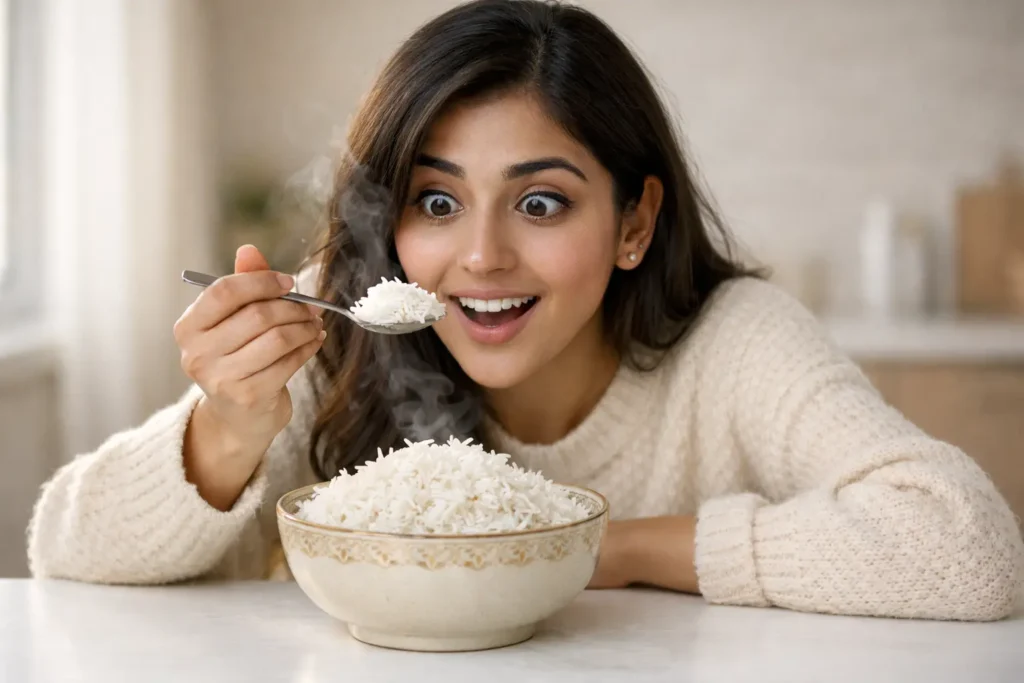
Zara opened the package. A waft of something warm, nutty, and faintly floral hit her nose. She didn’t know grains could smell like that. She cooked it. She ate it. And then, very dramatically, she sat at her kitchen table and thought: what was that?
So, what occurred, dear reader, was basmati rice. It was, in other words, the beginning of an obsession that would take Zara through nutritional rabbit holes, recipe testing sessions, late-night DMs to food scientists, and a reformation in how she viewed one of the most common foods on earth.
This is her story. But honestly? It’s your story too. Because if you haven’t yet asked yourself why basmati rice is different, why your bodybuilder cousin swears by it, why your Asian friends seem to eat rice at every meal and still look like athletes, or whether basmati is actually better for you than the regular stuff, then you’re long overdue for this conversation.
Let’s get into it.
The Day Zara Discovered That Not All Rice Is Created Equal
Zara wasn’t a rice person before this. She was, by her own admission, boring as hell about carbs. She bought whatever cost the least, forced it down until it was barely palatable, then chewed and swallowed without thinking. Rice was rice, she thought. It was a filler. A background character. The beige wallpaper of the food world.
And then she cooked that first pot of her Dadi’s basmati, and her worldview collapsed.
Because here’s the thing about basmati that no one prepares you for: It doesn’t just taste different. It transforms. You put these long, thin grains in the pot, and when they’re done, they’ve nearly doubled in length. We’re talking about grains that range from 6-8mm to over 20mm when cooked. Regular white rice doesn’t do that elongation. Jasmine doesn’t do that either. It’s a basmati thing, and it is, frankly, a little bit magical.
Zara called her Dadi immediately. “What is in this rice?” she demanded.
Her Dadi laughed. “It’s from Pakistan, bacchi. The real stuff.”
“But why does it smell like this?”
“God and good soil,” said her Dadi, and hung up.
As that proved inadequate, Zara took to the internet. And this is where the story truly begins.
The Science Of The Smell (Or, Why Basmati Rice Makes Your Kitchen Smell Like A Dream)
The unique aroma of Basmati comes from a natural compound called 2-acetyl-1-pyrroline. You don’t have to know how to pronounce it. You just need to know that this is the same compound found in jasmine flowers, pandan leaves, and some types of bread. It’s what gives basmati that warm, nutty, almost popcorn-like fragrance that fills your house as the rice cooks, the sort that sends people wandering in from other rooms to ask, “Wait a minute, what are you making?”
Regular white rice? Doesn’t have it. Not in the same concentration. Jasmine rice has some, too, which is why it’s also fragrant, but it’s a shorter-grain variety with a different cooking character and a notably higher glycemic index. The whole basmati vs jasmine rice comparison thing is, to be honest, a rabbit hole of its own—an interesting one at that.
The secret to the superlative concentration of this compound found in Pakistani basmati — especially those grown on the plains of Punjab and at the foothills of the Himalayas — lies in three factors: geography, soil, and climate. The specific mineral makeup of the soil, cool nights that follow hot days in the growing season, and centuries of farmers selecting seeds, who knew precisely what they were doing. You cannot replicate this by just growing any rice anywhere.” That’s why basmati from outside this region is considered technically basmati in name only — a concept the industry refers to as “geographical indication,” similar to how French champagne is different from any other sparkling wine.
And Zara wrote all of this in a notebook. Then she prepared another bowl of rice and continued on.
Basmati vs. Jasmine vs. Regular White Rice — The Showdown Zara Did Not Expect to Care About
By the second week of what she was now privately referring to as “The Rice Investigation,” Zara had purchased three varieties of rice and set them up on her countertop as though they were contestants in a cooking show that she was hosting completely alone.
Regular long-grain white rice. Jasmine rice. Basmati rice.
She cooked them all and compared. Here’s what she found.
Regular white rice: fine. Neutral. Completely inoffensive. The Honda Civic of rice. Reliable, affordable, completely unremarkable. It sticks together a bit, has a mild starchy flavor, and exists, more or less, to deliver sauces. Its glycemic index ranges from 72 to 87, depending on the variety. It will send your blood sugar soaring, with no interesting flavor to justify it.
Jasmine rice: Soft grains, slightly sticky, and lightly floral with a touch of sweetness. It works well for dishes like Thai curries and mango sticky rice. Jasmine rice has a glycemic index of 68-80, sometimes higher, making it quite high on the glycemic index scale.
Basmati rice: the main character. Fluffy, individual grains, that distinctive smell, and a glycemic index here of about 50 to 58. That’s a lot lower than either of the others. Which is why your body metabolizes it more slowly. This translates to sustained energy, a slower rise in blood sugar, and no mid-afternoon crash that comes from having a bowl of sticky white rice for lunch.
Zara looked long and hard at these three bowls. And then she ate all three, because she was doing research and also because she was hungry.
“All right,” she said to no one in particular. “Basmati wins.”
What Makes 1121 Basmati the Grain That Changed Everything
About three weeks into her investigation, Zara kept running across a name that seemed to pop up in every article, every export listing, and every rice nerd forum she found herself looking at: 1121 Basmati Rice.
She had to know.
What she found out is that 1121 Basmati is basically the record-breaker of grains. It was bred for maximum grain length, ultimate elongation on cooking, and the richest aroma. Uncooked, these grains measure about 8.3 to 8.4mm. Cooked, they grow to 20-25mm. That’s nearly three times their original length—no other commercially grown rice can compare.
There is a wide variety of 1121 Basmati rice, and they all have their specialized use. Then there’s the Extra Long Grain Basmati 1121 Creamy, which has a warm ivory hue thanks to little processing that leaves more nutrients than fully polished rice and is also famous for its buttery-deep flavor. Then there is the Extra Long Grain Basmati 1121 Creamy Parboiled rice that was boiled inside its husk before milling; that process pushes nutrients from the outer bran layer inside the grain itself, giving each grain a firmer chew and lowering it on the glycemic scale while rendering the stuff nearly impossible to overcook. Ideal for restaurants serving up hundreds of plates
Then there’s the Extra Long Grain Basmati 1121 Creamy Sella, a partially boiled-in-husk variety that imparts a slight golden hue and remarkable structural integrity — every grain remains discrete and elongated even at scale. The Extra Long Grain Basmati 1121 Creamy Silky Polished is just as its name suggests: The creaminess of minimal milling married with a silky, smooth finish that allows each grain to practically shine in the pot.
For something lighter and brighter, there’s the Extra Long Grain Basmati 1121 Steam — steam-processed for a delicate, airy grain that is incredibly easy to cook and is also beloved throughout Europe and the Middle East. And even its high-end counterpart, the Extra Long Grain Basmati 1121 Steam Silky Polished, lightness and airiness are what you get, but now polished gives it a gloss finish that upmarket hotels and restaurants go wild for.
Purists often jump into the Extra Long Grain Basmati 1121 White— the classic, unblemished, brilliantly white grain that’s considered the gold standard of export rice across the globe. And for anyone looking for a classic look with an absolutely perfect finish, the Extra Long Grain Basmati 1121 White Silky Polished is what you want: visually brilliant and perfectly uniform, aromatic in a way regular grocery-store rice can’t touch.
Zara read all of this and promptly ordered a kilo of every kind she could find. Her pantry was becoming a rice museum. And she wasn’t thinking that this was a problem in the first place.
Enter the Super Kernel — Pakistan’s Other World-Famous Contribution to Lovers of Grain
Just when Zara thought she had basmati all figured out, she ran into Super Kernel.
If 1121 is the world champion, Super Kernel Basmati is the heritage titleholder — the strain that put Pakistani rice on the global map before 1121 came along. Super Kernel is Pakistan’s own registered and geographically protected variety of basmati, and Super Kernel has its own identity: a grain that is slightly shorter than 1121’s but with an incredibly rich aroma, superior sweetness in flavor, and a cooking character that many rice connoisseurs argue is simply unbeatable for biryani.
The Super Kernel Basmati Creamy retains more of the bran layer for a nutty, nutritious result – a popular option among health-conscious shoppers who want the benefits of less-milled rice without going all the way to brown. The Super Kernel Basmati Creamy Parboiled adds the structural firmness that parboiling brings with it to its nutrient density, making it perfect for large-scale caterers who need to keep the rice looking immaculate, plate after plate after plate.
For maximum elongation and grain separation, the Super Kernel Basmati Creamy Sella is the choice of professional chefs throughout the Middle East and Central Asia, who swear by it — it practically refuses to go mushy. And the Super Kernel Basmati Creamy Silky Polished is what luxury hotel chains buy when they want rice that’s as gorgeous as it is delicious.
There’s also Super Kernel Basmati Brown — the whole grain version, bran layer unremoved, fiber and minerals intact. More on that in a moment, because this is where Zara’s bodybuilder cousin came into play.
“Why Do You Eat So Much Rice?” (A Question Zara Asked Her Cousin at the Gym)
Hamza, Zara’s cousin, competed in three bodybuilding shows. He was the kind of person who meal prepped on Sundays with the intensity of a general planning a military campaign. And his meal prep always, always featured basmati rice.
Not pasta. Not quinoa. Not the myriad of elaborate grain bowls that passed through fitness Instagram. Basmati rice. In large quantities. With chicken breast and a rotating cast of vegetables.
“Why basmati specifically?” One day at the gym, Zara asked him inquisitively.
Hamza stared at her as if she’d asked why the sky was blue. “It’s clean fuel,” he said. “It doesn’t spike me up high, it sustains me for the entire training session, and it gets stored as muscle glycogen rather than fat. And it’s light, so I don’t feel heavy going into my training.”
He was also, as it turns out, exactly right. Basmati rice’s lower glycemic index means that when you eat it, the carbohydrates are released into your bloodstream more gradually than they would be from regular white rice or jasmine rice. That prevents the huge insulin spike that drives fat storage, and instead gives muscles a steady supply of usable glucose. For bodybuilders, who must schedule their carbohydrate consumption in accordance with their workout periods for optimal performance and recovery, basmati rice is basically a precision instrument.
It is also naturally low in fat, moderate in protein (roughly 4 grams per cooked cup), easy on the digestive system, and can be portioned out and scaled almost precisely to set caloric targets. That it also tastes genuinely good — hard to say about plain white rice six times a week — adds the sustainability, rather than punishment, aspect of dietary change.
“Plus,” Hamza added, dumping a frankly staggering amount of rice into his meal prep container, “your aunt’s biryani is with basmati, and I won’t give it up for any diet.”
Fair point.
The Mystery of Why Asians Eat Rice Every Day and Somehow No One Freaks Out
One night, Zara was deep in a rabbit hole about rice consumption statistics— as you do — and came across a fact that bothered her: people in South and Southeast Asia eat rice at nearly every meal. Multiple times a day. And yet the health outcomes in many of these populations, especially those who eat traditional diets, are dramatically better than for people living in countries where rice is vilified as “too many carbs.”
How does that work?
She dug in. And the answer is both simple and profound. Rice is not the problem. What surrounds rice is the variable. Traditional Asian diets are complete but also different: they combine rice with huge amounts of vegetables, fermented foods (kimchi, miso, pickles), moderate quantities of lean protein, and minimal ultra-processed food. The rice serves as the carbohydrate base. The rest of the plate provides the fiber, the micronutrients, the probiotics, and satiety signals that keep us from eating too much.
In Western contexts, on the other hand, a “rice dish” typically means one with heavy cream sauces poured over it or processed meats of some kind, or just being served enormous amounts of rice without the range of vegetables that keeps the balance. The rice didn’t change. The surrounding food did.
Then there’s the tempo of eating. Research consistently shows that slower eating improves the regulation of appetite. Many traditional Asian ways of eating feature smaller bites, chopsticks that automatically slow the tempo of the meal, and a cultural custom to stop before feeling fully sated. The rice isn’t magic. The eating pattern around the rice is doing a lot of the work.
As an interesting aside — if you wonder why the cuisine of Pakistan in particular has built rice into something that nears a cultural philosophy, read about how Pakistani rice is taking over kitchens around the world; it’s genuinely worth your time.
The Honest Truth About the Downsides of Basmati Rice (Because Everything Has One)
Zara, to her credit, was not interested in becoming a rice evangelist who ignored inconvenient facts. So she also sought the drawbacks. Here’s what she found.
First: cost. Basmati rice — especially quality, export-grade basmati costs more than regular white rice. This isn’t a conspiracy — it’s the reflection of the real cost of growing, harvesting, sorting, and processing a grain that requires specific geography, climate conditions, and careful cultivation. If you’re supporting a large family on a small budget, the difference in cost per meal can add up.
Second: glycemic index. Yes, basmati has a lower GI than jasmine or regular white rice. But it’s still not, by absolute standards, a low-GI food. White basmati has a GI of about 50-58, classifying it in the medium range. Portion size still matters for people managing diabetes or blood sugar conditions. An enormous bowl of basmati rice is not the same as a small amount with lots of veggies.
Third: arsenic. All rice has some amount of inorganic arsenic in it, because rice plants are especially good at sucking the stuff up from the soil. Basmati, especially from Pakistan or India, typically contains less arsenic than rice grown in some regions of the United States — but it’s still useful information for people who eat rice every day and in extremely large amounts. Rinsing rice well before cooking removes some surface arsenic.
Fourth: milling loss. Basmati (or any brown rice) that is milled to become white loses fiber (along with the bran layer), vitamins, and minerals. This is the case with every white rice. Brown basmati, which holds onto the full bran layer, is ensconced in meaningfully more nutritious — although it takes longer to cook and yields a nuttier, chewier texture — if nutritional density is your main concern.
None of these downsides is a showstopper negative. These are just things you need to know in order to eat basmati mindfully instead of haphazardly — which, as Zara pointed out, really applies to pretty much everything you do in life.
What Is the Very Best Rice in the World?
Zara had arrived at the final-boss question of her inquiry. She plugged it into every search engine she could think of, scanned academic papers, reports on international trade, and assessments by food critics. The answer that kept popping up, from sources including the World Rice Conference to Michelin-starred chefs, was essentially identical.
Pakistani Basmati Rice. Specifically, 1121 Basmati. Specifically grown within the Punjab plains
The 1121 variety has the longest commercially grown grain in the world. It elongates the most, dramatically, when cooked. Its aroma is unlike anything else of its kind. And Pakistan’s unique blend of soil, water quality from Himalayan snowmelt, and climate during the growing season creates conditions that are genuinely impossible to reproduce elsewhere.
There’s a reason that when you step into a high-end Middle Eastern restaurant or an upscale Indian establishment in London, or even one of those fancy hotel buffets you find in exotic climes like Southeast Asia, the rice they’re serving isn’t just any old thing; it’s almost assuredly Pakistani basmati. Not because of marketing. Because of a quality that totally speaks for itself.
“The best rice in the world doesn’t boast. You simply cook it, and your kitchen starts filling with something that makes every person in the house come looking.”
— Zara’s Dadi, also correct about the butter
Brown Basmati, the Underdog That Deserves Its Moment
Then, during the last weeks of her investigation, Zara kept circling back to something she’d skimmed over: brown basmati rice.
If white basmati is the grain in its polished, elegant state, brown basmati is the grain in its earnest, nutritionally whole stage. The bran layer is intact. The germ is intact. That amounts to more fiber — about three times as much as white basmati — more B vitamins, more minerals like magnesium and phosphorus, and a lower glycemic index than even white basmati.
The trade-off is texture and time. Brown basmati cooks longer (about 40 to 45 minutes compared with 15 to 20 for white), has a chewier texture, and a nuttier taste. It’s less delicate than white basmati, so it doesn’t elongate quite as dramatically and doesn’t have quite the same fluff.
But for people who are mainly concerned with nutrition — athletes controlling their diets precisely, people with metabolic conditions, or just anyone who wants to eat the most nutritious version of rice available — brown basmati is not the dull second option. It’s the nutritionally most complete iteration of one of the great grains in the world.
Zara was mixing brown and white basmati now, 50/50. It was nutritionally brown, the fragrance and texture of white, and its cooking time landed nicely in between. She wrote this in all caps and double-underlined it in her notebook. It’s that good.
The Part Where a Lot Comes Full Circle
Half a year after that initial bowl of her Dadi’s basmati, Zara knew things about rice most people don’t know about their own pastimes. She’d learned the difference between Sella and Steam processing. Blindfolded, she could tell 1121 from Super Kernel. She had read why parboiled basmati is the caterer’s secret weapon, why silky polished rice looks so stunning on a plate, and why every serious cook should keep at least three of its wide varieties in the pantry for different uses.
She’d also learned something broader and more meaningful: that the food we think of as ordinary tends to be extraordinary if we actually look at it. Rice is not a filler. It’s not a background character. It is a food that has nourished more human beings, for more of history, than any other single grain; the best of it — grown mindfully in suitable soil by people who understand what they are growing — ranks among the best foods anywhere on earth.
One afternoon, her Dadi called to see if she had eaten well.
“I’ve been eating basmati every day,” Zara informed her.
A pause. “With butter?”
“No, Dadi.”
“Good girl.”
The investigation was closed. The rice, however, was eternal.
Whether you’re an ambitious home cook hoping to take your average weeknight supper to new heights, an importer searching for the best grain money can buy, or just a person who wants to understand why sometimes rice smells like something holy has entered their kitchen, basmati is the answer. And in case you’re wondering how it fits into the larger world of healthy, globally traded foods, the discussions about basmati vs jasmine rice and why Pakistani rice is taking over global kitchens are good entry points down a rabbit hole that you’ll be glad to have fallen down.
As for Zara, she now owns eleven different kinds of rice, a very considered opinion about the elongation of grains, and a weekly phone call with her Dadi to discuss cooking. The butter question remains unresolved.

2 Responses
挺不错的样子嘛!
每天都在战争,希望2026和平.