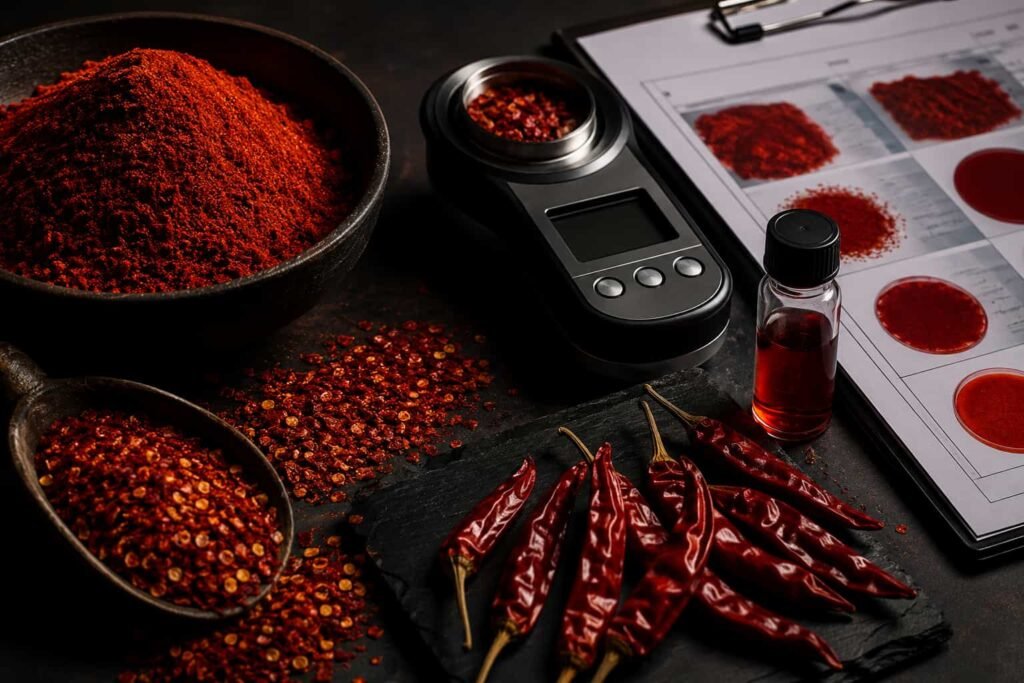
Serious chilli buyers stopped asking about heat level a long time ago. What actually determines whether a shipment clears customs, gets used in production, or gets destroyed at the border is a set of laboratory results and most rejections trace back to the same handful of test parameters. If you’re importing dried chilli in any form, these are the five results you should be asking for before you place an order, not after the container is already at sea.
Why This Is Far More Important Than Flavor
Dried chillies are among the spice groups most commonly reported to the EU’s Rapid Alert System for Food and Feed, with mycotoxin contamination among the recurring concerns — aflatoxins and ochratoxin A in particular, rather than flavour or pungency. A shipment might taste and smell just like they expected, only to be rejected outright because it fails some threshold for a mycotoxin that has nothing to do with sensory quality. That is a change in mindset that buyers need to adopt, because chilli sourcing is first and foremost a laboratory decision, secondarily a culinary one.
Test 1: ASTA Colour Value
ASTA colour value (developed by the American Spice Trade Association) — a numerical unit that indicates the extractable red colour pigment in chilli. This is the standard that has been adopted industry wide for quantifying colour strength and consistency – vital for seasoning manufacturers or private-label brands where each batch must match the colour profile their formulation was designed around.
Typically, low or variable ASTA is associated with either poor quality raw material, sun damage during drying or prolonged storage that has caused pigment degradation. ASTA tests are typically done when you need to know what range of values a finished batch will fall within, and if your input lies outside that specified range, it is not merely cosmetic because the difference may affect how the product performs and it may not perform well in a finished blend; This problem may necessitate reformulating mid-production run; very expensive. Never just ask for a general description — always request ASTA on the CoA
TACEU number: Test 2 – Aflatoxin B1 and Total Aflatoxins
Aflatoxins are toxic compounds produced by some species (e.g. Aspergillus flavus, Aspergillus parasiticus) of the Aspergillus fungus; they are responsible for the largest number of bans or seizures at points of entry into EU countries for dried chillies. The EU establishes both specific limits for aflatoxin B1 and total combined aflatoxins, and those limits are enforced without a tolerance band of “close enough.”
Mycotoxins become a problem due to poor drying, storing in humid conditions or a delay between harvest and processing of chillies. Relying on their appearance or smell simply won’t cut it in reliably detecting it; that’s why lab-testing is non-negotiable, not a nice to have. Instead, any supplier that cannot provide an up to date aflatoxin B1 and total aflatoxin result on demand (before or after a price has been agreed) should be treated like a customs risk: because it is.
Test 3: Ochratoxin A
Ochratoxin A, another mycotoxin produced by different molds than aflatoxin, needs its own dedicated test; good result on an aflatoxin test is not a clear ochratoxin A result. Ochratoxin A is also a common cause of rejection because it has been routinely tested at entry points, and an EU maximum limit for ochratoxin A in dried spices is also fixed as mentioned previously.
Ochratoxin A risk, like that of aflatoxin, is closely associated with post-harvest handling: chilli that sits for too long at high moisture before drying or is stored in poor conditions afterward is at greater risk even if the crop itself was grown well. Buyers must request ochratoxin A as a separate line item on the CoA; do not take for granted that it is included in a “mycotoxin screening” statement.
Test 4: Microbial Safety
Microbial testing addresses the pathogen and spoilage-organism portion of the risk profile, which often includes total plate count, yeast and mold counts, as well as pathogen screens (e.g., Salmonella, E. coli) depending on destination market requirements. This is especially relevant for buyers of chilli used in ready-to-eat seasoning blends or items that are not subject to further heat processing before being delivered to the consumer.
Dirty drying conditions, contact with dirty surfaces during processing and unfit packaging that allows moisture while travelling all increase the risk of microbial contamination. If you are selling food safety-certified products, a CoA that outlines microbial findings within your market limits is generally called due diligence by buyers, and often the expectation in a mandatory document rather than an optional one.
Test # 5: Screening for artificial colour and Sudan dye
This is the test that catches deliberate adulteration rather than incidental contamination. Sudan dyes (Sudan I to IV)—carcinogenic industrial red azo dyes banned for food use—have been used in the past to enhance the red colour of poor quality chilli powder, to disguise low ASTA value or degraded pigment. One of the quickest ways for an entire brand to have its shipping history flagged for more stringent review at customs is when a shipment tests positive for Sudan dyes, as this indicates intentional adulteration as opposed to something introduced accidentally during processing.
However, any chilli powder or crushed product obtained from suppliers offering unusually vivid colour at a low price should be screened specifically for Sudan I-IV before import. It is different from ASTA colour value; a product can pass an ASTA reading with added dye, so ASTA alone cannot be used as a replacement for dye screening. For buyers sourcing chilli powder for private-label or retail goods, screening at source for Sudan dye should be treated as a non-optional step: given the health threat and potential reputational damage if the product tests positive downstream.
Moisture & Water Activity: The Driver of Everything Else
The majority of these risks can be tied back to a single common denominator: moisture control during drying, packaging and transport. High moisture content does not only lead to mold growth directly, it is also the main factor that determines water activity — an independent measurement of how much of the moisture present in plant material is available for microbial growth and mold growth, or bound within the plant material.
Thus, two batches of chillies may show similar moisture percentages but different conditions and methods can result in significantly different water activity levels. What keeps a shipment stable and prevents mold from developing during transportation — especially on long-haul sea freight routes to places like the EU or North America — is controlling these factors both during drying and by using sealed, moisture-barrier packaging during shipping.
Whole Chilli, Crushed Flakes, and Powder Carry Different Risk Levels
Format matters as much as origin when it comes to risk exposure. Whole dried chilli has the lowest surface area exposed to moisture and contamination, and defects are visible on inspection, making it the lowest-risk format, generally speaking. Crushed flakes have significantly more exposed surface area than whole pods, which raises both moisture sensitivity and the speed at which mold or pigment degradation can develop if storage conditions aren’t controlled. Powder carries the highest risk profile of the three: maximum surface area, the format most commonly targeted for Sudan dye adulteration (since color deficiencies are easiest to disguise once ground), and the format where a contamination issue is hardest to detect visually before lab results come back.
This is a useful rule of thumb for buyers building a testing budget: if you’re sourcing powder rather than whole pods, your testing rigor should increase accordingly, not stay the same because “it’s still chilli.”
What This Means for Your Sourcing Checklist
Before placing a bulk order, request a CoA that itemizes all five results individually: ASTA colour value, aflatoxin B1 and total aflatoxins, ochratoxin A, microbial safety panel, and Sudan dye screening along with moisture and water activity figures. A supplier offering a general “quality certificate” without these specific line items hasn’t actually demonstrated the shipment is import-ready; they’ve demonstrated it exists.
At Harmain Global, every batch across our dry red chilli products whole, crushed, and powder is tested against this full panel before shipment, as part of the standards outlined on our processing standards page. If you’d rather see the data before committing to volume, you can request lab-tested chilli samples directly.