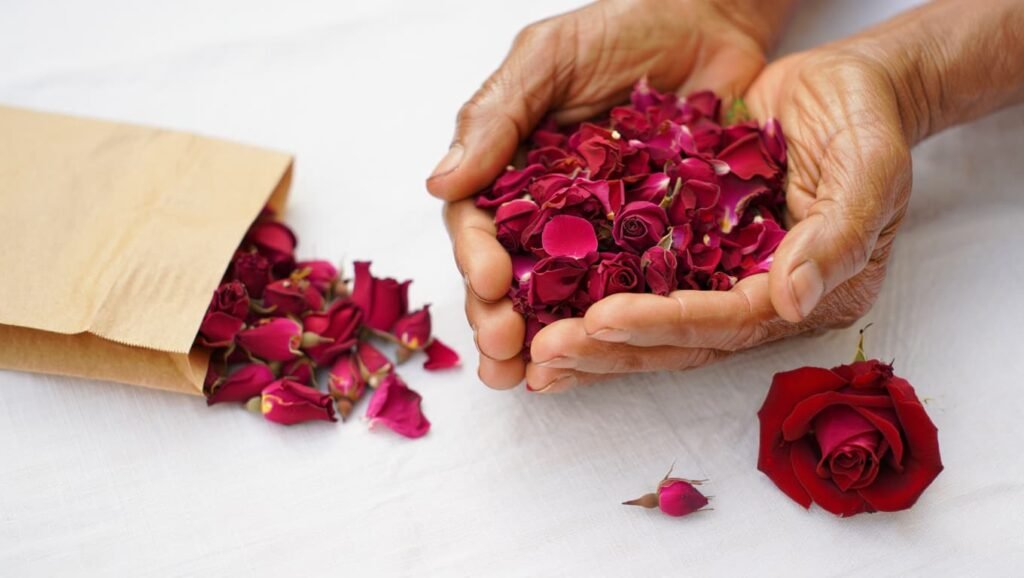
Muhammad Aslam is already in his field before the sun has decided fully to rise, before sunshine has brewed its first chai of morning, and before a majority of the world rolls over deciding it wants to be awake. He walks the rows slowly, deliberately with an unhurried confidence only someone who has enacted this for forty years can understand and know beyond any doubt that you cannot rush it. There are roses all around him, stretching to distance that no camera can photograph within a politeness set. Deep crimson, impossibly fragrant, nodding slightly in the cool pre-dawn air like they are greeting him. He does not say much. He does not need to. His hands already know what to do.
This is where your rose petals come from.
Not a factory. Not a processing warehouse in an industrial estate somewhere outside a city you have never visited. A field. A farmer. A relationship that is older than most of the companies currently trying to sell you “premium botanical ingredients.” And if that sentence alone does not make you want to call Harmain Global and ask for a sample, keep reading, because it gets better.
Pakistan Grows Roses the Rest of the World Cannot Replicate
Here is something that does not get said enough in the global botanical trade: Pakistan is genuinely extraordinary when it comes to roses. Not “pretty good.” Not “a decent source.” Extraordinary. And the reason comes down to three things that money cannot manufacture, climate, tradition, and stubbornness.
The rose farms that supply Harmain Global’s rose products sit across two primary regions: the Sindh corridor around Hyderabad and Masu Bhurgri, and the Punjab belt spanning Multan, Pattoki, Tibba Sultanpur, and stretching toward Lahore. They both have a specific combination of dry heat, rich alluvial soil and long growing seasons that will deliver rounds with extraordinarily dense colour, high concentration of fragrance and a natural medicinal potential far superior to any Rosa damascena grown elsewhere. You may try cultivating that particular species in a greenhouse within the Netherlands. People have. The roses grow. The petals do not smell the same. The colour does not hold the same way. The cosmetic and tea industries that know what they are looking for come back to Pakistan every single time.
Then there is the harvesting tradition. Muhammad Aslam does not send machines into his fields at noon with mechanical fingers that strip the blooms indiscriminately. That is not how this works, and every serious buyer of handpicked Pakistani rose buds knows exactly why it matters. Roses are harvested by hand, at dawn, when the bloom is fully open, but the heat has not yet driven off the fragrance oils. A few hours later, those oils, the ones that make the tea taste like something from another century, the ones that give the cosmetic formula its edge, have partly evaporated into the morning air. You cannot harvest them back. You either pick at dawn or you pick a lesser flower. Muhammad Aslam has been picking at dawn since 1985. His workers know this. His fields are scheduled around this. There is no negotiating with the sun.
Next, the drying process cannot be ignored. Sun-drying without the chemicals, without sulfur, none of those shortcuts that turn a beautiful deep red petal into a faded cardboard smelling remnant of what it was. Petals are placed meticulously onto clean shaded surfaces with full air circulation and dried slowly until the moisture content reaches a level that preserves aroma, colour and active components. No accelerants. No cutting corners. This means a product lands in its destination nation looking and smelling like something picked 1 week prior, not a half year ago as the drying has been done legitimately since day one.
1985: A Handshake That Became a Supply Chain
When Harmain Global was founded in 1985, Pakistan’s agricultural export sector looked very different. The formalized certifications, the phytosanitary documentation, the international buyer audits, these were future problems. What existed then was something arguably more reliable: reputation. You were only as good as your word, and your word only meant something if your product consistently matched it.
The founder of Harmain Global met Muhammad Aslam’s family through the agricultural networks of Sindh at a time when the company was still figuring out exactly what it wanted to export and to whom. What they found in that rose farm was not just a product. It was a philosophy. The family grew without chemical additives. They harvested properly. They dried carefully. They took no shortcuts because shortcuts showed up eventually in the product, and a bad product was bad business. Two philosophies aligned, hands were shaken, and forty years later, that handshake is still the foundation of every shipment of export-quality dried rose petals that leaves Pakistan under the Harmain Global name.
What does four decades of continuity actually mean to an international buyer? It means the rose petals you ordered in your third year of working with Harmain Global look, smell, and test the same as the rose petals you ordered in your first year. It means there is no supply chain roulette, no “our usual supplier had a bad season, so we sourced from somewhere else” surprise, no batch-to-batch quality lottery. The farm is the same. The practices are the same. The family growing the roses has been doing it long enough that the plants themselves, the root systems, the soil microbiome, and the seasonal rhythms are tuned to produce at the highest possible level. This is not a marketing claim. This is what happens when human knowledge accumulates in one place over four decades.
From Field to Freight: What Muhammad Aslam Actually Grows
Three products come out of this farm, and each one serves a different corner of the global botanical market with a different purpose.
The dry red rose petals are the broadest category and the most versatile. Tea manufacturers use them in luxury rose blends and floral infusion lines. Cosmetic brands incorporate them into facial masks, toners, bath soaks, and exfoliant formulations. Food manufacturers use food-grade rose petals in confectionery, gulkand preparations, and premium culinary applications. The petals are cleaned, graded by size and colour consistency, and packed under food-grade conditions. They arrive intact, deeply pigmented, and smelling exactly as rose petals should smell — which sounds obvious but is apparently a higher bar than the industry average would suggest.
The dry rose buds serve a slightly more specialized buyer: the premium tea companies, the herbalists, the aromatherapy product formulators who want the visual drama of a whole bud floating in a cup or sealed in a glass jar on a wellness shelf. Dried rose buds from Pakistan have become a known hallmark of quality in the global loose-leaf tea marketplace, and buyers sourcing from Harmain Global receive full traceability back to this one farm relationship. The buds are harvested at the perfect stage when they are still well shaped yet not fully opened, using maximum fragrance and a striking appearance. Sun-dried without chemical intervention. Graded for uniformity. Perfect for the kind of buyer whose customer will hold the jar up to the light before purchasing it.
The dry red rose flower, the whole bloom, dried intact, is the luxury end of the range. These go to high-end floral tea brands, to decorative botanical wholesale buyers, to perfumery houses sourcing rosewater raw material, and to traditional medicine formulators who want the complete flower for specific applications. Growing and drying a whole flower without losing its structural integrity requires even more care than petals or buds. The harvesting timing, the drying conditions, the handling at every stage, it all matters more when the final product needs to arrive looking like a flower and not like what happens when someone tries to dry a flower poorly. Muhammad Aslam’s team has this dialed in. They have had forty years to dial it in.
After harvesting and drying, Harmain Global takes over the certification and quality assurance side. Every batch goes through testing, COA per batch, phytosanitary certification, certificate of origin, Halal certification, and SGS or Bureau Veritas verification, depending on buyer requirements. Visit this page to understand the full scope of documentation available. The farm does the growing. Harmain does the verifying. The buyer gets a product they can take directly to their regulatory team without apologizing for it.
Why the World Wants Pakistani Rose Petals Specifically
The global market for dried botanicals has exploded in the last decade, and rose petals sit at the intersection of multiple high-growth industries simultaneously. The tea industry wants them for luxury blends. The skincare industry wants them for clean beauty formulations. The perfumery world wants them as a natural fragrance raw material. The herbal supplement sector wants them for their antioxidant properties. The aromatherapy industry wants them for mood and wellness applications. The functional food sector wants edible rose petals, food-grade Pakistan, for confectionery and health products. Everyone, essentially, wants rose petals, and the buyers who know what they are doing come to Pakistan to get them.
The reason is not just tradition or sentiment. It is measurable. Pakistani sun-dried rose petals from the Sindh and Punjab growing regions consistently show higher essential oil retention than conventionally dried alternatives from other origins. The natural drying process preserves the flavonoids and antioxidant compounds that cosmetic and herbal formulators are actually paying for. The absence of sulfur treatment means the colour is natural and the scent is authentic, which matters enormously to any brand whose customer base can tell the difference between real rose fragrance and a chemical approximation of it. When you are putting premium dried roses from Pakistan into a luxury product at a premium price point, “authentic” is not optional.
Harmain Global’s position in this supply chain is also worth understanding. They are not a broker. They are not buying from the spot market and repackaging. They have a direct, decades-long relationship with the farm producing the product, which means they have visibility into every stage of the supply chain in a way that casual buyers cannot replicate by calling a random exporter and asking for a quote. Ethical sourcing is not a marketing phrase here. It is the actual structure of how the business operates.
The Business Case for a 40-Year Relationship
Let us be direct about something that the “supplier diversity” crowd sometimes loses track of: stability is a competitive advantage. When you are building a product, whether it is a tea blend, a skincare line, a herbal supplement, or a botanical extract, your supply chain consistency is part of your product quality. If your rose petal supplier changes every two years because you are always chasing the lowest price, your formula changes. Your colour changes. Your scent profile changes. Your customers notice even if they cannot articulate why. They just stop buying.
The brands that have been sourcing bulk rose petals for tea and cosmetic applications from Harmain Global for multiple years are not doing it because they have run out of alternatives. They are doing it because consistency has a dollar value, and that value compounds over time. A supplier relationship that is forty years old has been tested through bad seasons, through shipping disruptions, through regulatory changes in multiple countries, through global price shocks — and has survived all of it. That is not luck. That is infrastructure.
Muhammad Aslam did not build a forty-year supply relationship by accident either. He built it by growing the same high-quality product year after year, by maintaining his farming practices even when cutting corners would have been cheaper, and by understanding that his reputation as a farmer is inseparable from the reputation of the exporter whose name goes on the shipment. Check this out if you want to understand the full range of rose products available from a supply chain that has been tested by four decades of international trade.
This Is Not a Faceless Supply Chain
There is a tendency in the global commodity trade to talk about botanical ingredients as if they materialize in a warehouse by themselves. As if “Pakistani rose petals” is just a product category and not, specifically, the result of someone waking up before sunrise every morning during harvest season and making a series of careful, skilled decisions about when to pick and how to dry and how to handle a product that is genuinely alive until it is not.
Muhammad Aslam is that someone. His family has been that someone since 1985. And Harmain Global — the company that verifies, certifies, grades, and ships these export-quality rose flowers from Pakistan to buyers in Europe, North America, the Middle East, and beyond — is the bridge between that field in Sindh and your production line.
If you are a tea brand looking for bulk dried flowers from Pakistan with full documentation, you are looking at the right supplier. If you are a cosmetic manufacturer sourcing rose petals for skincare formulations with Halal certification and SGS testing, this is the supply chain you want. If you are a perfumery house or herbal supplement company looking for a trusted rose petals exporter in Pakistan with traceability going back forty years, there is a farmer in Sindh who has been growing exactly what you need since before most of your competitors existed.
Learn more here and reach out to Harmain Global directly. There is a real farmer, a real relationship, and a real product behind every shipment. Tell them Muhammad Aslam’s roses sent you.