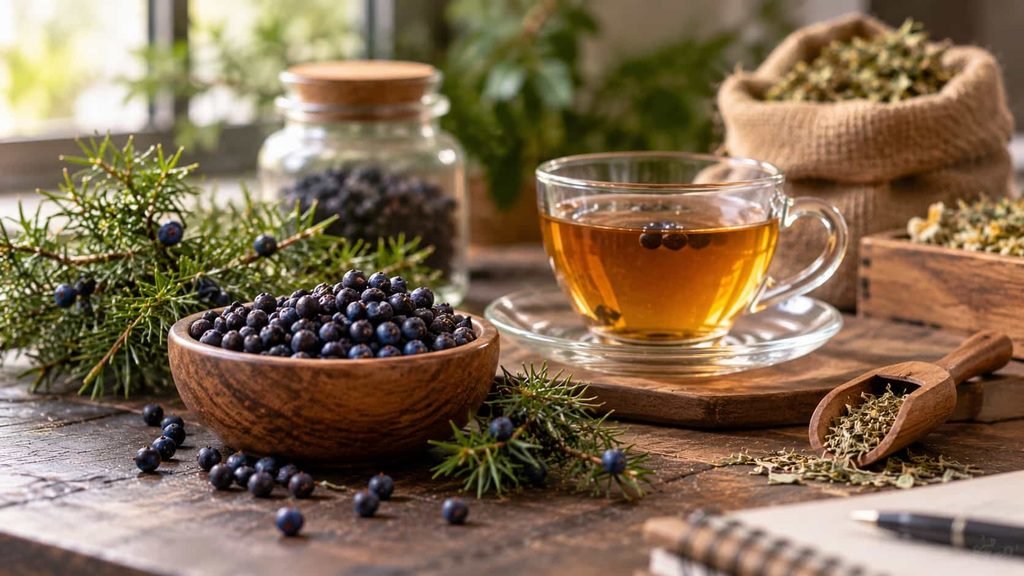
Everyone knows about juniper and gin, but very few people know about juniper and tea. That seems strange since the berry did not sign a contract with any distillery. Somewhere along the way it earned its keep as a gin ingredient and the name stuck, like a nickname you got at fourteen and still cannot shed. This is the berry’s other life, the quieter one in tea blending rooms and herbal workshops, and a case for why the people who run those places should care where their juniper comes from.
Begin with how the product is actually described. Juniper berries are valued first for culinary, medicinal and herbal purposes, and gin is only one of several uses in that picture, not the whole of it. If you manufacture herbal products, that matters because juniper berries for herbal manufacturers is not an odd request that needs special explaining to a supplier. It is a standard application of a well-known botanical. Many blend manufacturers have simply never included it in their procurement lists, as much of the discussion regarding juniper takes place in bars.
A good juniper berry is hard to forget once you have met it: mildly piney, with a bright citrus cut running underneath, as if a forest had happened to grow near a lemon tree 🌲🍋 A blender who understands that profile can do a lot with it. A few whole dried berries in a blend bring a lift and resinous depth that many other botanicals can’t replicate. That is why juniper berries for herbal tea production deserve a spot on the shelf next to the more obvious ingredients. Juniper berries aren’t a novelty; rather, they’re a friend who was never invited to the tea party.
Juniper has a long history in traditional remedy preparation and turns up in established herbal practice, including a European Union herbal monograph on juniper berry from the European Medicines Agency, which is why we touch on it lightly here, in general terms and without turning it into promises. Nobody reading this needs a list of conditions from us. For a manufacturer the question is simpler: the berry already belongs to herbal formulation, so finding a juniper berries traditional remedies supplier you can rely on is a purchasing decision, not an act of faith. Your regulatory authorities and your formulators determine what you may claim on your product labels. A supplier’s job is to give you a clean, consistent ingredient and the paperwork that goes with it 🌿
So what does a herbal manufacturer need that a gin distiller doesn’t? Slightly different things, as it turns out. A distiller steeps the berries into a spirit, so aroma is what counts most. A tea blender or remedy producer often puts whole dried berries straight into a blend or a traditional preparation, which makes the berries themselves the finished ingredient. Whatever is in the bag ends up in the cup. That puts a premium on consistency, because a recipe only stays a recipe if batch twelve behaves like batch one. It also makes grading and cleaning more than a nice extra. If you are a wellness company shopping for bulk juniper berries for supplement brands, the same logic applies, only with more scrutiny on what sits behind the ingredient.
And that brings us to the not-so-glamorous issue that runs through it all: hygiene and paperwork. If it is something designed to be swallowed, the bar is higher. A distillation input gets transformed, filtered and heavily processed before anyone drinks it. A tea ingredient does not get that kind of second chance. Hygienically processed berries matter because no later step will save a sloppy one 🧼 Your own end product should also have a story to tell, connecting each ingredient back to its place of origin. A lab tested juniper berries supplier who can back that up with a Certificate of Analysis gives you something solid to attach to your own batch records. For anyone doing juniper berries medicinal use sourcing in a serious way, traceability is not a bonus feature. It is the whole point 🔬
Let’s look at the map for a moment, because interest in herbal tea and traditional remedies is not evenly spread around it. Herbal tea and wellness cultures exist in depth in the United Kingdom, the Netherlands and Finland. Shelves are stocked with various types of blends, and consumers read the ingredient list like most people would read a book. There is also a very active wellness and supplement scene in Canada and Australia. Singapore is a busy trade center. Georgia, Indonesia, Brazil, South Africa, Ecuador, the Philippines, Uruguay and Zimbabwe all have their own herbal traditions and a market for botanical ingredients. Whether you own a tea business in Utrecht, a remedy workshop in Surabaya, or a wellness brand in Cape Town, you may want to join in on this discussion regardless of what time zone your coffee is in ☕
And then comes the question that every brand in growth mode will eventually ask: can I put my own name on it? Premium grade, hygienically processed berries are one half of the answer. Custom bulk packaging and private labeling are the other half, available for tea and wellness brands building their own line. Say what you need early, because label and pack decisions are easiest when they are settled before anything is sealed. A verified juniper berry exporter for herbal brands that understands this saves you the awkward back and forth later, and a trusted botanical exporter for herbal manufacturers will not blink when you ask 🎯
Juniper has other lives, too, mind you. It features in charcuterie and preserved meats, and that story could fill another article, as could the practical side of placing a large order once you are ready to go from curiosity to actual berries. Think of them as individual rooms within a single home. They are connected to each other, and as you explore each room, the label of “gin” becomes less and less applicable to juniper.
And this is where Harmain Global comes into the picture. We know juniper beyond the still, and we work with herbal tea blenders, traditional medicine makers and wellness lines that want a supplier who speaks about the berry the way they do. You can browse our full product range first, visit our juniper berries page for the details, or read our guide to bulk juniper berry export if you are ready to order.
So here is the shift, quietly, the way good shifts happen. You walked in thinking juniper belonged to gin. You leave seeing an ingredient with a flavor worth blending, a place in traditional herbal practice, and a supply path built around cleanliness, documentation and consistency. Tell us about your brand, your market and what you are making. Ask about samples, documents, packaging and anything else on your mind. The berries have waited a long time to be asked about tea. Go ahead and ask 🎉