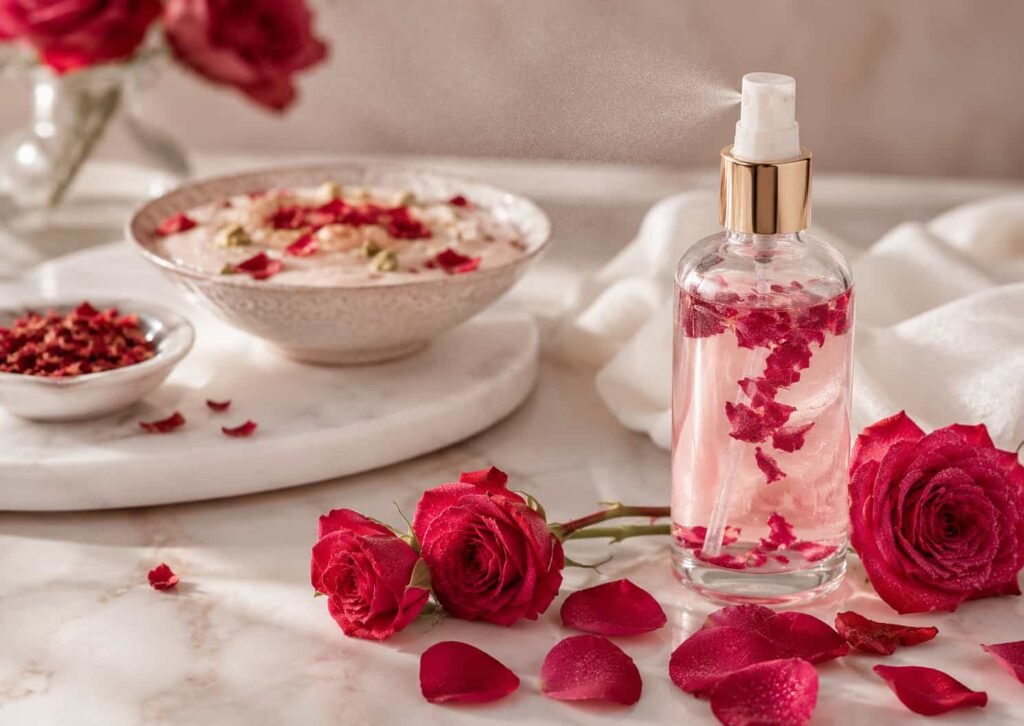
Rose water sits at an unusual intersection: the same steam-distilled liquid can end up in a skincare toner, a spa treatment room, a batch of baklava, or an aromatherapy diffuser blend. But “rose water” is not one product with one specification. Cosmetic-grade and culinary-grade rose water are produced, tested, and documented differently — and buyers who source the wrong grade, or source without the right paperwork, run into compliance problems long before they run into quality problems.
This guide breaks down what actually separates the two grades, and what documentation each type of buyer — skincare brand, food manufacturer, aromatherapy label, salon, spa, halal retailer, or private-label distributor — should be requesting before placing an order.
Same Distillation, Different Endpoint
The two grades normally start with the same process: fresh rose petals (usually Rosa damascena) are steam distilled, extracting volatile components as steam permeates through the flowers and condenses to yield rose water, with rose oil separating as a co-product in higher-yield distillations. It is not the distillation method itself that typically differentiates cosmetic from culinary grade, but rather petal sourcing, processing hygiene, filtration, and downstream testing.
Petal quality matters more than most buyers assume. Petals harvested with agrochemical residue, handled in unhygienic conditions, or stored too long before distillation carry that risk profile into the final liquid, regardless of grade label. Buyers sourcing either grade should ask for information on petal origin and harvest handling, not just the finished product’s test results, since contamination introduced at the petal stage is not something a lab test always fully captures after the fact.
Cosmetic Grade: Built Around Skin Contact and Regulatory Filing
Cosmetic-grade rose water is produced and tested mainly for skin application. This generally means tighter microbial testing (including total viable count, yeast and mould, as appropriate for leave-on and rinse-off skin products, pathogen screening), documented preservative-free or preservative-system status, and batch-to-batch consistency suitable for toners, facial mists, micellar formulations, and spa treatment use.
For the skin care and spa buyer, “preservative free” is a meaningful claim; preservative-free status downstream impacts packaging choices, storage directions and formulation decisions — a preservative-free rose water requires different handling, packaging, and often refrigeration guidance compared to a version with a preservative system. Only by asking suppliers to explicitly put in writing whether or not their product is preservative-free and what shelf life and storage conditions that claim implies can buyers be assured they are really getting a free-of-preservative product.
The Regulatory Layer: EU, UK, and the Responsible Person
For any skincare brand marketing and selling finished cosmetic products containing rose water into EU, prior notification is required through the Cosmetic Products Notification Portal (CPNP) in accordance with the requirements laid out by Regulation (EC) No 1223/2009 before a product can be placed on the market within the EU. This notification can only be made by a legally established Responsible Person in the EU so brands based outside the EU need to appoint one before selling into the region.
The UK runs an entirely different system. Since Brexit, Great Britain has needed its own Responsible Person and separate notification to the Submit Cosmetic Product Notification (SCPN) system — brands operating in both EU and Great Britain need to meet the separate notification requirements for each market, with an EU Responsible Person for the EU and a UK Responsible Person for Great Britain.
Underpinning both notifications is the Cosmetic Product Safety Report (CPSR), a safety assessment prepared by a qualified safety assessor covering the finished formulation’s ingredients, exposure, and toxicological profile. A rose water supplier cannot complete a brand’s CPSR on its behalf, but a well-documented raw material — with a clear ingredient specification, microbial data, and any relevant allergen declaration — makes the safety assessor’s job faster and the CPSR more defensible. Buyers should request a raw-material specification sheet formatted for CPSR use, not just a generic product data sheet.
Label requirements for finished cosmetic products sold in the EU and UK include INCI-compliant ingredient naming, Responsible Person contact details, batch code, and any required warnings — all of which trace back to accurate raw-material documentation from the rose water supplier.
Culinary Grade: Built Around Food Safety, Not Skin Contact
If rose water was food or beverage grade, the formulation and testing would be specifically for ingestion instead of topical use; therefore the testing priorities change. Documentation for food grade processing should include suitable relevant microbial testing, confirmation of the conditions of equipment and processing facility as being appropriate and – importantly, with regard to halal retailers and somewhat halal-conscious food manufacturers a halal certification or declaration confirming no cross-contamination with non-halal processing lines or additives.
Food producers that use rose water to flavor baked goods, beverages, or confectionery should request a food-grade Certificate of Analysis in addition to standard import documentation (i.e., commercial invoice, packing list and phytosanitary / health certificate as necessary to the destination country), since some food safety authorities around the world treat imported flavoring liquids differently from cosmetic imports on entry under customs law.
Aromatherapy brands are in a slightly different category again — their products are also not swallowed, but depending on the market and claims they won’t necessarily be de facto registered as cosmetics either, so purchasers from this space should get clarity with their respective regulatory counsel whether they’re looking for cosmetic-grade documentation, food-grade documentation or both based on what product/market combination.
Private Label and Bottle Format Considerations
Selection of grade should be solidified prior to bottle format & branding choices, not after for private-label buyers and distributors. Cosmetic-grade rose water en route to spa and skincare retail, usually finds its way into glass vessels with fine mist or pump dispensers which is consistent with skin-contact use and the intended retail positioning. Food grade rose water used in food manufacturing or retail is more typically shipped as bulk food grade containers or smaller retail bottles sized for kitchen use, with labelling that highlights food-safety and halal information over skincare claims.
Harmain Global supplies steam-distilled rose water in both cosmetic and culinary grades, alongside dry rose petals for buyers sourcing further upstream. For brands building a private-label rose water line, our private label programme covers grade selection, bottle format, and documentation aligned to your target market from the outset — reducing the back-and-forth that typically happens when grade and compliance requirements are addressed only after production has begun.
The Documentation Checklist, By Buyer Type
Skincare and spa buyers need: microbial CoA, preservative status declaration, shelf-life and storage guidance, and a raw-material specification suitable for CPSR preparation. EU-facing brands additionally need a Responsible Person and CPNP notification; UK-facing brands need a separate Responsible Person and SCPN notification. Food manufacturers and halal retailers need a food-grade CoA, halal certification, and standard import/customs documentation. Private-label distributors need all of the above matched to the specific grade and market their finished product will enter — requested and confirmed before, not after, committing to a bottle format and label design.