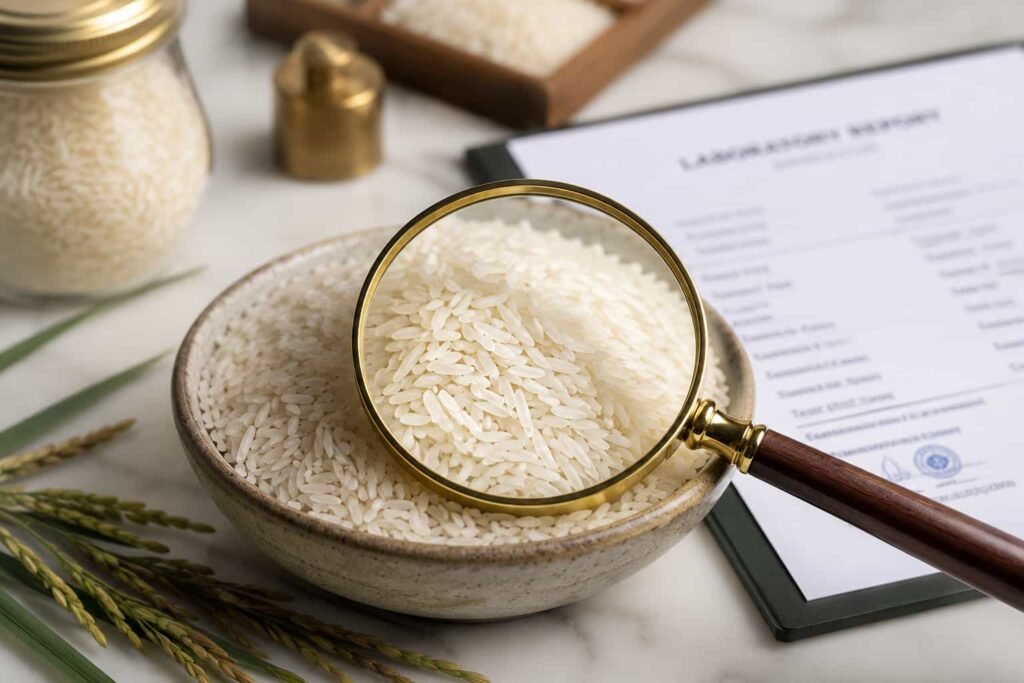
Basmati is one of the most imitated grain names in global trade. Long-grain aromatic rice grown far outside the traditional Basmati-growing regions of Pakistan and India is routinely blended with genuine Basmati or sold under the name outright, and buyers who don’t verify what they’re actually receiving end up with a product that fails on aroma, cooking behavior, or both once it reaches the end consumer. For importers, wholesalers, and private-label brands, authentication isn’t a formality — it’s the difference between a repeat customer and a returned container.
Why Basmati Authenticity Has Become a Legal Question, Not Just a Quality One
The stakes around Basmati origin have moved beyond commercial reputation and into regulatory territory. Pakistan filed an application to register “Basmati” as a protected geographical indication in the EU, published in 2024 — a move that reflects how seriously origin-producing countries now treat unauthorized use of the name. For buyers, this signals a market direction: geographical indication protection typically brings tighter enforcement and clearer legal standing for origin disputes, which means sourcing decisions made today on loosely verified “Basmati” could face compliance scrutiny that didn’t exist a few years ago.
That regulatory backdrop is exactly why serious buyers no longer accept a supplier’s word on variety and origin. They ask for evidence.
DNA Testing: The Adulteration Detector Sensory Testing Can’t Replace
Basmati adulteration typically takes one of two forms: blending genuine Basmati with cheaper long-grain rice varieties, or selling non-Basmati aromatic rice under the Basmati name entirely. Both are difficult to catch through visual inspection or even cooking tests, especially when the adulterating variety has been chosen specifically because it resembles Basmati in grain shape and length.
DNA marker testing solves this by identifying variety at the genetic level rather than relying on physical characteristics that can be selectively matched or disguised. Laboratories use molecular markers specific to authenticated Basmati varieties to determine what percentage of a sample is genuine Basmati DNA versus non-Basmati rice DNA — producing a quantifiable adulteration percentage rather than a subjective quality opinion. A buyer receiving a shipment with, say, 15% non-Basmati content mixed in isn’t dealing with a marginal quality issue; they’re dealing with a mislabeled product, and DNA testing is the only method that reliably proves it either way.
For high-volume importers and private-label brands building a Basmati product line, requesting DNA authentication test results — not just a variety declaration on the CoA — is becoming standard due diligence, particularly for shipments destined for markets with GI enforcement infrastructure.
Why 2AP Aroma Matters as Much as Grain Length
Basmati’s defining sensory characteristic isn’t just its long grain — it’s aroma, and the compound responsible is 2-acetyl-1-pyrroline (2AP), recognized as the principal aroma compound in fragrant rice varieties. 2AP concentration is what produces Basmati’s characteristic popcorn-like fragrance during cooking, and it’s a measurable, quantifiable compound rather than a subjective tasting note.
This matters commercially because 2AP levels vary by variety, growing conditions, and post-harvest handling — meaning two batches that look identical and both carry a “Basmati” label can have meaningfully different aroma intensity. For ethnic food distributors and private-label brands whose customers specifically buy Basmati for its aroma, a low-2AP batch is a product quality failure even if the DNA test confirms genuine varietal origin. Buyers sourcing for aroma-sensitive markets should treat 2AP as a distinct quality parameter worth requesting alongside — not instead of — variety authentication.
1121 vs. Super Kernel: Two Premium Grades, Different Buyer Fit
Not all genuine Basmati is interchangeable, and two of the most commonly traded premium grades — 1121 and Super Kernel — serve slightly different buyer priorities.
1121 Basmati is known for exceptionally long grain length, extending further on cooking than most other Basmati varieties, along with strong aroma and a well-established international trading history. It’s a common choice for buyers prioritizing visual grain length and aging potential, since 1121 is frequently sold as aged rice with grain elongation improving over storage time.
Super Kernel Basmati is positioned as an even higher premium tier in many markets — typically distinguished by grain uniformity, milling quality, and consistency batch to batch, making it a frequent choice for high-end retail and premium private-label positioning where visual and textural consistency matters as much as aroma.
Neither grade is universally “better” — the right choice depends on whether a buyer’s end market prioritizes maximum grain elongation and aging characteristics (1121) or milling consistency and premium retail presentation (Super Kernel). Buyers should specify grade explicitly in an RFQ rather than requesting “Basmati” generically, since pricing and specification sheets differ meaningfully between the two.
The Documentation Stack Buyers Should Request
Authentication and aroma testing matter, but they sit alongside a broader documentation set that should accompany every compliant Basmati shipment:
- Variety declaration — a specific statement of which Basmati variety (1121, Super Kernel, PK-386, or other) is being shipped, matched against the DNA test results rather than asserted independently.
- Certificate of analysis (CoA) — covering grain length, broken grain percentage, moisture content, and other physical specifications relevant to the buyer’s intended use.
- Broken grain analysis — a specific breakdown of broken grain percentage, which directly affects both pricing tier and end-use suitability; higher broken grain content is acceptable for some processing applications but a defect for premium retail packaging.
- Moisture report — critical for storage stability during transit and warehousing; rice shipped above target moisture thresholds is at elevated risk of mold, insect activity, and quality degradation before it reaches the end customer.
- Phytosanitary certificate — confirms the shipment meets the destination country’s plant health import requirements; most customs authorities will not clear a bulk grain shipment without it.
- Fumigation certificate — documents that the shipment has been treated against storage pests prior to export, a standard requirement for bulk grain shipments on extended sea freight routes.
- Certificate of origin — issued through Pakistan’s Chamber of Commerce, establishing Pakistani origin for customs purposes and for any origin-based claims the buyer makes on their own packaging.
A supplier who provides this full set as standard practice — rather than needing to be asked for each document individually — is generally operating with export markets in mind, not just domestic trade. For buyers building a private-label Basmati line or supplying retail distribution, that distinction matters at audit time as much as at the point of purchase.
Sourcing With Verification, Not Assumption
Basmati’s commercial value comes directly from its authenticity — variety, aroma, and origin together, not any one of the three alone. A shipment that’s genuinely Pakistani-origin but tests low on 2AP will underperform on the shelf. A shipment with strong aroma but adulterated DNA content carries labeling and legal exposure the buyer may not discover until a dispute arises. Requesting DNA authentication, 2AP data, and the full documentation stack together — rather than treating any single test as sufficient on its own — is what separates a sourcing decision built on verified evidence from one built on a supplier’s assurance.
Explore our full range of Basmati rice products, including 1121 Basmati rice and Super Kernel Basmati, each shipped with full authentication and export documentation as standard practice.