Every serious supplier sends a Certificate of Analysis with samples and shipments. Most buyers glance at it, confirm it exists, and file it. That habit is understandable — the document is dense, the numbers look technical, and if nothing gets flagged at the border, there seems to be no reason to engage with it further.
But a CoA, properly read, tells you whether your supplier’s product will clear EU or US border inspection, whether your formulation will hit its active compound target, and whether you might be holding a batch that carries a contamination risk your own customers could trace back to you. A CoA you do not understand is not a compliance document. It is a liability you have not assessed.
This guide explains what to look for, what the numbers mean, and what should concern you — without requiring a food science background.
What a CoA Is — and What It Is Not
A Certificate of Analysis is a document issued by a laboratory certifying the test results of a specific batch of product. The operative word is batch-specific. The CoA applies to the lot tested — not to your supplier’s product in general, not to a previous shipment that performed well, and not to a reference sample from a different production run.
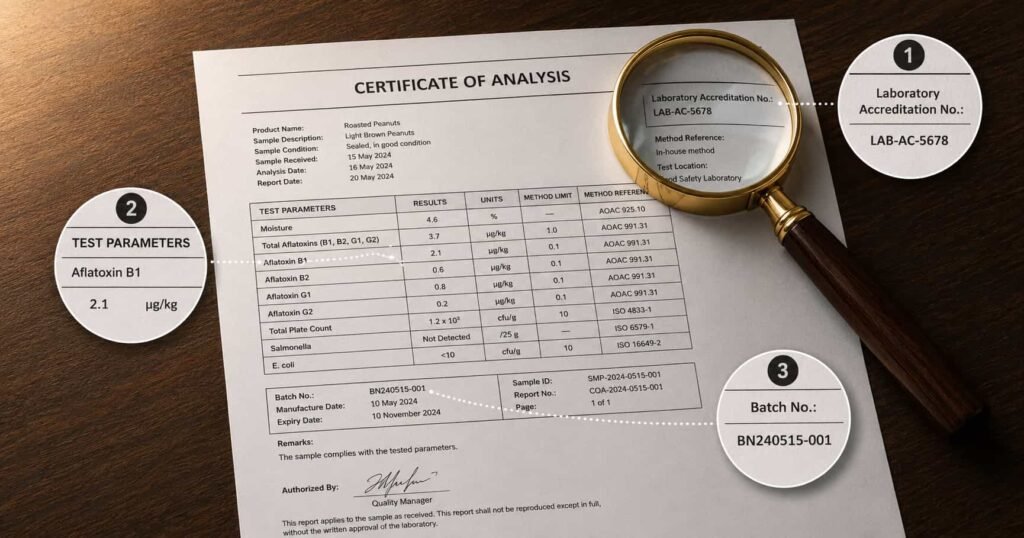
This matters practically. A supplier who provides a CoA dated six months ago, or one that carries a different batch reference than your delivery documents, is not providing you with meaningful quality assurance for the goods you are receiving. Before reading a single test result, check that the batch number on the CoA matches the batch number on your packing list and shipping invoice. If they do not match, request the correct document before clearing customs.
The second thing to check is the laboratory itself. An ISO/IEC 17025-accredited laboratory meets the international standard for testing competence and impartiality. This matters for a specific regulatory reason: under EU Implementing Regulation 2019/1793, which governs enhanced border controls on certain food and feed imports, only results from ISO/IEC 17025-accredited laboratories are accepted at EU border inspection posts for official control testing. Non-accredited lab results are not accepted for official controls, and many professional compliance teams will not accept them internally either. The laboratory’s accreditation number and the name of the accreditation body should appear on the CoA header. If they are not there, ask why.
The Parameters That Matter — Explained
A typical CoA for dried herbs, spices, or dry fruits will run 10 to 20 test parameters. Not all of them carry equal weight. The ones below are the ones that determine compliance, safety, and shelf suitability.
Moisture (%) — How dry the product is. High moisture creates mould risk during transit and storage, and accelerates aflatoxin development. For most dried herbs and spices, ≤10% is the standard specification. Anything above 12% warrants a question about storage and transit conditions.
Aflatoxin B1 and Total Aflatoxins (µg/kg) — Naturally occurring fungal toxins that form in improperly stored or dried agricultural products. Under EU Regulation 1881/2006 Annex, the limit for herbs and spices is B1 ≤5 µg/kg and total aflatoxins ≤10 µg/kg. If a CoA states only “within limits” or “compliant” without listing the actual numerical result, push for the number. “Within limits” begs the question: within whose limits? The EU threshold, the US threshold, and individual retailer standards are not the same figure.
Pesticide Residues — Should list the specific compounds tested and the numerical result for each, with a reference to EU MRL Regulation 396/2005 if the EU is your destination market. “Not detected” against an EU MRL panel is the correct result format. Vague assurances — “pesticide-free,” “no pesticides used,” “within acceptable limits” — without accompanying lab data are not test results. They are statements. Statements do not satisfy border controls.
Heavy Metals — Lead (Pb), Arsenic (As), Cadmium (Cd), Mercury (Hg) — EU Regulation 1881/2006 sets specific limits by product category. For spices, the lead limit is ≤0.9 mg/kg. Results must be numerical. A CoA that lists heavy metals as “pass” without a value tells you nothing about how close to the regulatory threshold the batch actually sits.
Salmonella — The result should read “Absent in 25g.” This is a binary test. Any result other than absence is a rejection criterion under EU food safety law, full stop.
Total Plate Count (TPC) — The total microbial load in the product, expressed in CFU/g (colony-forming units per gram). For dried herbs and spices, ≤10⁵ CFU/g is the accepted standard for most applications. Higher counts do not necessarily mean the product is unsafe — dried goods carry higher counts than fresh — but a result well above this threshold warrants follow-up on handling and hygiene conditions.
Product-Specific Parameters Buyers Often Miss
General CoA parameters apply across all herb and spice categories. But certain products have critical product-specific markers that standard templates omit — and if they are missing, the CoA is incomplete for your use case regardless of how clean the rest of it looks.
For black seed, the primary active compound is thymoquinone (TQ). TQ percentage should be measured by HPLC — high-performance liquid chromatography — not estimated from a generic range. If you are formulating a supplement or selling black seed on the basis of its active compound content, a CoA that does not include HPLC-verified TQ percentage is not adequate for your product claim.
For sesame seeds destined for the EU market, ethylene oxide (EtO) must be listed as not detected. EU authorities have been enforcing zero-tolerance controls on EtO in sesame since 2020 following a series of recalls. This is not an optional parameter — it is a border rejection risk if the CoA does not address it.
For chilli products, ASTA colour value and capsaicin or SHU level should both appear if the product is sold with a colour or heat specification. For dried fruits carrying a sulphur-free claim, SO₂ (sulphur dioxide) must be listed as absent. A CoA that does not include the parameter relevant to your product’s primary claim is, at best, incomplete.
Four Red Flags That Should Prompt a Conversation with Your Supplier
1. No laboratory accreditation number on the document header. Ask for the accreditation body name and number. Verify it independently if the shipment is high-value or high-risk.
2. Batch number on the CoA does not match your delivery documentation. Do not accept a reference CoA as a substitute. Request the batch-correct document before clearing customs.
3. Parameters listed as “pass/fail” or “compliant” without numerical results. A pass/fail result cannot be compared to a regulatory threshold. Ask for the raw numbers.
4. Key parameters for your destination market or product category are absent. Ethylene oxide for EU sesame, thymoquinone for black seed, aflatoxin for any spice or dried fruit — if it is not on the CoA, it has not been tested for this batch, or it has not been reported. Neither is acceptable.
A supplier who pushes back on any of these requests is giving you information about how they operate. A supplier confident in their product and their laboratory relationship has no reason to resist a batch-correct CoA from an accredited lab.
What to Expect from a Compliant Supplier
At Harmain Global, every commercial shipment includes a batch-specific CoA from an ISO/IEC 17025-accredited laboratory. The parameter set is matched to the destination market — EU-bound shipments include the full aflatoxin panel, pesticide residues against EU MRL Reg. 396/2005, heavy metals against Reg. 1881/2006, and product-specific parameters for the relevant category. You receive the CoA before shipment clears, not after it arrives at your warehouse. Our processing standards are designed to produce results that stand up to official control testing — not just to pass a supplier-selected lab.
If you want to see what a complete CoA looks like for any of our products — and compare it against what you are currently receiving — the most direct option is to request a sample.
See the standard in practice before you commit to a shipment.
Request a sample with full CoA and we will send you product alongside batch-matched documentation from our accredited laboratory. You will be able to read it against everything in this guide and compare it directly with what your current supplier provides.