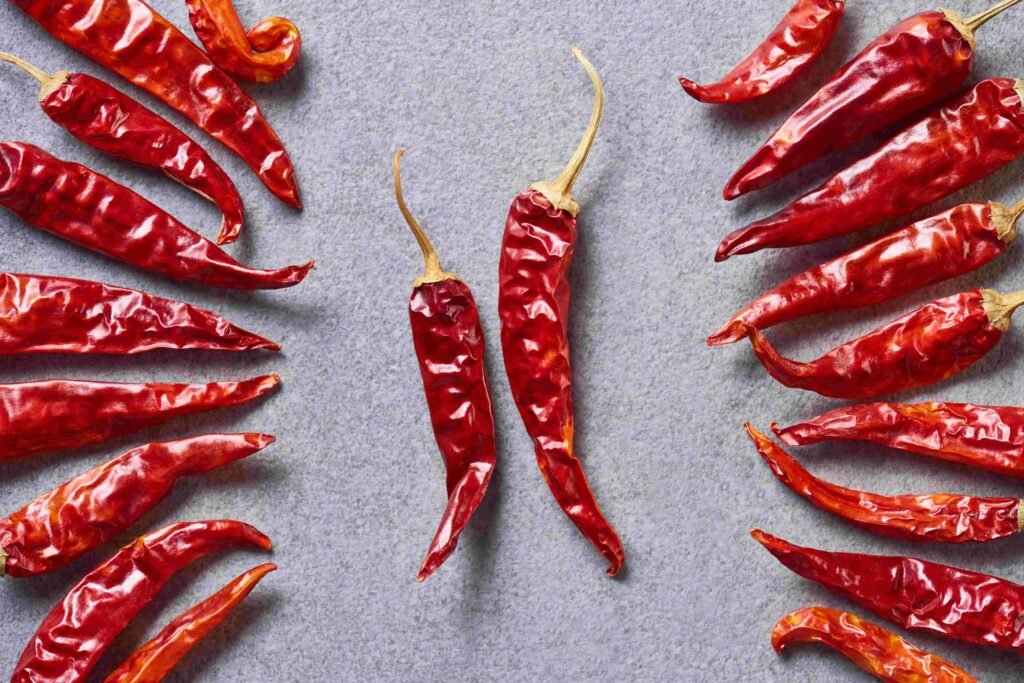
Ask ten importers what Pakistani red chilli they’re buying and most will say “Kunri Longi” or “Dundicut” as if the names are interchangeable. They are not — and that confusion, once it reaches your production floor, shows up as inconsistent colour in your curry powder, unexpected heat spikes in your blends, and the occasional phytosanitary headache at the border. Understanding the distinct categories of Pakistani red chilli varieties is not trivia. It is procurement discipline.
At Harmain Global, we have sourced directly from contracted Kunri farms since 1985. What follows is what we tell our buyers before they place their first order.
Longi Chilli: The Export Standard
Longi is the long, slender pod variety — 8 to 12 centimetres in length — grown in the Kunri belt of Umerkot district, Sindh, the same region that produces roughly 80 to 85 percent of Pakistan’s total chilli output. Pakistan itself is the world’s 4th-largest chilli producer, contributing approximately 7 percent of global exports, and Kunri is where that reputation was built.
Longi chilli sits in the 30,000–45,000 SHU range: serious heat, but not overwhelming. More importantly for processors, it delivers ASTA colour values at or above 100 — the benchmark most European and GCC spice buyers specify in their quality contracts. The flavour profile is smoky, earthy, and bold; dried Longi pods carry a complexity that survives grinding and still shows up in finished masala blends. That is precisely why Sri Lanka (21% of Pakistan’s chilli imports), Saudi Arabia (19%), and the UAE (16%) are the top destination markets — buyers in those regions are building flavour-forward products, and they are paying for it.
For your supply chain: if you are formulating masala blends or sourcing whole pods for restaurant-grade tempering oil, Longi Grade A is the correct specification. Request ASTA colour certification with every consignment — not every exporter tests to the same standard.
Kunri Chilli: The Medium-Pod Variety
Kunri is where the trade language gets loose. Buyers hear “Kunri chilli” in an export document and assume it means Longi, or assume it’s simply a place name with no varietal meaning of its own. Neither is accurate. Kunri is a distinct variety in its own right — a medium-sized pod, shorter and thicker than Longi, grown across the same Umerkot belt that gives the region its name.
Because Kunri sits between Longi and the smaller pod varieties in size, it’s often used where buyers want a balance of pod integrity and grinding yield without the full length of Longi.
The practical takeaway for procurement: “Kunri” on a purchase order should be treated as a variety name when your supplier means the medium pod, and as a geographic origin when it doesn’t. Ask which one you’re being quoted, and get the variety confirmed in writing rather than assumed from the region name.
Dundicut: A Processing Cut, Not a Variety
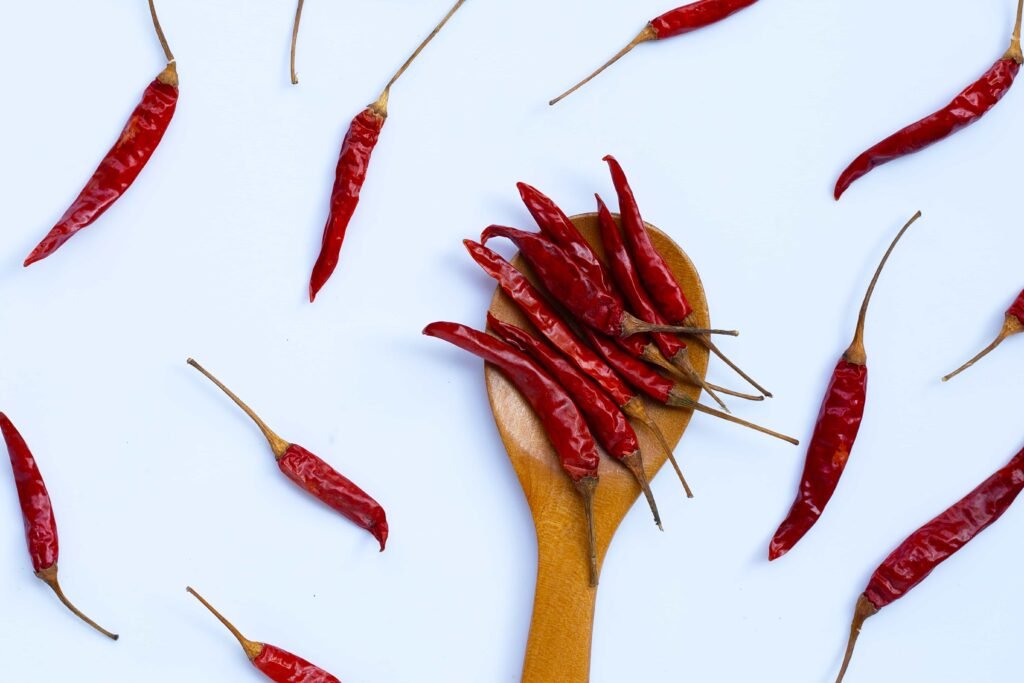
Dundicut is the term that causes the most confusion in trade conversations, because buyers hear it and assume it names a specific crop — a small, separate pepper distinct from Longi or Kunri. It doesn’t. Dundicut is a processing description, not a variety. It refers to pods that have had the stem and calyx removed — destemmed. Any variety can be processed as Dundicut: Longi destemmed is Dundicut, Kunri destemmed is Dundicut, Round chilli destemmed is Dundicut.
Because of that, Dundicut doesn’t have its own fixed heat range, ASTA colour, or flavour profile — those come from whichever underlying variety was destemmed to produce it. A Dundicut order should always specify the base variety (e.g. “Longi, destemmed” or “Kunri, destemmed”), not just “Dundicut,” if colour and heat consistency matter to your application.
What Dundicut processing does affect is handling and downstream use: destemmed pods are ready for grinding or crushing without the extra step of stem removal at the processor’s end, which matters for buyers running whole-pod-to-powder lines or condiment production where stems would otherwise need to be picked out.
Buyers who spec “Dundicut” for whole-pod applications — traditional curry bases, condiment production, or halal food lines targeting South Asian diaspora consumers — should confirm which base variety was used. Assuming Dundicut is a fixed ingredient with its own heat index is how you end up with an inconsistent product between one lot and the next, depending on which variety the supplier happened to destem that season.
Hybrid Varieties: The Yield Story
The next category is the one most buyers do not know they are buying until they test. Maxi, Desi, and Nageena are hybrid varieties developed for agricultural yield, not culinary performance, and grown across both the Sindh chilli belt and Punjab — Punjab-origin hybrid material tends to run to a longer pod length than the traditional Kunri cultivars, which is part of what makes it easy to mistake for genuine Longi at a glance.
Hybrids produce 2.0 to 2.5 tonnes per hectare compared to traditional cultivars, which makes them attractive to growers managing input costs. They also produce inferior colour and noticeably weaker aroma than Longi or Kunri.
This is where the specification gap causes commercial problems. A buyer who asks for “Kunri chilli” or “Longi” without specifying variety, origin, and minimum ASTA colour value may receive hybrid-origin material — including Punjab-grown hybrid that is long enough in pod size to pass a casual visual check. On paper it looks right. In a colour-extraction application or a premium curry powder, it does not perform to the standard the customer paid for.
Hybrid material has legitimate uses. For crushed chilli flakes where heat throughput matters more than flavour complexity, or for bulk powder blending where the end product will be seasoned with complementary aromatics, the hybrid grades offer cost efficiency without compromising the brief. The problem is not the product — it is misrepresentation or ambiguous specification.
What This Means When You Place Your Order
Match the variety to the application, and put the specification in writing.
Whole pods for tempering or traditional cooking: specify dry long red chilli, Longi variety, Grade A, ASTA colour ≥100. For Dundicut pepper applications — chutneys, whole-pod condiment lines, or high-heat spice blends — specify Dundicut by name and confirm pod diameter tolerance in your quality agreement.
For crushed flakes going into a mid-tier retail blend: Longi Grade B or hybrid-origin crushed is cost-efficient and appropriate. For curry powder with a colour claim on-pack, do not use hybrid material without testing your ASTA colour value first. The ASTA colour value should appear on your Certificate of Analysis by lot — not estimated, not averaged across a season.
In every case, your purchase order should specify: variety (Longi, Dundicut, or hybrid-acceptable), minimum SHU range, minimum ASTA colour, moisture content ceiling, and whether non-hybrid origin is required. “Kunri chilli” on its own is a geographic origin, not a quality specification.
Work with a Kunri chilli exporter who sources at the farm level.
As a Kunri chilli exporter with four decades of direct farm relationships, Harmain Global can supply Longi and Dundicut with full traceability documentation, ASTA colour certification, and custom grading to your production spec. If you are evaluating suppliers or reformulating a blend, the fastest way to assess quality is a physical sample against your current stock.
Request a sample and we will send you Longi Grade A, Kunri medium-pod, either destemmed on request, and your choice of hybrid-grade crushed — side by side, so the differences speak for themselves.