There is a man named Tariq. 👨 You probably know a Tariq. He is 38, works in a mid-size office in Lahore, consumes three cups of chai ☕ before 10 am, not because he especially enjoys it, but because his body has really threatened legal action that unless the supply is there, nothing will function. He has a gently protruding belly that crept in around his 35th birthday 🎂 and has shown no intention of leaving, like an overnight houseguest who found the WiFi password. He sleeps seven hours 😴 and wakes up as if he’d slept forty-five minutes on a bus. He has belonged to a gym for two years 🏋️. He has gone to the gym eleven times. He is not a bad person. He’s just one tired person, and Pakistan is full of Tariqs.
This is the story of when Tariq fell upon Shilajit Gummies 🍬 and finally listened.
It began, as many things in Tariq’s world do, with his cousin Bilal. 👦 Bilal is the type of person who reads ingredient labels on juice boxes at weddings 🧃 and asks the host whether the biryani🍛 has MSG in it. Tariq finds this exhausting. But Bilal also looks infuriatingly fit 💪, lifts things at the gym that would land Tariq in a hospital 🏥, and never seems to complain about being tired, something Tariq finds deeply suspicious. During a family dinner in March, Bilal leaned over and told him, with the casual confidence of a man who has somehow already solved his life: “Bhai, you need to start taking Shilajit.” 🌿
It’s immediately what Shilajit even is: the first response from Tariq. And his second response, after Bilal explained, was: ‘ That sounds made up.’ Bilal wasn’t wrong, though, and here’s what he told Tariq that night as their aunts bickered over which of them made better gulab jamun. 🍮
Shilajit is a blackish-brown, tar-like resin that oozes out from between layers of rocks in the Himalayas and Karakoram range 🏔️; it’s created when organic plant matter decomposes and compresses into the ground over millions of years ⏳. It looks like tar. It smells aggressive. 😤 And for centuries, practitioners of Unani medicine, Ayurvedic traditions, and Tibb-e-Nabawi wellness frameworks have used it as if it were liquid gold 🥇 because in many ways it is. That stuff contains fulvic acid, humic acid, and more than 84 trace minerals and compounds that help with everything from mitochondrial function to hormone balance. Ancient texts named it “the destroyer of weakness.” ⚔️ Modern researchers refer to it as an adaptogen. Tariq called it “that thing that Bilal won’t shut up about.” 🙄
The real question that Tariq had, the one every sane person does, is what exactly shilajit is good for other than sounding cool at a dinner party. 🎉 And that is where it becomes interesting. Energy ⚡ is the main reason most men use Himalayan shilajit products. Not the sort of energy that comes from caffeine, which arrives with a crash attached as if it were a free gift 🎁. Real cellular energy, since fulvic acid in shilajit assists transport directly into cells & aids ATP synthesis 🔋 —simply put, the fuel your mitochondria runs on 😊. When your mitochondria are happy, you are not dozing off during meetings at 2pm 😪. Tariq’s had clearly been deeply unhappy for several years.
But Tariq had an issue with traditional shilajit resin. He had tasted it one time, years back, from a humble shack near Anarkali 🏚️, and it was so tongue-tingling 😖 that for a whole week afterward, he couldn’t help but question his own life choices every time he dissolved the sticky black blob in warm water and drank. It tasted like something midway between motor oil and profound regret. Bilal had prepared for this reaction. He directed Tariq toward Shilajit Gummies Pakistan possibilities, namely the variety that encases Himalayan shilajit extract inside a chewy gummy vessel so you can get it all without the sensory horror show. 🎉
This was a turning point. ✨ And not just for Tariq, but for a whole generation of Pakistani men and women who grew up listening to their grandparents talk about herbal remedies 🌿, only never to get past the taste or the preparation or simply the inherent inconvenience of traditional formats. Gummies changed the math entirely. You take them like you take a vitamin 💊, only these taste infinitely better and the benefits are significantly more interesting than vitamin C.
Tariq ordered a supply. 📦 He was skeptical, but in the way that only someone who actually wants to be proven wrong can be skeptical — a very hopeful kind of skeptical. He figured he’d give it sixty days and write down what happened because Bilal had challenged him, and Tariq is forty percent spite. 😤
The first couple of weeks were dull in the best possible sense. He was not hallucinating clarity or floating. But by about day ten, he realized he was not reaching for his third cup of chai as urgently. By day fourteen, he noticed he sat at his desk between 9am and 2pm without the usual haze that blankets my brain around noon like Lahore fog 🌫️. This was not a miracle. This was shilajit for energy, performing exactly as the research had predicted, quietly and without fanfare (the way good things tend to do). 👌
But by the fourth week, something happened that Tariq had not steeled himself for. He went to the gym. Twice. Not because he had warmed up to the idea but because he finally wanted to, which had not been the case since 2019. He began to think in terms of “shilajit gummies for gym,” which is how you know a product has truly penetrated your psyche. Shilajit supports physical performance and recovery, and has adaptogen properties — the compound builds in your system with regularity. It won’t offer you forty-five minutes of aggressiveness like some pre-workouts. It’s more like a gradual adjustment of your baseline energy 📈, which, quite frankly, is a better deal.
Then his wife, Sara, began asking questions. 👩⚕️ Sara is a doctor, so she needed proof before she was going to touch anything, and she also found Tariq’s sudden zeal for wellness very amusing. She opened studies on her phone, read research on fulvic acid benefits and shilajit’s effects on testosterone, then, to Tariq’s great delight, said: “This is actually not bad.” Sara had her reasons for being intrigued. She had been reading about whether or not women could take shilajit, because it seems to be universally considered a “men’s supplement”— presumably due to all the conversations surrounding testosterone — but science does not support that gendered limitation whatsoever. 🔬
Can women take shilajit? 🤔 The short, gut answer is yes, and the long answer is that shilajit gummies’ benefits for women are truly remarkable 🌟 when you analyze them closely. For further understanding: Shilajit enables iron assimilation, and this is profoundly significant for ladies experiencing frailty. Its adaptogenic properties help with hormonal balancing. It is good for fatigue 😴, mood, and stress response. The fulvic acid part has a similar effect in the woman’s body as well, because mitochondria don’t have gender preferences. Sara began taking them, and after three weeks she told Tariq (with the restrained enthusiasm of someone still too broke down to admit to conversion), that she felt “noticeably less tired”. That’s practically a standing ovation coming from a doctor who sleeps five hours on rotation nights.
The testosterone conversation deserves its proper time because it is so frequently skirted, and everyone deserves a straight answer. 💬 Does shilajit boost testosterone levels? Several clinical studies, one of which was published in Andrologia (2015) 📄, found that men taking purified shilajit experienced a statistically significant increase in total testosterone, free testosterone, and dehydroepiandrosterone —compared with a placebo group. One potential mechanism for these effects is shilajit’s action on the hypothalamus-pituitary axis 🧠, which regulates hormone production in the body. So yes, shilajit gummies do promote testosterone. The evidence points that way. Tariq felt this, too, although he reported the experience less clinically and more as “feeling like a person again,” likely the most relatable testosterone review ever penned.
Now this is where people start getting scared 😨, and rightfully so. What are the side effects of shilajit gummies? Are shilajit gummies safe to take daily? These are the right kinds of questions to be asking, and for the most part, the answers are reassuring. When purified and third-party tested 🧪, shilajit is deemed to be safe for most healthy adults. The operative word in that statement is purified, because raw, unrefined shilajit can be infected with heavy metals and toxins that you definitely do not want to ingest into your body. This is also why sourcing is huge. Brands that make the best shilajit gummies in Pakistan use Himalayan shilajit extract and are made by brands with third-party testing documentation, because this is not a nice-to-have; it is a non-negotiable.
Minimal side effects are found when taking clean shilajit in proper doses. Some people have mild digestive upset 🤢 when they start, especially if taken on an empty stomach. Some do feel a bit warm 🌡️, which is one of its known effects. As for the shilajit gummies dosage, the one-size-fits-all approach of how many shilajit gummies per day is probably one to two gummies, and, when considering when exactly to eat shilajit gummies, it’s usually with food in the morning 🌅 (so that energizing support works with your day rather than against your sleep 😴). Tariq landed on one gummy first thing every morning with breakfast and said that pattern was successful. He did two on big-presentation days and said he noticed a difference in the clarity of his mind 🧠, though that’s hardly surprising considering shilajit’s known cognitive-enhancer properties.
The kidney thing is something Tariq actually asked Sara about, because his uncle had said something vague and alarming about shilajit being harsh on the kidneys. Sara looked at the research. Is shilajit safe for the kidneys? In healthy doses in healthy people, current research does not support concerns around the kidneys. There are some theoretical cautions for those who already have kidney disease or high uric acid levels; hence, anyone with an underlying condition should always consult their physician 👨⚕️ before starting any supplement. For Tariq, who has healthy kidneys and no underlying health conditions, it was a non-issue.
Blood Pressure Related to People. Also, ask, is shilajit good for high BP? This one is nuanced. 🤔
Shilajit is generally supportive of cardiovascular health given its adaptogenic properties, and there is some evidence that it helps to promote healthy blood pressure levels, as has been observed through its ability to decrease stress markers and support vascular function. But those on blood pressure medication 💊 should definitely consult their doctor before adding shilajit, as supplements and medications can interact in ways that should be approached with caution. ⚠️
Sara had made this clear to Tariq, and Tariq made it clear on the family WhatsApp group when three uncles immediately wondered whether they could start using it as well. 👴
Does shilajit lower cholesterol? 🩺 Emerging research suggests the potential impact of shilajit on lipid profiles and healthy cholesterol levels mediated through antioxidant & anti-inflammatory activity. It can’t substitute for prescribed cholesterol management, but as a potential adjunct to the housing of heart-healthy lifestyle pieces, the data is encouraging.” Tariq’s cholesterol improved at his quarterly checkup 📋, but as Sara correctly pointed out, this could also be the result of his having started exercising, which is the maddening thing about lifestyle changes: you can never know which variable deserves credit 🤷.
By the third month 📅, Tariq was a new person in those small, subtle ways that add up. He was not a superhero 🦸. He still liked chai ☕. He continued to have unsolicited opinions about cricket 🏏. But he was generally perky, his gym visits had surged to eight a month (this is more than the sum total of his entire previous two years), and he had stopped regarding his bed at 4pm like a man waiting for someone to salvage him from drowning 🌊.
He also, perhaps more than he expected himself to be, became interested in the provenance of his supplements. He began reading about export quality nutraceuticals from Pakistan, about halal certification in supplements, and about when a product is genuinely third-party tested versus when it just claims to be. He fell down a rabbit hole 🐇 of herbal wellness traditions in the subcontinent and wound up reading about everything from the surprising things cumin does to your body to ancient herbal wisdom that still checks out under modern science. He found out that Pakistan, his own country, has incredible natural resources for the production of herbal supplements, and this play is finally being grasped by the global market, as Unani Practitioners have known for centuries. 📜
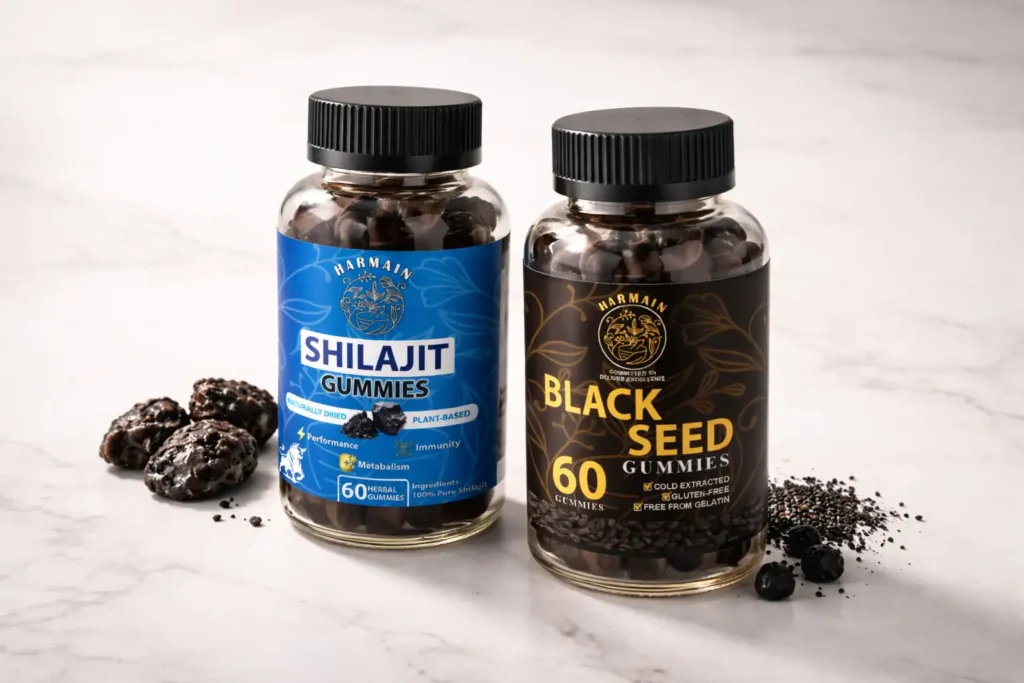
He also learned that the brand of gummies he had been taking was called Harmain Global, a Pakistani health and beauty company that makes halal-certified, export-quality herbal gummies like their Shilajit Gummies — and their Black Seed Gummies (which is an entirely different conversation Bilal had been working toward for months and finally got to have at the next family dinner 🍽️).
Black seed 🖤, for those who haven’t met, is nigella sativa (monikers include kalonji in Urdu), and it’s an inheritor of one of the most extraordinary legacies in history among natural medicines. The Prophet Muhammad, peace be upon him ﷺ, has said it is a cure for everything except death, and modern researchers are spending a lot of time trying to discover why that claim stands up quite well. The active ingredient is thymoquinone, and it has been widely studied for its anti-inflammatory, antioxidant, antimicrobial, and immune-modulating properties. Sara — who had been somewhat of a skeptic regarding supplements in general prior to Tariq’s experiment with shilajit — was far less skeptical about black seed because the evidence base is so large. If you want to know what black seeds actually do to your body, the science is truly interesting.
The challenge with black seed (same as shilajit) is the format. 😣 For most people, black seed oil is no walk in the park. The flavor is bright, patchy, and lingering in a way that makes everyone purchase the bottle, use it a couple of times, then hide behind olive oil where they forget. Black seed gummies totally turned this on its head, providing the thymoquinone supplement benefit in a format that people actually keep doing long enough to see change, which is literally the only format that matters.
What are black seed gummies used for? The list is legitimately long. Their thymoquinone content boosts immune function 🛡️. They possess myriad anti-inflammatory benefits for everything from joint 🦴 health to skin conditions 🌸. Studies have examined black seed for blood sugar regulation, cholesterol, and respiratory and gut health. Especially in a world where people have been considering their immune resilience 🛡️ for more than five years, the black seed immune support angle is relevant. For someone like Sara, who handles hospital environments and the thousands of pathogens they include 🦠, this was something she felt directly.
Black seed gummies: benefits for females? Yes, and the rationale is more than a general immune boost. Studies have looked at the impact of Nigella sativa on hormonal health, including one related to PCOS women’s symptoms. It is an antioxidant that works from the inside out for the skin ✨. It helps a healthy inflammatory response that is relevant to comfort during the monthly cycle. The health benefits of black seed gummies are not gender-limited, but there are specific reasons women should take note 📝.
Sara began incorporating the black seed gummies into her current regimen. Within three weeks, she found her energy ⚡ and general resilience felt better, and a recurring skin inflammation 🌸 she had managed for years had visibly lessened. Tariq could tell this much, from the way she said it: that her view was one borne of a proven hunch about needing to examine something more carefully 🔍, which, at least as Tariq remembers the timeline, is not quite how things went down, but he silently declined to contest.
Are black seed gummies halal? In the Pakistani and Gulf markets, this is not a trivial question 🤔, which means that the answer for Harmain Global’s products is also yes, halal certified as well — a point from QM perspective, because halal certified processes require transparency in the ingredients being used and manufacturing practices to be followed, which helps every consumer as some of these are actually quality signal.
Harmain Global’s halal certified gummies are also of export quality, meaning they comply with the standards set by international buyers like those from the Gulf, UK, and EU markets — thus a significant assurance for customers at home.
So, for those of you wondering about the side effects of black seed gummies, the outlook is generally good, but it comes with warnings similar to shilajit. Most individuals tolerate clean, correctly dosed Nigella sativa gummy at suggested doses. As always, there are people who are pregnant 🤰 and on blood-thinning medication or have a certain chronic condition who will want to consult their doctor. One to two gummies a day taken with food is well researched, well-supported territory for a healthy adult.
What is the benefit of taking black seed daily? And the research indicates that regular, consistent supplementation is where those benefits pile on. Thymoquinone does take a while to gather protective antioxidant benefits. Immune response takes weeks to build, not hours. This is not a product that hits the ground running on day one. It’s more of an investment 💰 that quietly and reliably pays interest periodically, which is precisely how Tariq now describes his entire supplement regimen to anyone who would listen, which at this point consists of colleagues, neighbors, the man who owns his favorite chai dhaba, and a few people he doesn’t know on the internet.
By month six, Tariq had, without quite planning it that way, become the Bilal of his social circle. He was also the one bending over dinners to explain shilajit resin vs gummies, why it makes sense that the gummy format improves compliance, why halal certification matters for supplement quality and would you believe why Pakistan of all places is making some of the most interesting herbal nutraceuticals even found anywhere? He volunteered opinions on fulvic acid. He had briefly tried shilajit liquid drops and said he preferred using gummies daily, though the liquid format, he said, could be appealing for those who wanted faster absorption time and were not put off by taste.
He was still Tariq. He still had three cups of chai, although at this point it was less a lifeline than a ritual. He still had views on cricket. But he was the take-charge version of Tariq, the one who arrived at things eager to get involved, who completed projects rather than stared blankly at them 😤, who went willingly to the gym without feeling it was a form of punishment. His wife was taking black seed and shilajit gummies regularly. His cousin Bilal had discreetly begun purchasing from the same brand. He had said his mother had asked him to describe what he was taking, and that he’d spent forty-five minutes on the phone going over it all with her 📱, which she listened to with the patience of a woman who has been getting reports about supplements from her son-in-law for six months. 😂
The takeaway of Tariq’s story is not that gummies are magic. They are not magic. They are the science, tradition, and good manufacturing 🏭 brought in a format that is regularly used by humans to allow the science to do its job. Shilajit is a popular herbal extract that is found in the Himalayan mountains 🏔️, and it takes millions of years to produce. For thousands of years, Nigella sativa has been healing people. The wrapper is the only thing that changed, and sometimes that’s all the innovation you need 💡. Go to https://harmainglobal.com, check out both products, read the certifications 📋 — and hit your own call as Tariq did in curiosity with a healthy dose of skepticism that good products can take just fine.
The last thing Tariq said to Bilal was that he understood, finally, why Bilal read ingredient labels at social gatherings (this happened at a wedding in November 💒, while their aunts resumed the never-ending debate over gulab jamun). Not because it is normal behavior — it isn’t — but because one of the most quietly radical things you can do in a world that constantly seeks to exhaust you is pay attention to what goes into your body. Shilajit gummies and black seed gummies had not transformed Tariq’s life in a dramatic, cinematic sense. They had done something better. They had returned him to the version of himself that was not tired all the time, and that person turned out to be a much more interesting company. If you are somewhere in Tariq’s story and are looking to know what a regular herbal routine with herbs looks like when it goes well, check this out. And if you want to learn more here before making a commitment to anything, that is precisely the right approach to take with a decision around your health.
5 Responses
Very good i like it
wish you all the best
What happend i dont know
wish you best and best
Great information! I’ve recently started exploring Ayurvedic wellness ingredients and came across Harmain Shilajit Resin while reading about traditional wellness practices. Thanks for sharing this useful article.