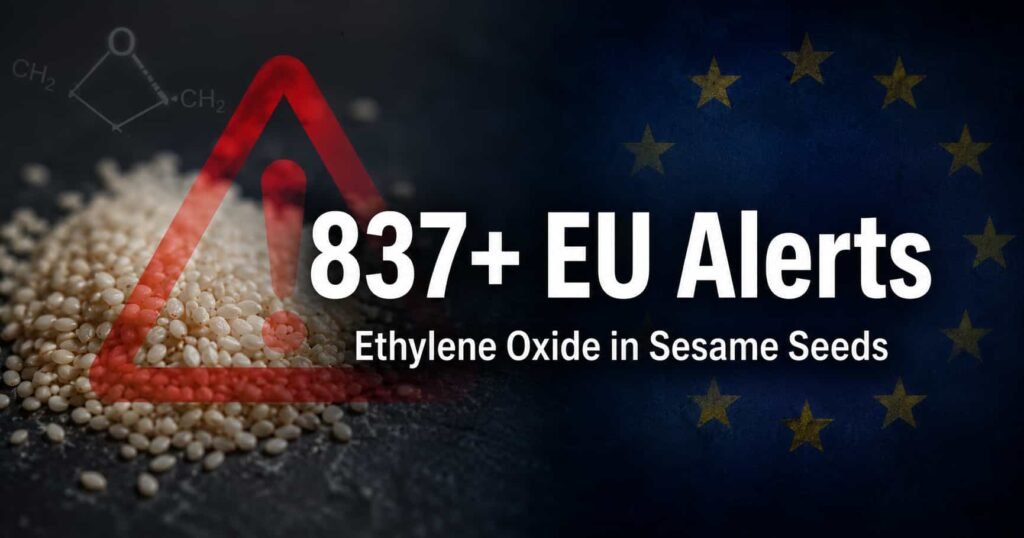
In September 2020, Belgian food safety officials at the FASFC submitted a single alert to the EU’s Rapid Alert System for Food and Feed — RASFF — about ethylene oxide residues detected in sesame seeds from India. It looked, at first, like an isolated finding. In under three months, that solitary alert became over 300 RASFF notifications. The total was 477 by early 2021. By 2022, notifications summed up to more than 837 and came from 24 EU member states as well as nine third countries. The EU’s own 2021 Alert and Cooperation Network report described what followed as the largest food recall operation in EU history.
Contaminated sesame seeds had moved through the supply chain and into finished products — cereals, bread, crackers, biscuits, bagels, sesame oil, chocolate coatings, Asian ready meals. Thousands of product lines across Europe were recalled and destroyed. The sesame market never looked the same again.
837+ RASFF alerts for EtO in sesame by 2022
24 EU member states reached by contaminated product
0.05 mg/kg EU MRL for EtO — effectively zero tolerance
26 New EtO alerts raised in April 2022 alone
Understanding what happened — and whether it has been resolved — is not an academic question for sesame buyers. It is a live procurement decision.
What Ethylene Oxide Is, and Why It Was Being Used
Basics of Ethylene Oxide and Its Use. Key concept: ethylene oxide- a fumigation-based chemical designed to kill bacteria, moulds, fungi and insects in stored agricultural products. Able to penetrate bulk grain and seed material quite well, it formed a practical tool for controlling Salmonella — the pathogen previously plaguing Indian exporters and their customers with different types of recurring problems.
The rub is ethylene oxide is a known carcinogen. The International Agency for Research on Cancer has classified it as Group 1 — carcinogenic to humans. The EU has only outlawed its use as a pesticide because of this reason and the MRL is 0.05 mg/kg (the sum of EtO and its main metabolite, 2-chloroethanol). Above that level, the MRL is less of a safety level and more of a limit of quantification — i.e., not found in any functional quantity. What the 2020 crisis revealed was that Indian sesame exporters had been using EtO fumigation — apparently for years — and the practice had never been systematically screened at EU borders.
EtO is not banned everywhere. In the United States, Canada, and several other markets, it remains a legally permitted treatment for certain commodities. Indian exporters adapted to the EU crackdown by separating their production: EtO-treated lots are routed to markets where treatment is legal; untreated lots are designated for EU export. The EU responded with Commission Implementing Regulation EU 2020/1540, enacted in October 2020, requiring mandatory prior testing of all Indian sesame for EtO contamination before it can be exported to the EU. That regulation has since been extended and maintained as a permanent enhanced control measure.
The scale of what had to be unwound was significant. Sesame seeds are a widespread ingredient — not just in whole-seed applications like bakery toppings and tahini, but embedded as a component in dozens of compound products. Tracing contaminated sesame back through supply chains to identify every affected finished product proved enormously complex. The recalls were not a contained event. They cascaded across categories, manufacturers, and markets for months.
EU auditors found that India’s traceability system “cannot verify, because of a lack of traceability to farms, that sesame seeds are produced under conditions that comply with EU hygiene rules.”— EU audit finding on Indian sesame supply chain controls
Why the Risk Has Not Gone Away
Six years after the first alert, EtO in sesame is no longer a crisis — but it is not a resolved problem either. It is a managed risk, and managed risks require ongoing verification.
The system India established — clean lots for EU, treated lots for the US and Canada — depends on the integrity of lot-tracing from farm through processing to export. EU auditors examined those controls and found them wanting. When auditors cannot verify that production conditions comply with EU rules at farm level, the assurance that a given lot has not been treated rests almost entirely on documentation and declarations rather than independently verified traceability. That is a meaningful gap.
The numbers support caution. Twenty-six RASFF alerts for EtO in sesame were raised in April 2022 alone — more than two years after the initial crisis and after the mandatory testing regime was in place. The alerts continued because the underlying conditions that created the problem — fumigation practice, fragmented traceability, large volumes moving at speed — had not been eliminated. They had been reduced and controlled, but not eliminated.
For EU importers, UK buyers, tahini manufacturers, and bakery ingredient buyers, this means that sourcing Indian sesame with an EtO test result on file is necessary but not the same as sourcing sesame that was never treated. A supplier who fumigates some lots and not others, and depends on internal lot management to keep them separate, is a different risk proposition than a supplier who does not use EtO at any stage of the supply chain.
That distinction is where Pakistan’s position in the sesame market has become commercially significant.
Pakistan has never used ethylene oxide fumigation on sesame — not as a standard practice, not as an exception for pest or pathogen control. The practice simply does not exist in the Pakistani sesame sector. The country has grown into Europe’s third-largest sesame supplier partly on the strength of this, with EU importers actively diversifying their sesame sourcing away from Indian origin following 2020. Pakistani white sesame seeds and hulled sortex sesame are tested for EtO as standard, and the test result is not a managed output — it reflects the absence of a practice rather than the control of one.
At Harmain Global, every sesame shipment is accompanied by a batch-specific Certificate of Analysis from an ISO/IEC 17025-accredited laboratory with EtO listed as not detected under EU MRL Reg. 396/2005. We also provide a signed declaration that no ethylene oxide fumigation was used at any stage — at farm, in storage, or at our processing facility. Those are two separate documents because they address two separate questions: the lab result tells you what was in the product; the declaration tells you what was done to it.
Before placing your next sesame order, ask your supplier for two things:
1. A batch-specific CoA from an ISO/IEC 17025-accredited laboratory showing EtO as “not detected” or below 0.05 mg/kg (sum of EtO and 2-chloroethanol), matched to the lot number on your shipping documents.
2. A signed declaration that no ethylene oxide fumigation was applied at farm, storage, or processing stage for that lot.
If either document is unavailable, or if the batch number does not match, you are carrying a verification gap. EU border inspection posts are not forgiving on this parameter — EtO violations remain among the most frequent causes of RASFF notifications for sesame and sesame-containing products.
The sesame EtO crisis was not a failure of intent — most of the exporters involved were responding to a real pathogen problem with a tool that was legal in their market. It was a failure of visibility: buyers and regulators did not know what was happening until millions of kilograms of contaminated product had already moved through the supply chain and into food manufacturing. The lesson is not to avoid sesame. It is to know, precisely, what was done to the sesame you are buying, and to verify it with documentation that would hold up at a border inspection post.
Verify before you commit.
We send samples with the full compliance package — batch-specific EtO CoA from an accredited lab, signed EtO-free declaration, and origin documentation — so you can review the paperwork against our product before placing an order. Request sesame samples, and we will have them to you with a complete documentation set.