Colgate launched in 1873. Crest showed up in 1955. And somehow, in between, the entire world came collectively to decide tooth care was a contemporary discovery. But here is the thing — when those toothpaste tubes rolled off factory lines for the very first time, miswak had already been cleaning teeth for over 7,000 years. Seven thousand years. Let that land for a second. While Western civilization was getting excited about wheels and early metallurgy, the people of Arabia, the Indian sub-continent, and East Africa had been walking around for centuries with the single most effective dental hygiene device on planet Earth tucked in their pocket. Plainly put, calling toothpaste modern oral care is a level of audacity that seems honestly comical.
Then, of course, 1400 years ago, hundreds of millions of souls had that issue settled as authoritatively as can be settled. This was not just advice for miswak, but rather encouragement by the Prophet Muhammad (PBUH). He was emphatic. He said: Miswak cleans the mouth and pleases your Lord Sahih al-Bukhari 887. Ibn as the Prophet (peace and blessings be upon him) said to his companions, I would have made miswak obligatory before every prayer except that it would become a burden on my Ummah” [Muslim 252]. Scholars narrated that a prayer performed after using miswak will be rewarded seventy times more than without. This is not folk wisdom handed down by grandmothers of the village. This is the highest verified chain of Islamic texts available in the world that uses a stick and says: use this on your teeth daily before standing in front of your creator. And so, hundreds of millions of people never read the list. They leveraged this through the cremation and rise of empires, through wars that went hot from rancour over fluoride; Live experiments were conducted under dental operatives — 20th-century plastic tooth brushes should rebut this more honourable way. They kept shaking after the stick.
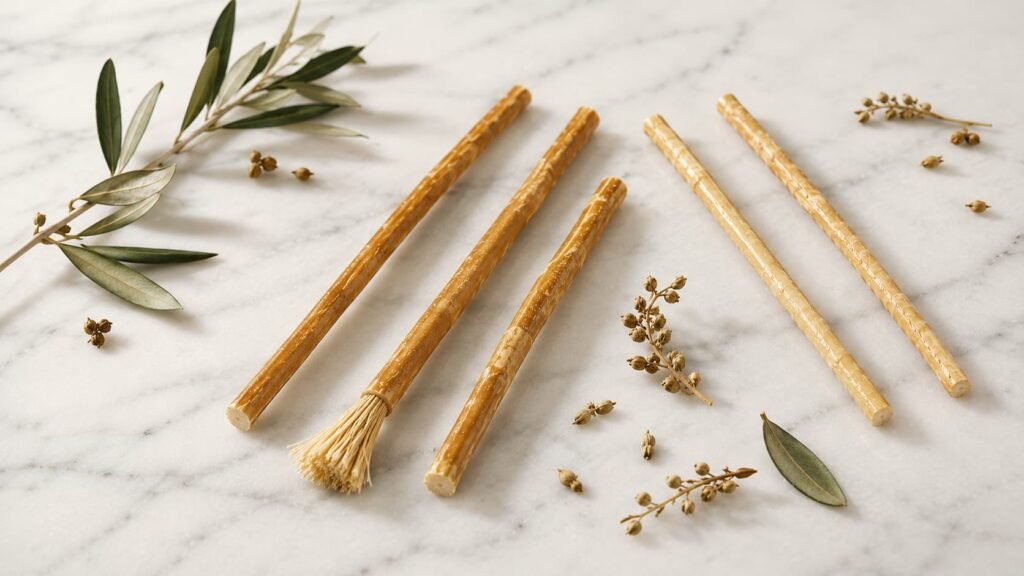
And What the Hell As This Thing Anyway Traditional peelu miswak (Salvadora persica) – the arak tree (A shrub that grows wild in Pakistan, India and countless other regions of the Arabian Peninsula and East Africa), is full of large chunks of highly fibrous connective tissue with chemistry to make a pharmaceuticals company weep You choose a root or twig, cut it down and that stick IS both your toothbrush as well as your toothpaste. No factory. No plastic. No mint flavor lab. There is no dubious ingredient supply chain allowed. You chew one end until it bristles out into natural bristle fibers, then you brush. This entire operation needs zero packaging, zero synthetic processing, and a complete lack of what sodium lauryl sulfate is doing to the lining of your mouth. Truly, it has to be the most beautiful personal care product ever invented, and it has just been lying about in rain-soaked leaves for thousands of years waiting for others to catch up.
And catch up science indeed did — clumsily, slowly, and hat-in-hand. WHO-funded Studies commissioned on miswak have found that regular users statistically require less dental treatment than toothpaste users. Less treatment. Not equivalent. Less. Nestled in the unassuming stick is an entire arsenal of bioactive compounds that oral care formulators now spend millions trying to replicate in synthetic form. Natural fluoride that strengthens enamel. Only commercial pastes have powerful abrasives and harsh chemicals; this silica mildly abrades and whitens without damage. Tannic acid that tightens gum tissue, thus decreasing bleeding. Salvadorine and trimethylamine — “super-lethal” antibacterial agents that attack the same bacteria that cause plaque, tooth decay, and halitosis. These are such resins that know the surface of teeth and seal against bacterial penetration. These compounds have an astringent effect and also help keep gum tissue taut and well-nourished. By the way, toothpaste companies know all of that. And that is also why they fill their best product lines with synthetic versions of those compounds and then ask twelve dollars a tube for the privilege. The original formula was free. It grows in the ground.
Now in the world of miswak, we have two options to choose from. “Peelu miswak — the Salvadora persica (the tree from which this)” is traditional, best-studied, high-level sunnah! This is also the variety with quite a peppery, bold flavor and hard bristle action found to be preferred by hardworking miswak users. It is the classic. Then comes olive miswak, also known as the mildest of all miswaks, which is made from olive wood. It introduces someone into this practice in its gentlest form (making a good start for anyone who finds the peelu variation too intense to start with week 1). The olive type has been gaining a lot of traction with buyers who cater to health-focused customers who are looking for the sunnah tradition but prefer a more familiar sensory experience. Both are real, both are good quality, and both can be obtained from a local/wholesale miswak supplier in Pakistan who has been dealing in the herbal Marketing business since 1985. The market segments are different. But the sense of quality remains the same.
And about the markets: a natural toothbrush from Pakistan is no longer just a niche curiosity. Gulf retail chains are now displaying miswak together with high-end oral care products on pharmacy and supermarket shelves. Halal wellness brands in the UK have built complete ranges around sunnah personal care, and are leveraging sunnah oral care as a core product category. From natural oral care brands in Europe and North America who have removed fluoride to those going packaging-free, crowdsourcing Salvadora persica sticks to Pakistan because miswak meets every criterion their consumers care about—no synthetic chemicals, no plastic waste, biodegradable plant materials with anti-bacterial effects backed by millennia of documented use. Distributors targeting South Asian diaspora audiences in the UK, North America, and Australia are servicing consistently buoyant domestic appetites from communities with generations of existing familiarity to begin with. Like all these buyers, they are not questioning whether miswak works. Prophetic instruction answered that question and was re-answered by the WHO. The answer is sourcing — right sizing, right moisture levels, verified origin, Halal, and export documentation.
This is precisely the very thing Harmain Global deals with. Bulk miswak sticks wholesale, olive and peelu type, Halal-certified, properly processed, and ready for export to other countries. Something so old, proven, and so globally desired does not require a marketing story — it already has the best one ever penned. It merely requires the proper hands behind the present chain. Click here for Harmain Global’s complete range of Miswak, or click the page to start a wholesale inquiry. The stick is a winner for 1400 years. The only variable is with whom you give this a shot.